
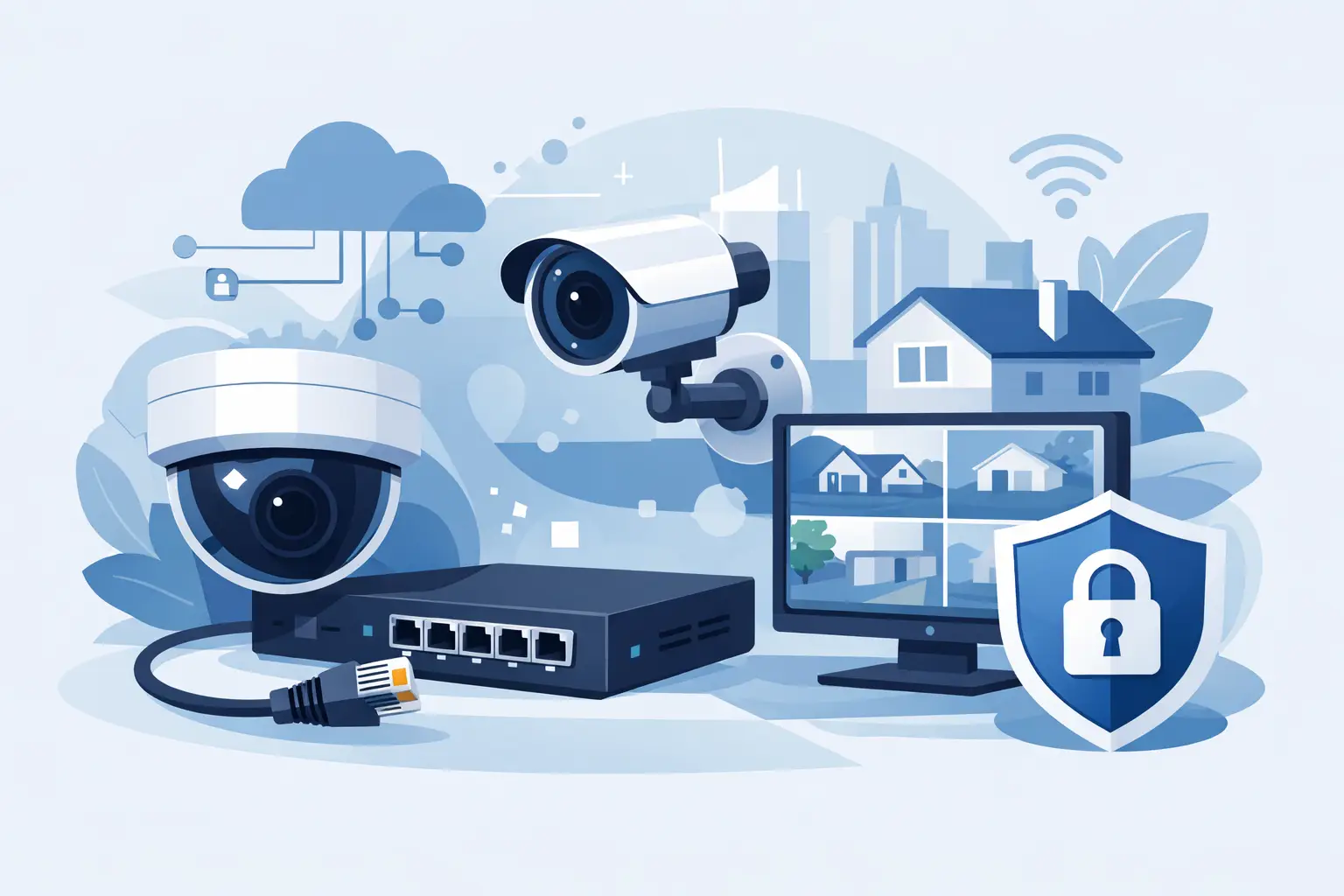
A parking lot camera that looks sharp at noon but turns into a blur at 2 a.m. is not doing its job. The same goes for a front entry camera with a wide view that cannot capture a usable face, or a warehouse system that records everything except the loading door you actually need to monitor. Choosing a poe security camera system is less about buying cameras in a box and more about matching the system to the site, lighting, cabling path, and recording requirements.
For installers, property managers, and commercial buyers, PoE remains one of the most practical ways to deploy video surveillance. It gives you data and power over a single Ethernet cable, which simplifies wiring and reduces the need for local power at each camera position. That does not mean every PoE setup is equal. Camera type, switch capacity, storage planning, and recorder compatibility all affect how the system performs after installation.
What a PoE security camera system actually includes
A PoE security camera system typically consists of IP cameras, a network video recorder, Ethernet cabling, and a PoE source. That power source may be built into the NVR or provided by a separate PoE switch. In a small installation, an NVR with built-in PoE ports can be the cleanest approach. In a larger building or multi-area property, a separate switch often gives you more flexibility for cable runs, camera distribution, and future expansion.
The main advantage is straightforward. You avoid running a power adapter to every camera location, which helps in soffits, exterior walls, hallways, detached structures, and other hard-to-power areas. You also gain the benefits of IP video, including higher resolutions, remote configuration, analytics options on some models, and easier integration with broader network-based security infrastructure.
That said, PoE does not remove planning. Cable distance still matters, available wattage matters, and network design matters. A poorly sized switch or recorder can create problems that look like camera failures when the real issue is power budget, bandwidth, or storage limitations.
Start with coverage, not camera count
One of the most common buying mistakes is starting with a four-camera or eight-camera package before defining what needs to be seen. A better approach is to map the site first. Identify the entrances, exits, cash handling points, shared corridors, parking lanes, delivery areas, gates, stairwells, and any blind spots created by walls, fences, or parked vehicles.
A single wide-angle camera may cover an open lobby, but it may not provide enough pixel density for identification at the far end of the scene. In contrast, a tighter field of view at a doorway can produce much better facial detail. This is why camera placement and lens selection matter as much as resolution.
For many commercial and multi-tenant properties, the right answer is a mix of camera types. Turret cameras work well for general exterior and interior coverage. Dome cameras are often chosen for finished interiors or locations where tamper resistance is a concern. Bullet cameras can be useful where you want a more visible deterrent or need a longer viewing angle. Varifocal cameras are worth considering when the exact scene width is not finalized or when the distance to the target area varies.
Choosing the right cameras for the environment
A poe security camera system should be built around the conditions of the site, not just the price point. Outdoor cameras need weather-rated housings, and in some climates they also need better low-temperature performance or built-in heaters depending on the model and location. Areas with high contrast lighting, such as glass entryways or loading docks, benefit from strong wide dynamic range so faces are not lost in backlighting.
Night performance is another area where specifications can be misleading if read too quickly. Resolution by itself does not guarantee usable video after dark. Sensor size, supplemental lighting, lens quality, and processing all affect the final image. For parking lots, alleys, gates, and yards, pay attention to how the camera handles low light and whether integrated IR is sufficient for the actual mounting distance.
In schools, apartment common areas, offices, and retail spaces, audio may also be part of the conversation. Some cameras support built-in microphones, but that decision should always be reviewed against local policy and legal requirements. The point is simple: the camera should fit the operational need and the environment where it will be installed.
NVR and storage planning for a PoE security camera system
The recorder is where many systems are either right-sized or compromised. An NVR has to support the number of cameras, the recording resolution, the bit rate, and the retention period you actually need. If a customer wants 30 days of continuous recording across multiple high-resolution cameras, storage planning cannot be treated as an afterthought.
Motion-based recording can reduce storage use, but it depends on the scene. Busy streets, moving trees, rain, insects, and headlights can all trigger events. In some installations, continuous recording remains the more reliable choice because it gives a full timeline without missed context. In others, a hybrid schedule works well, with continuous recording during business hours and motion recording overnight.
When sizing an NVR, also think beyond day one. A six-camera project often becomes an eight-camera project after a tenant change, a gate automation upgrade, or a new requirement at a secondary door. Leaving room for expansion is usually less expensive than replacing the recorder later.
PoE power budget and network design
PoE sounds simple because each camera receives power through the network cable, but the switch or recorder still has a total wattage limit. Fixed cameras usually have modest power requirements, while PTZ cameras, heaters, and some advanced models draw more. If the power budget is tight, cameras may disconnect intermittently or fail to initialize correctly.
Cable quality matters too. Solid copper Ethernet cable is the standard choice for reliable performance. Poor cable quality, excessive distance, or bad terminations can create unstable links that are difficult to troubleshoot once the installation is complete. For detached garages, outbuildings, and gate areas, you may need to consider surge protection, fiber segments, or weather-protected enclosures depending on the site.
On larger properties, separating surveillance traffic from the general business network may be the better option. It can simplify management and reduce performance issues, especially where the video system is expected to scale over time. This is one reason professional buyers often prefer application-specific guidance instead of choosing equipment by headline specs alone.
Where PoE makes the most sense
A poe security camera system is a strong fit for offices, retail stores, apartment buildings, mixed-use properties, schools, warehouses, and single-site commercial facilities. It works especially well where structured cabling is possible and where centralized recording is preferred.
It is also well suited for projects that may later connect with access control, intercoms, or gate monitoring. For example, a property manager may begin with entry and perimeter cameras, then later add video coverage tied to controlled doors or visitor communication points. Starting with an IP-based surveillance platform makes those expansions easier to plan.
There are cases where a different approach may be better. Very small sites with one or two cameras may not need a full recorder-based system. Remote areas with limited network access, temporary deployments, or places where trenching is not practical may require another design path. The right answer depends on the building, the risk points, and how the video will be used.
Buying for professional use, not just for installation day
A surveillance system should be judged by how it performs six months after installation, not by how quickly it came out of the box. That means considering replacement parts, recorder compatibility, camera availability, technical support, and whether the product line can support future changes. A low-cost package may look acceptable on paper, but if it lacks expansion options or dependable support, it can become expensive in service time.
This is where working with a specialized supplier matters. Buyers who manage real properties and real security responsibilities usually need more than a carton count. They need to know whether a camera suits a hallway, whether a recorder can handle the bit rate, whether the switch has enough PoE headroom, and whether the system can grow with the site. That is the difference between consumer-style shopping and specifying equipment for actual use.
For that reason, many contractors, facility teams, and property operators prefer to source through established distributors such as UnikCCTV, where the conversation can focus on deployment needs instead of generic marketing claims.
How to make the right decision
If you are selecting a PoE system for a new project or replacing an aging analog setup, begin with the site conditions and the operational goal. Decide what must be identified, what must simply be observed, how long footage needs to be retained, and whether the system may later connect with intercom or access-control hardware. From there, camera type, recorder capacity, and PoE design become much easier to specify correctly.
The best poe security camera system is not the one with the longest feature list. It is the one that gives clear video where it matters, records reliably, supports the property as it changes, and can be serviced without guesswork. If you build around those priorities, the system will keep doing its job long after the installation is finished.
 No products in the cart.