
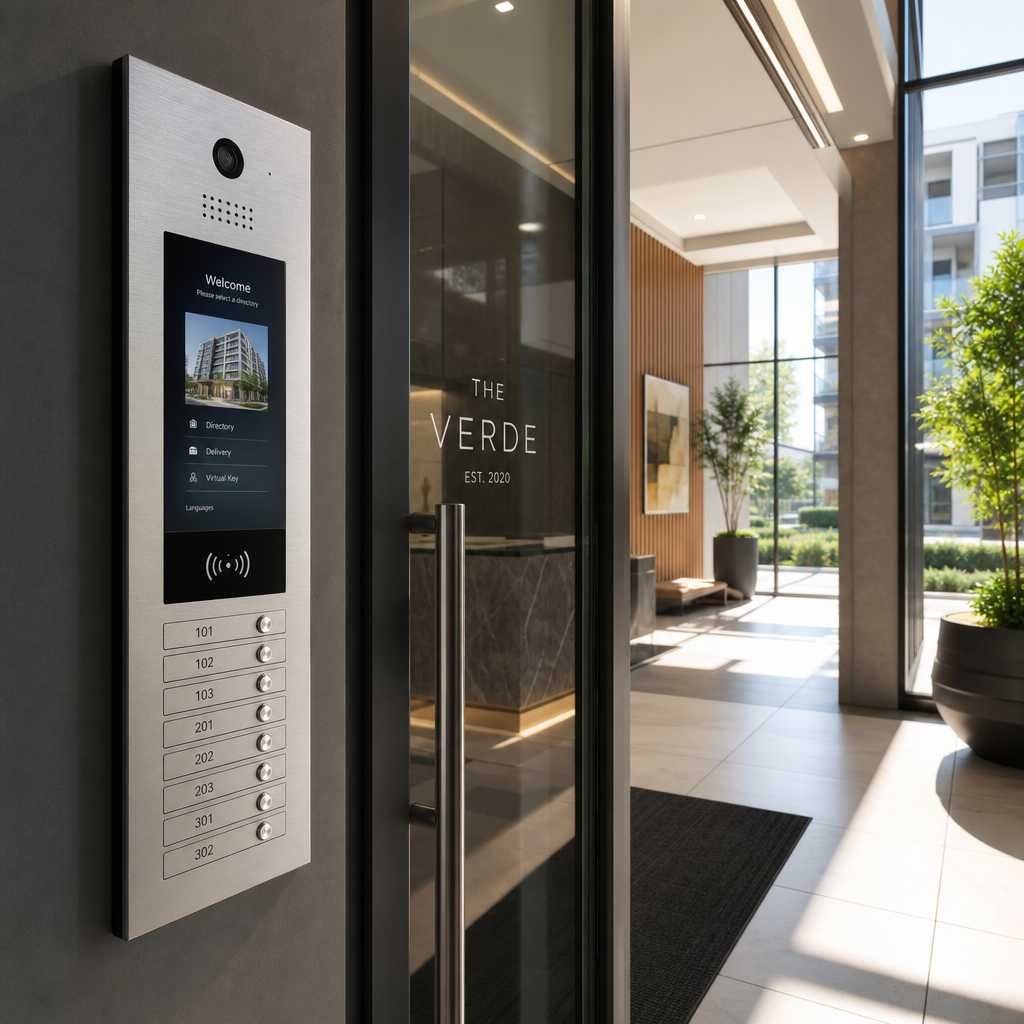
Picking the wrong intercom system for apartment building use is an expensive mistake that property managers make constantly. The wrong choice means frustrated tenants, repeated service calls, and a front door that either locks out residents or lets in anyone who presses a button confidently. With multi-tenant buildings, the stakes are higher than a single-family home because one bad decision affects dozens or hundreds of people every single day. This guide cuts through the noise and tells you exactly what to evaluate, what to avoid, and how to match the right system to your building’s specific size, wiring situation, and tenant needs.
Table of Contents
- Why Apartment Intercoms Are Different from Residential Intercoms
- Quick Takeaways
- Types of Intercom Systems for Multi-Tenant Buildings
- Wired vs. Wireless: What Actually Works in Large Buildings
- Key Features to Evaluate Before You Buy
- Intercom System Comparison by Building Type
- Installation Considerations and System Integration
- Cost, Scalability, and Long-Term Ownership
- Frequently Asked Questions
- References
Why Apartment Intercoms Are Different from Residential Intercoms
A single-family doorbell camera and a multi-tenant intercom system are not the same product category, and treating them as such is the first mistake most buyers make. In a single-family home, one person controls access. In an apartment building with 20, 50, or 200 units, you need a directory system, tenant-specific call routing, and the ability to grant or revoke access without rewiring anything.
In practice, the failure point for most building entry systems is tenant turnover. When a tenant moves out, their access credentials need to be deactivated immediately. Systems that require a technician visit every time a tenant changes are simply not viable for property managers handling dozens of units. The system you choose must support remote management as a baseline requirement, not a premium add-on.
Property managers should also account for guest access, delivery drivers, and service personnel. These use cases expose weaknesses that a basic residential intercom would never encounter.
Quick Takeaways
| Key Insight | Explanation |
|---|---|
| Remote management is non-negotiable | Any building entry system for apartments must allow you to add or remove tenant credentials without an on-site technician visit. |
| Wired systems outperform wireless in buildings over 4 stories | Signal degradation through concrete floors and steel framing makes wireless-only systems unreliable in mid-rise and high-rise buildings. |
| Video intercoms reduce false entries by a measurable margin | Audio-only intercoms are easier to spoof. Video allows tenants to visually confirm a visitor before buzzing them in. |
| IP-based systems offer the best integration flexibility | IP intercoms connect to your existing network, support cloud management, and integrate with smart locks and access control panels. |
| Scalability must be built in from day one | Buying a system rated for 20 units when you plan to expand to 60 means replacing the entire system in 18 months. |
| Tenant app support is now an expectation, not a luxury | Modern renters expect to receive visitor calls on their smartphones. Systems without mobile app support will feel outdated immediately. |
| Facial recognition and biometric locks reduce shared-credential abuse | PIN codes and keycards get shared. Biometric and facial recognition access control eliminates this vulnerability at the building entry point. |
The table above summarizes the most operationally important factors. Each one will be covered in depth below, with specific guidance on how to evaluate products against these criteria before spending a dollar.

Types of Intercom Systems for Multi-Tenant Buildings
There are four practical categories of intercom systems used in apartment buildings. Each has a defined use case, and choosing the wrong category wastes money regardless of how good the specific product is within that category.
Audio-Only Intercom Systems
Audio intercoms are the most affordable and the most limited. They work well for small buildings, typically under 10 units, where tenants know their visitors and the risk profile is low. The major weakness is identity verification. A tenant cannot confirm who is at the door without seeing them, and social engineering attacks (someone claiming to be a delivery driver) are straightforward to execute.
For property managers prioritizing budget above all else in a low-traffic building, audio systems from a reputable supplier can still be a reasonable choice. Just understand what you are accepting in terms of risk.
Video Intercom Systems
Video intercom systems are the current standard for any building with more than 10 units or any building in a higher-density urban environment. They provide visual confirmation, deter unwanted visitors who know they are on camera, and offer a recording function on higher-end models. Most new installations in apartment buildings now default to video.
UnikCCTV’s catalog of wireless video intercom products covers this category specifically for buildings that cannot easily run new cabling, which is a common constraint in older apartment stock.
IP-Based and Cloud-Connected Intercoms
IP-based intercoms transmit video and audio over your existing network infrastructure. They are the most flexible option for integration with other systems, including smart locks, CCTV cameras, and access control panels. Management happens through a web dashboard or mobile app, which means tenant changes take minutes, not service visits.
This is the category that makes the most sense for property managers overseeing multiple buildings or facilities from a single office. The upfront cost is higher, but the operational savings on service calls and credential management are significant over a 3 to 5 year horizon.
Telephone Entry Systems
Telephone entry systems route visitor calls to a tenant’s mobile phone or a designated landline. They are effective for buildings where tenants are rarely on-site to receive in-unit calls. The limitation is that they rely on mobile network coverage, which can be inconsistent, and they offer no video capability unless paired with a separate camera system.
Wired vs. Wireless: What Actually Works in Large Buildings
This is the most contested question in multi-tenant intercom selection, and the honest answer is that building construction type determines the answer more than any other factor.
When Wired Systems Are the Right Choice
Concrete and masonry construction, which describes the majority of mid-rise and high-rise apartment buildings, blocks radio frequency signals aggressively. A wireless intercom that performs perfectly in a wood-frame suburban duplex will deliver poor audio and dropped connections through four floors of reinforced concrete. In practice, wired systems using Cat5e, Cat6, or two-wire configurations remain the reliable choice for buildings over 4 stories with solid construction.
The installation cost is higher because cable runs are labor-intensive, but the system performs consistently for 10 to 20 years with minimal maintenance.
When Wireless Systems Are Viable
Wireless intercom systems are genuinely competitive in wood-frame construction buildings, garden-style apartment complexes, and retrofit situations where running new wire through finished walls would be prohibitively expensive. Modern wireless transmitters operating on dedicated frequencies can cover significant distances in open or lightly obstructed environments.
UnikCCTV stocks a range of wireless transmitters designed specifically for these retrofit and low-obstruction scenarios. The key is matching the transmitter’s rated coverage and frequency to the actual construction material between the entry point and the tenant units.
Pro tip: Before selecting any wireless intercom system for a multi-story building, conduct a signal test with a wireless transmitter at the proposed installation point. Walk the signal path to the farthest unit with a test receiver before committing to the installation. This single step eliminates most post-installation regret.

Key Features to Evaluate Before You Buy
Beyond the basic technology category, there are specific features that separate systems worth buying from systems that will create ongoing problems. These are the criteria UnikCCTV’s consultation team consistently raises with property managers during system selection.
Tenant Directory and Call Routing
A proper building entry system for apartments needs a programmable tenant directory. Visitors should be able to search by name or unit number and initiate a call directly to that tenant. Systems that require manual rewiring or on-site reprogramming every time a tenant changes are operationally unacceptable for any building with regular turnover.
Mobile App Integration
Tenants under 40 broadly expect to manage building access from their phones. Systems that route calls to smartphones and allow remote door release from anywhere are now a standard expectation in urban and suburban markets. This feature also benefits property managers who need to grant temporary access to contractors without being physically present.
Access Credential Types
Consider what credential types the system supports: PIN codes, keycards, mobile credentials, biometric, or facial recognition. Each has a different security profile and administrative burden. PIN codes are convenient but get shared. Keycards get lost or cloned. Biometric access, including fingerprint and facial recognition locks from UnikCCTV’s lineup, eliminates shared credentials entirely because the credential is tied to a specific person’s physical characteristics.
Integration with Existing CCTV and Access Control
If your building already has a CCTV surveillance system or an access control panel, the intercom system you choose should integrate with that infrastructure rather than operate as a standalone silo. IP-based systems typically offer the best integration paths through standard protocols. Ask vendors specifically whether their system integrates with your existing hardware before purchasing.
Pro tip: Request a wiring diagram and integration specification sheet from any vendor before finalizing a purchase. If a vendor cannot provide one, that is a reliable indicator that the system will be difficult to integrate or expand later.
Power Backup and Failure Modes
What happens to your building entry system during a power outage? This question eliminates many otherwise attractive systems. The best systems fail secure, meaning locked, while still allowing a manual override for fire egress compliance. Confirm that any system you consider has a documented power failure mode and battery backup option.
Intercom System Comparison by Building Type
The table below compares three common intercom approaches against the building types where each performs best. Use this as a starting filter before diving into specific product specs.
| System Type | Best Suited For | Key Limitation |
|---|---|---|
| Wired Video Intercom (two-wire or Cat6) | Mid-rise and high-rise concrete buildings, 10 to 200+ units, new construction or major renovation | High installation labor cost, not ideal for retrofit in finished buildings without conduit access |
| IP-Based Cloud Intercom | Multi-building portfolios, tech-forward properties, buildings with existing network infrastructure, any size | Requires reliable network infrastructure and ongoing cloud subscription fees in most implementations |
| Wireless Video Intercom with App Integration | Small to mid-size wood-frame buildings, retrofit situations, garden-style apartment complexes under 5 stories | Signal reliability degrades significantly in concrete or steel-frame construction above 3 to 4 stories |
Installation Considerations and System Integration
Installation quality determines whether a well-chosen system performs as specified or becomes a persistent source of complaints. The data consistently shows that the majority of intercom system failures in apartment buildings are installation-related, not product defects.
Professional Installation vs. Self-Installation
For buildings with more than 10 units, professional installation is strongly recommended. The complexity of running cables, programming tenant directories, integrating with existing door hardware, and configuring network settings exceeds what a typical maintenance team can execute reliably. UnikCCTV provides professional installation resources and consultation services specifically for property managers who need expert support at this stage.
Smaller buildings and simple wireless systems are legitimately manageable as self-installation projects, particularly when the supplier provides detailed documentation and support access.
Door Hardware Compatibility
The intercom panel is only part of the system. The electric strike or magnetic lock on the door, the door release mechanism, and the existing door frame all need to be compatible with the intercom’s output specifications. A mismatch between the intercom’s relay output voltage and the door release mechanism is one of the most common installation problems encountered in retrofit projects.
“Access control failures at building entry points are most commonly attributed to improper installation, inadequate system specification for the building type, or failure to account for tenant turnover management requirements.” – Security Industry Association, Physical Security Research
Integration with Gate Access Controls
Buildings with parking gates, secondary entrances, or perimeter access points need an intercom strategy that covers all entry points, not just the front door. UnikCCTV’s gate access control products are designed to work in conjunction with building intercoms so that property managers are operating a unified system rather than four separate products from four different manufacturers.
Cost, Scalability, and Long-Term Ownership
The upfront price of an intercom system is the least useful number for evaluating total cost of ownership. A common mistake is selecting the lowest-cost system per unit and then discovering that every tenant change requires a paid service visit, that the system cannot expand beyond 32 units without a hardware replacement, or that the manufacturer discontinued support within 5 years.
Total Cost of Ownership Calculation
A realistic total cost of ownership calculation for a multi-tenant intercom system should include: hardware purchase price, installation labor, any cloud subscription fees, anticipated service calls per year, credential management time per tenant turnover, and the expected hardware replacement cycle. When you run this calculation over 5 years, IP-based systems with remote management often cost less than cheaper wired systems that require on-site technician visits for every change.
Scalability Planning
Ask every vendor directly: what is the maximum unit count this system supports, and what changes are required to scale from your current unit count to your projected maximum? Systems that require a full controller replacement to expand from 40 to 80 units are not scalable systems. Genuine scalability means adding capacity through software licenses, additional panels, or hardware modules without replacing core infrastructure.
According to Statista’s research on smart building technology adoption, investment in building access control and intercom technology continues to grow at a rate that exceeds general construction spending, which underscores why future-proofing your system selection matters now rather than later.

Manufacturer Support and Product Longevity
Intercom systems in apartment buildings are infrastructure, not consumer electronics. They need to function reliably for 10 to 15 years. Choosing a system from a manufacturer with a thin product catalog or uncertain long-term market presence is a real risk. Verify that replacement parts, firmware updates, and technical support will be available for the expected life of the installation.
This is one area where working with a dedicated security and access control specialist like UnikCCTV provides a practical advantage over purchasing through a general home improvement retailer. Specialist suppliers understand the full product lifecycle and can advise on compatibility, parts availability, and upgrade paths that a general retailer simply does not track.
Frequently Asked Questions
What is the best intercom system for a large apartment building with over 50 units?
For buildings with over 50 units, an IP-based video intercom system with cloud management is the most practical choice. It supports a large tenant directory, allows remote credential management without service visits, integrates with existing network infrastructure, and routes visitor calls to tenant smartphones. Wired two-wire or Cat6 systems are also appropriate in concrete construction buildings where wireless reliability is a concern, but they should still include a cloud or network management layer for tenant administration efficiency.
Can a wireless intercom system work reliably in a concrete apartment building?
In most cases, no. Concrete and reinforced masonry construction severely attenuates wireless signals, and buildings over 3 to 4 stories with this construction type will experience consistent performance problems with wireless-only intercoms. The exceptions are buildings where all apartments are accessible via an open-air courtyard or corridor that provides a clear line of sight from the entry panel. In all other concrete construction scenarios, a wired or hybrid wired-IP system is the correct choice.
How does a building entry system handle tenant turnover?
The right system handles tenant turnover entirely through software. An administrator logs into a web dashboard or mobile management app, deactivates the departing tenant’s credentials (PIN, mobile access, or keycard), and adds the new tenant’s credentials in the same session. No technician visit, no rewiring, no physical key collection. Systems that require on-site reprogramming for every tenant change create ongoing costs and administrative burden that compound significantly in buildings with regular turnover.
What is the difference between a video intercom and a facial recognition access control system?
A video intercom displays a live image of the visitor to the tenant, who then decides whether to grant access remotely. The human makes the access decision. A facial recognition access control system automatically identifies a pre-enrolled person and grants or denies access without requiring any human intervention. Facial recognition is faster and more secure for recurring users such as residents and staff, while video intercom is better suited for managing unknown visitors and deliveries. Many modern installations use both: facial recognition for residents and video intercom for guests and deliveries.
Should I integrate my intercom system with my existing CCTV cameras?
Yes, if your building already has CCTV surveillance infrastructure, integrating it with the intercom system creates a significantly more useful security layer. When a visitor triggers the intercom, the CCTV cameras at that entry point can automatically display their feed on a management monitor, log the interaction with video timestamps, and provide footage for incident review. This integration requires that both systems use compatible protocols, which is why selecting an intercom system from a supplier that also provides CCTV equipment, such as UnikCCTV, simplifies the compatibility question considerably.
How much should a property manager budget for a multi-tenant intercom system?
For a 20 to 30 unit building, a professionally installed video intercom system with remote management typically runs between $2,000 and $6,000 depending on construction type, cabling requirements, and feature set. For buildings with 50 to 100 units, budgets of $8,000 to $20,000 are realistic for a full IP-based system with integration to door locks and CCTV. These ranges do not include ongoing cloud subscription fees, which vary by provider from free to several hundred dollars per year. Always request an itemized quote that separates hardware, labor, and recurring costs so you can calculate true total cost of ownership.
If you manage an apartment building or multi-tenant property, share your current intercom setup and the biggest challenge you face with it in the comments. Real-world experience from property managers is often more useful than any specification sheet.
References
- Statista: Smart Building and Access Control Market Data and Statistics
- Forbes: Real Estate Technology Adoption Trends for Property Managers
- NIST: Physical Access Control System Guidelines and Security Standards
- U.S. Department of Energy: Building Technology and Security Infrastructure Resources
- HUD: Multifamily Housing Safety and Building Access Standards
 No products in the cart.