
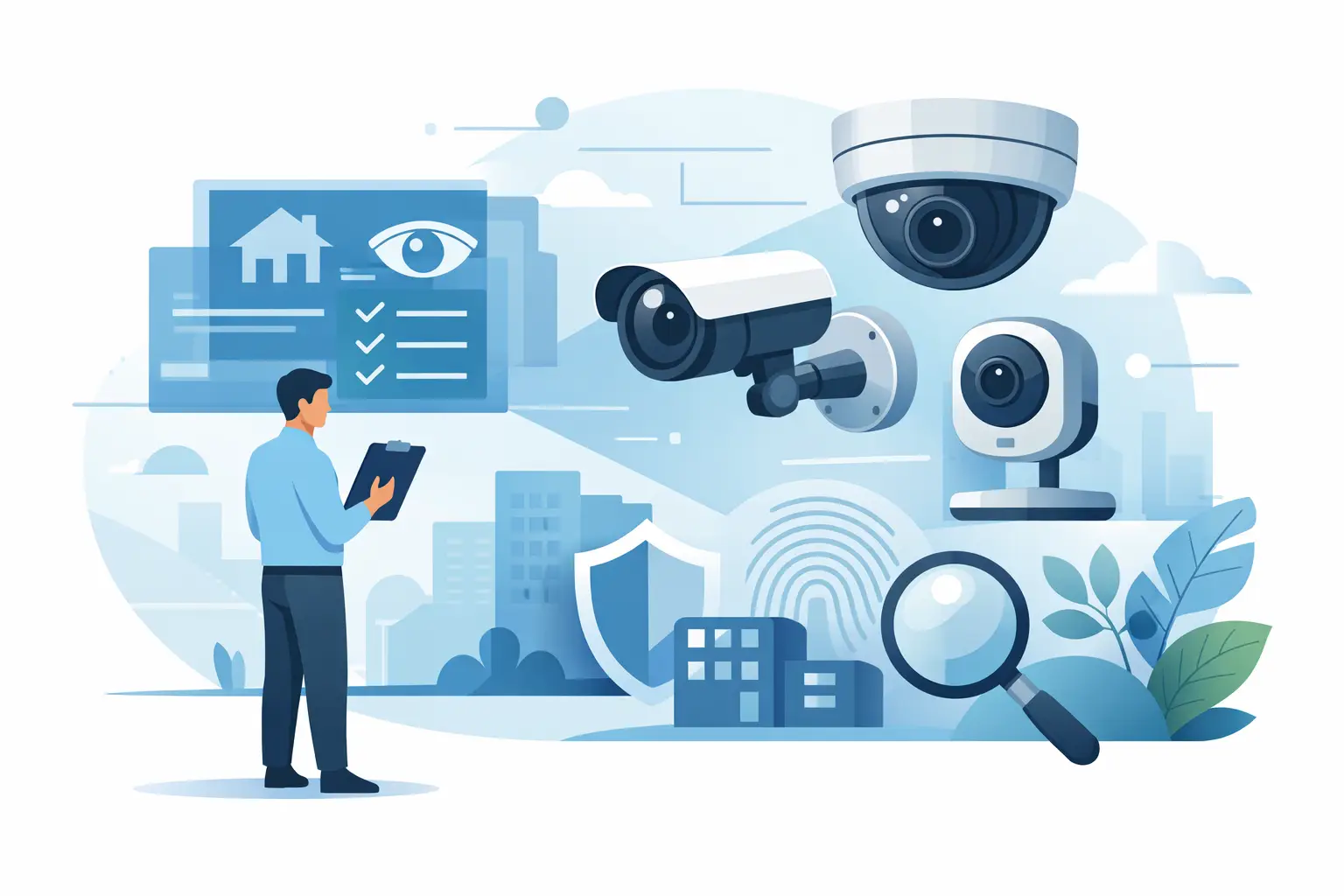
A parking lot camera that looks fine on paper can fail the job the first night it faces glare, distance, and low light. The same goes for a front entry camera that captures motion but not a usable face, or a warehouse camera that covers aisles but misses the loading dock. Choosing cctv cameras is less about buying a popular model and more about matching the camera, recorder, lens, and placement to the site.
For installers, property managers, and facility teams, that distinction matters. A camera system is part of a working security setup, not a standalone gadget. It has to support real operations – entry monitoring, incident review, tenant disputes, delivery verification, gate control, and after-hours accountability. When the application is clear, product selection gets easier and system performance improves.
What cctv cameras are expected to do
At the most basic level, cctv cameras are there to observe, record, and support response. In practice, the requirement is usually more specific. One customer needs facial identification at a vestibule. Another needs broad situational awareness across a school hallway. A commercial site may need to document vehicle traffic at the gate while also monitoring pedestrian entry at the office door.
That is why a camera count alone tells you very little. Eight poorly selected cameras can leave major blind spots. Four well-placed cameras, paired with the right recorder and lighting conditions, may produce a much more useful result. The question is not just how many cameras are needed. The better question is what each camera is responsible for seeing.
In professional environments, there are usually three common objectives. The first is deterrence – visible cameras influence behavior. The second is verification – confirming whether an event happened, who was involved, and when. The third is operational oversight – keeping an eye on entrances, common areas, shipping points, or restricted spaces during normal business activity.
Matching cctv cameras to the site
A small single-family home, a six-unit apartment building, and a multi-door commercial property should not be approached the same way. Each has different traffic patterns, lighting conditions, liability concerns, and recording priorities.
Residential and small multi-unit buildings
For homes and small apartment properties, the usual concern is entry coverage. Front doors, rear doors, driveways, side paths, and package areas are common priorities. Here, the balance is between enough field of view to understand movement and enough image detail to identify a person close to the entrance.
A wide-angle camera can cover more area, but there is a trade-off. The wider the view, the smaller the subject appears at distance. If the mailbox, gate, and front walk all need coverage, one camera may not be enough if identification is the goal.
Offices and mixed-use buildings
Office environments often need layered coverage. Exterior cameras document arrivals, deliveries, and parking access. Interior cameras may be placed at reception, hallways, storage rooms, or cash-handling points. In these jobs, camera placement has to respect workflow. You want usable footage without creating unnecessary views of private work areas or generating constant false motion events.
Mixed-use buildings add another layer because residential and commercial traffic may overlap. Entrances, corridors, and shared access points need careful planning, especially if access control, intercoms, or electric locking hardware are part of the same security design.
Schools, warehouses, and industrial sites
These properties usually require broader system thinking. Long corridors, perimeter lines, loading docks, fenced areas, and multiple buildings can push a system beyond basic consumer-grade equipment quickly. Distance, weather exposure, nighttime coverage, and retention requirements all become more important.
In these environments, it is common to combine fixed cameras for predictable views with specialized cameras for choke points such as gates, doors, and vehicle entries. The right setup depends on what needs to be documented and how often footage will actually be reviewed.
Resolution matters, but not by itself
Buyers often start with resolution because it is easy to compare. Higher resolution can absolutely help, especially when the camera needs to capture detail at a wider scene. But resolution is only one part of image quality.
Lens selection, sensor performance, frame rate, compression, and lighting have a direct impact on whether footage is usable. A high-resolution camera aimed into poor lighting can still produce disappointing results. A properly positioned camera with balanced exposure and an appropriate lens may give better evidence even at a more modest specification.
This is where application planning matters. If the goal is to identify faces at a door, the camera should be positioned for that distance and angle. If the goal is to monitor a lot or yard, broader coverage may be more useful than extreme detail. One camera rarely does both equally well.
Low light, backlight, and real-world image problems
Most camera disappointments show up after sunset or during difficult daytime lighting. A doorway with bright exterior light behind a visitor can create a silhouette. A parking lot with uneven fixtures can produce glare and dead zones. A warehouse with overhead doors may look fine at noon and become a shadow problem by late afternoon.
When evaluating cctv cameras, ask how the camera will handle the actual light on site, not ideal showroom conditions. Infrared capability helps, but infrared is not magic. Reflective surfaces, long distances, and environmental obstructions can reduce effectiveness. In some applications, better ambient lighting or a different mounting position is just as important as camera specification.
A practical system design accounts for these conditions early. If a camera is being installed at a front entry, think about whether it will capture a face when the door opens and outside light floods in. If it is mounted above a roll-up door, think about headlights at night and changing exposure during loading activity.
Recording and retention are part of the camera decision
A good camera without the right recorder setup is still a weak system. Storage capacity, recording mode, number of channels, and remote access all affect how the system performs day to day.
Continuous recording gives a fuller record, but it uses more storage. Motion-based recording saves capacity, though it can miss context if detection settings are too narrow or the scene is too busy. Higher resolution footage also requires more storage and network planning. That is not a reason to avoid better cameras, but it does mean the recorder and hard drive capacity should be selected with the same care.
Retention expectations vary by property type. A retail or office site may want a shorter review window. A multi-tenant building, school, or industrial site may need longer retention because incidents are sometimes reported days later. The right answer depends on policy, risk profile, and operational reality.
Integration often matters more than buyers expect
Many professional sites do not need cameras alone. They need cameras that work alongside intercoms, locks, gate operators, and access-control hardware. That is especially true at apartment entries, commercial doors, and managed facilities where visual verification is tied to controlled entry.
A camera can document a visitor, but an integrated system can also support the decision to grant or deny access. That is a different level of functionality. For some properties, the camera system should be planned as one part of the larger entry and communication infrastructure rather than treated as a separate purchase.
This is also where experienced technical support matters. Compatibility questions around recorders, power, mounting, cable runs, and control hardware can change product choice quickly. A system that looks simple on a product page may be much less simple once it is mapped to an actual building.
Common buying mistakes
One of the most common mistakes is selecting cameras based on price before defining the coverage goal. Another is overestimating what one camera can do from a single mounting point. Buyers also underestimate environmental issues such as weather exposure, vandal risk, nighttime glare, and cable path limitations.
There is also a tendency to overspec in the wrong areas. More megapixels, more channels, or more features are not automatically better if they do not serve the site. In many jobs, dependability, clear recording, and serviceable replacement options matter more than chasing every feature on the box.
For professional buyers, long-term support should be part of the conversation. Replacement parts, accessory availability, technical guidance, and the ability to expand the system later can save time and cost after the initial installation. That is one reason many installers and property teams work with specialized distributors such as UnikCCTV rather than treating security hardware like a commodity purchase.
The better approach to choosing cameras
Start with the property layout, entry points, lighting conditions, and what the footage needs to prove. Then determine where identification is required, where general monitoring is enough, and how long footage needs to be retained. Once those answers are clear, the right camera types, recorder capacity, and supporting hardware usually follow.
That approach is less flashy, but it is how dependable systems are built. The best cctv cameras are not the ones with the longest spec sheet. They are the ones that fit the doorway, lot, corridor, gate, office, or warehouse they are being asked to protect.
If you are planning a new installation or replacing older equipment, treat the camera as part of the jobsite solution, not the whole solution. A system that fits the property, the traffic, and the daily use case will do more than capture video – it will give you footage you can actually use when the moment comes.
 No products in the cart.