
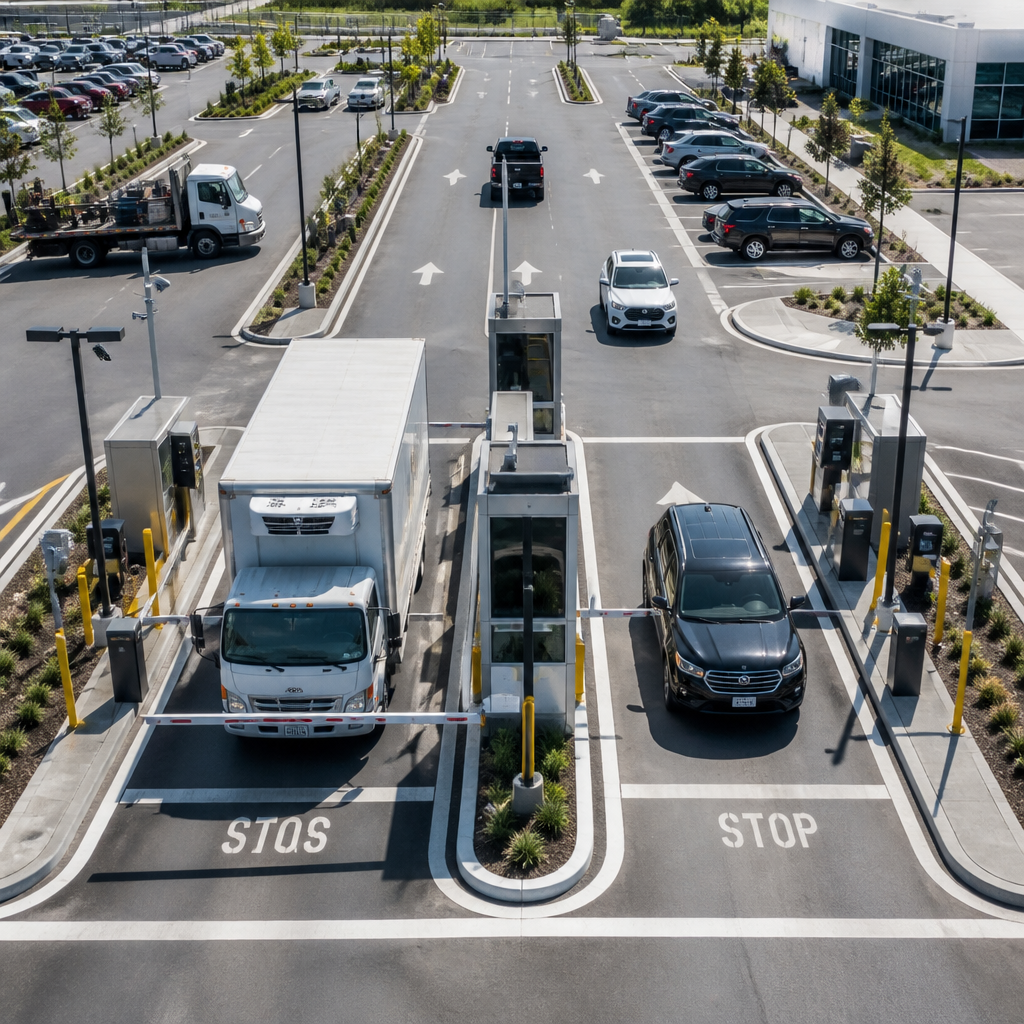
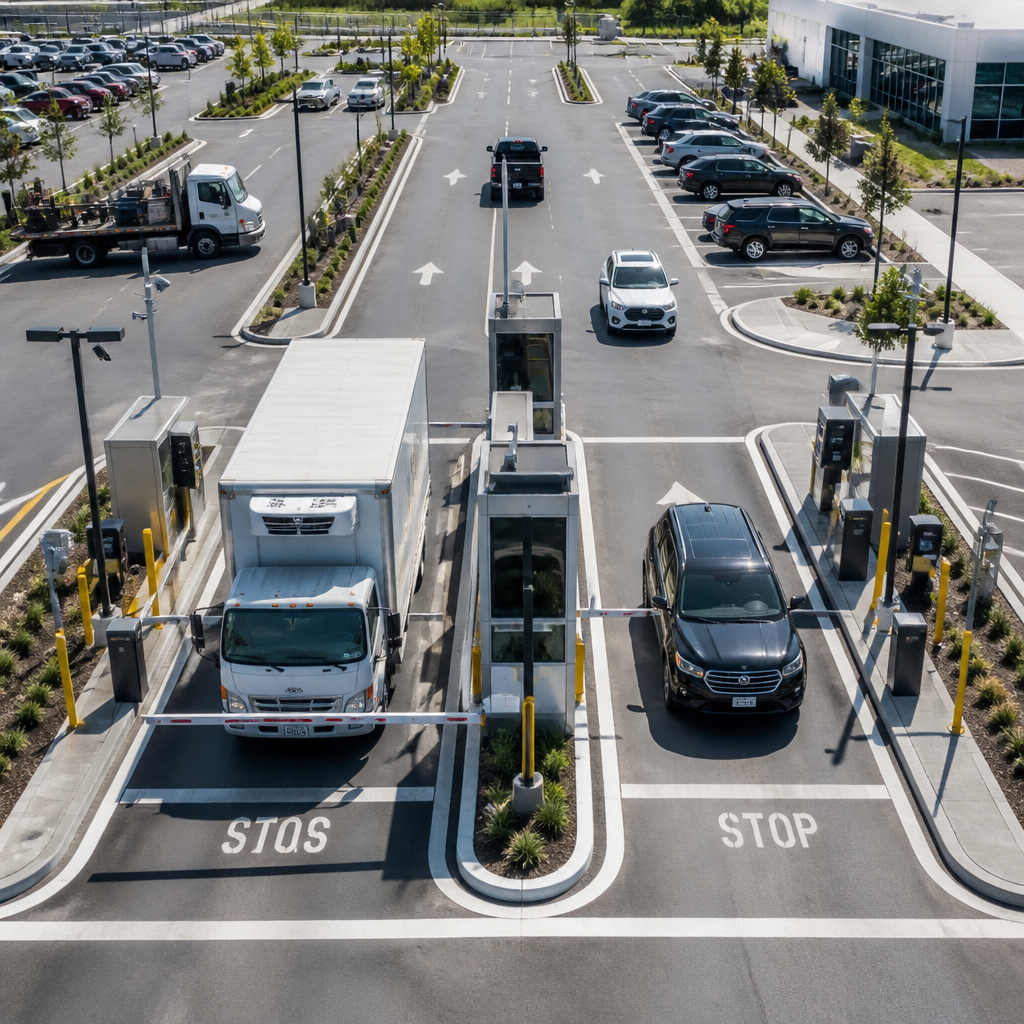
Pick the wrong camera for the wrong job and you will spend months wondering why your security system keeps failing you. Property managers and facility operators make this mistake constantly: they install a powerful 4K PTZ camera at a gate entrance expecting it to automatically log every vehicle, or they deploy a fixed license plate recognition camera across a wide courtyard expecting it to track moving intruders. Both are wrong. These two camera types are engineered for fundamentally different purposes, and understanding that difference before you buy will save you real money and real headaches. This guide cuts through the noise and tells you exactly which camera belongs where.
Table of Contents
- Quick Takeaways
- What Is a 4K PTZ Camera and What Can It Actually Do?
- What Is a License Plate Recognition Camera and How Does It Work?
- Core Differences Between PTZ and LPR Cameras
- Where Each Camera Type Performs Best
- Comparison Table: 4K PTZ vs. LPR vs. IP Speed Dome
- Installation Requirements and Common Mistakes
- Choosing the Right Camera for Your Facility
- Frequently Asked Questions
- References
Quick Takeaways
| Key Insight | Explanation |
|---|---|
| PTZ cameras cover large areas, LPR cameras cover specific lanes | A 4K PTZ camera sweeps wide-open spaces and zooms on demand. An LPR camera is fixed on a narrow lane or gate entry to reliably read plates. |
| LPR is not just high-resolution video | A license plate recognition camera uses OCR software to read plates automatically and match them against a database in real time, not just record footage for human review later. |
| PTZ optical zoom does not equal reliable automated plate reading | A 4K PTZ camera with 40x optical zoom can resolve a plate visually at distance, but it cannot reliably trigger automated database lookups the way a dedicated LPR camera can. |
| LPR camera angle is critical and unforgiving | For accurate automated recognition, the camera angle should stay within roughly 30 degrees in all directions from the plate. Deviation beyond that degrades accuracy sharply. |
| PTZ cameras are operator-dependent; LPR cameras are not | PTZ cameras require someone to pan, tilt, or program patrol routes. LPR cameras work automatically 24/7 without any operator input once configured. |
| Most facilities need both camera types working together | Deploy LPR at controlled entry and exit points, and use PTZ cameras for wide-area surveillance of parking lots, courtyards, and perimeters. |
| Storage and integration requirements differ significantly | LPR systems generate searchable plate databases that must be managed and purged per local data retention laws. PTZ systems generate continuous high-resolution video that demands more raw storage. |
What Is a 4K PTZ Camera and What Can It Actually Do?
A 4K PTZ camera is a motorized IP speed dome camera that can pan horizontally, tilt vertically, and zoom optically, all while recording at 3840×2160 resolution. The combination of movement and resolution makes it the most versatile single unit in commercial surveillance. One well-placed PTZ camera can monitor a wide parking lot, chase a moving subject, zoom in on a face at distance, and return to a preset patrol position, all without anyone physically adjusting it.
The optical zoom capability is where PTZ cameras separate themselves from fixed cameras. A 4K PTZ unit with 40x optical zoom can resolve license plates and facial features at distances exceeding 140 meters in daylight conditions. That kind of reach is simply not achievable with a fixed CCTV surveillance camera, no matter how high its resolution is. However, that sharpness applies only to the zoomed field of view at any given moment. While the camera is focused on one area, everything else is unmonitored.
Modern 4K PTZ cameras also carry AI-powered features including auto-tracking, smart motion detection, and face detection. These functions partially offset the limitation of only viewing one direction at a time. Auto-tracking, in particular, allows the camera to follow a moving person or vehicle autonomously without operator input, which matters enormously in unmanned facilities.
Pro tip: For large outdoor spaces like parking lots, commercial yards, and building perimeters, program your 4K PTZ camera with preset patrol routes that cover the highest-risk zones. Use auto-tracking only as a secondary behavior triggered by motion events, not as the primary monitoring strategy.
What Is a License Plate Recognition Camera and How Does It Work?
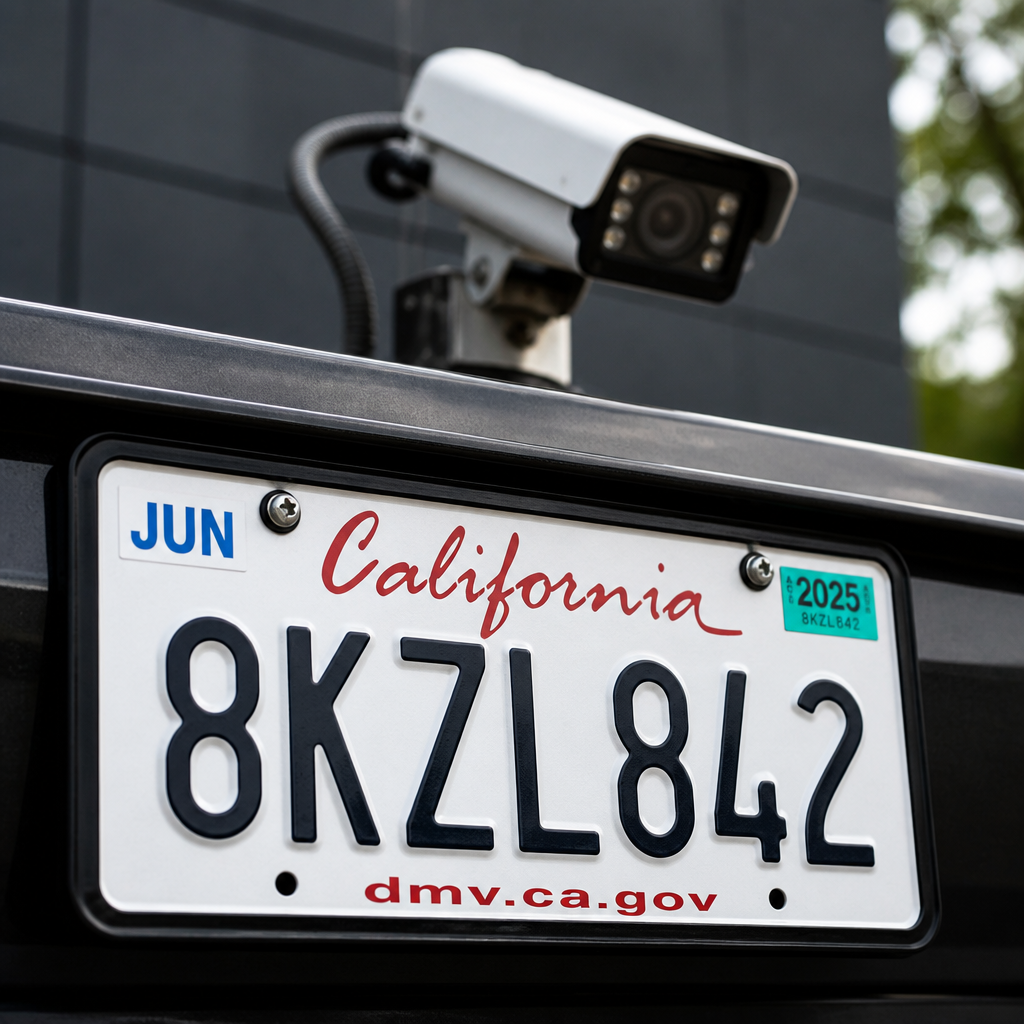
A license plate recognition camera (also called an LPR camera or ANPR camera) is an engineered combination of hardware and software. The hardware includes high-speed image capture, infrared illumination optimized for plate reflectivity, and a fixed lens tuned to a specific capture distance. The software uses optical character recognition (OCR) to extract plate characters from captured images and match them against a database in real time.
This is a crucial distinction: a standard security camera with good resolution captures video that a human can later read. An LPR camera captures plate data that a computer reads, logs, and acts on automatically. The system operates through several distinct stages: image capture, preprocessing to normalize lighting and contrast, character segmentation, OCR processing, and database matching. That chain happens within fractions of a second.
LPR cameras are frequently integrated with physical access control systems to automate vehicle entry and exit. Gated communities integrate LPR with gate controllers so resident vehicles pass without stopping. Commercial parking facilities use LPR to enforce permit-based parking, detect unpaid violations, and manage vehicle access. Multi-level garages use them to track vehicle movement floor by floor. None of this automation is possible with a standard PTZ or fixed camera alone.
The difference between a high-resolution camera that can show a plate and an LPR camera that reads a plate is the difference between evidence you find after the fact and access control that prevents incidents in real time.
Modern LPR cameras can read plates on vehicles traveling at significant speed. Some systems are designed to capture plates on vehicles moving at over 60 miles per hour, which makes them practical for driveways, entry ramps, and roadway-adjacent installations where vehicles do not slow to a stop. For most commercial and residential facility applications, vehicles move far more slowly, which only improves recognition accuracy.
Core Differences Between PTZ and LPR Cameras
The deepest difference between these two camera types is not resolution or price. It is purpose. A 4K PTZ camera is a general-purpose surveillance tool built for flexible, wide-area monitoring. An LPR camera is a single-purpose tool built for automated vehicle identification at a defined point.
Field of View and Coverage Strategy
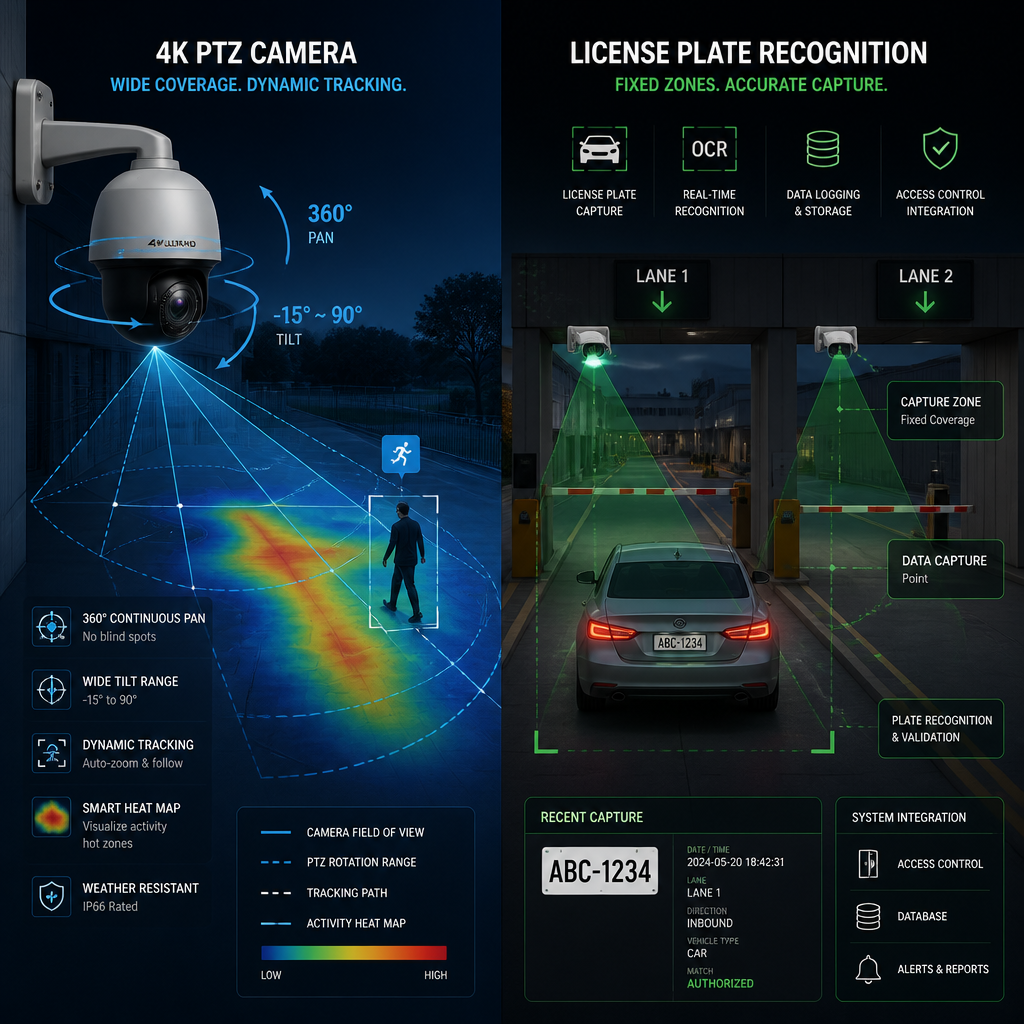
A PTZ camera covers enormous ground by moving. It can sweep 360 degrees horizontally and respond to motion events anywhere in a large area. An LPR camera covers a deliberately narrow field, optimized for a specific lane or gate approach. Expanding LPR coverage beyond that single point requires additional dedicated units, not zoom adjustments.
Automation vs. Human Involvement
LPR cameras run their core function without any human involvement. They read, log, and alert on plates autonomously. PTZ cameras, by contrast, require either an operator actively monitoring and controlling the camera or well-configured preset patrols and auto-tracking rules. Without those rules in place, a PTZ camera sitting in one position is just an expensive fixed camera.
Data Output and Integration
An LPR system outputs structured data: plate numbers, timestamps, match status, and access decisions. That data feeds directly into parking management platforms, access control systems, and security dashboards. A PTZ camera outputs video, which is useful for review and investigation but requires human eyes or a separate AI layer to extract actionable vehicle information.
Pro tip: If your facility needs automated gate access based on vehicle identity, you need an LPR camera at that gate point, not a PTZ camera. A PTZ camera can supplement it for wide-area monitoring of the surrounding lot, but it cannot replace the LPR function at the entry control point.
Where Each Camera Type Performs Best
Getting camera placement right is where most property managers either succeed or waste their budget. The decision framework is straightforward: if you need to monitor behavior across a space, use a PTZ. If you need to identify and log vehicles at a defined point, use an LPR camera.
Best Applications for 4K PTZ Cameras
Large parking lots and open courtyards benefit most from PTZ coverage. A single well-mounted unit can monitor hundreds of parking spaces, respond to perimeter intrusions, and zoom in on suspicious activity at any corner of the lot. Warehouse yards, loading docks, and commercial campuses with large open perimeters are also natural fits. The optical zoom security camera capability means operators can investigate an incident at one end of the property without sending staff to investigate in person first.
PTZ cameras also serve well in lobbies and common areas of apartment complexes and office buildings where general monitoring is needed and the field of view would otherwise require three or four fixed cameras to cover adequately. One PTZ camera replacing four fixed cameras is a real-world cost justification that property managers understand immediately.
Best Applications for LPR Cameras
Entry and exit points of gated communities, corporate campuses, parking garages, and commercial lots are the natural home of LPR cameras. Any location where you need to know which vehicle entered, when it entered, and whether it was authorized should have a dedicated LPR unit. Automotive dealership lots use LPR to maintain visibility across vehicle inventory and customer parking. Multi-tenant commercial properties use LPR at garage entrances to enforce tenant permits without staff involvement.
LPR cameras also work effectively at perimeter checkpoints for facilities with restricted areas, where vehicle identity must be confirmed before a gate or barrier opens. Integrating LPR output directly into an access control system creates a seamless automated entry process that neither requires a physical credential nor depends on a guard being present.
Comparison Table: 4K PTZ vs. LPR vs. IP Speed Dome
Many buyers also consider a standard fixed IP speed dome camera as a middle-ground option. Here is how all three compare across the factors that matter most to property managers and facility operators.
| Feature | 4K PTZ Camera | LPR Camera | Fixed IP Speed Dome Camera |
|---|---|---|---|
| Primary purpose | Wide-area flexible surveillance | Automated vehicle plate identification | Fixed-point monitoring of a defined area |
| Coverage area | Large, dynamic, 360-degree sweep | Narrow, fixed lane or entry point | Fixed wide angle, no pan or tilt |
| Optical zoom | Up to 40x optical | Fixed or limited zoom, optimized for plate distance | Typically fixed focal length, some varifocal options |
| Automated data output | Video only (AI add-ons available) | Structured plate data, timestamps, alerts | Video only |
| Access control integration | Limited, via third-party AI layers | Direct, native integration | Not applicable |
| Operator dependence | High without AI/auto-tracking | None after initial setup | Low, passive monitoring |
| Best facility type | Open lots, perimeters, campuses | Gated entries, parking garages, checkpoints | Hallways, lobbies, fixed choke points |
| Storage demand | Very high (continuous 4K video) | Moderate (image captures + database records) | High (continuous video, lower resolution) |
| Relative hardware cost | Higher, roughly four times a basic IP camera | Higher, specialized hardware and software | Lower, simple and scalable |
Installation Requirements and Common Mistakes
Installation decisions determine whether either camera type actually performs as expected. The hardware specs on a product sheet mean nothing if the camera ends up in the wrong position or pointed at the wrong angle.
Installing 4K PTZ Cameras Correctly
Height and unobstructed sightlines are the two non-negotiable requirements for PTZ installation. Mount a PTZ camera too low and its zoom range is blocked by vehicles, fencing, or landscaping. The camera needs elevation to take advantage of its long-range zoom. Ceiling or overhead mounting in covered areas and pole mounting in open lots are both common and effective. The motorized movement also means you need to verify that the camera rotation path is physically clear and that auto-tracking zones are configured to match your actual risk areas, not just the default factory settings.
Installing LPR Cameras Correctly
LPR installation is less forgiving than PTZ installation because the recognition software has rigid requirements. The camera angle from the plate should stay within roughly 30 degrees in all directions. Camera mounting position should be as close to license plate level as practical. The license plate should occupy a significant portion of the frame, and the plate itself should be at least 100 pixels wide in the captured image to achieve reliable OCR performance.
Backlighting is the most common LPR failure point. If a vehicle is approaching from a direction where the rising or setting sun sits directly behind it, the plate will be washed out and unreadable. Selecting the correct camera position relative to the sun’s path at your specific facility is a step many installers skip, and it leads to hours of unexplained recognition failures during certain times of day.
The distance between the camera and the capture point also matters. For most commercial LPR installations, the effective capture distance falls within a practical range that depends on the specific camera model and lens configuration. A dedicated LPR camera is tuned for that specific range. Do not try to extend the range by zooming a PTZ camera in and locking it on a lane as a substitute for a proper LPR unit. The two are not interchangeable for automated plate reading.
Pro tip: For any gate or barrier entry point where you plan to run LPR, install a separate wide-angle commercial security camera alongside the LPR unit. The LPR camera captures the plate. The wide-angle camera captures the full vehicle and driver context. Both together give you a complete record for any incident investigation.
Choosing the Right Camera for Your Facility
The practical answer for most facilities is that you need both camera types, positioned for what each does best. The question is not which one wins but how many of each you need and where each one goes.
For Apartment Complexes and Residential Properties
Deploy LPR cameras at all vehicle entry and exit points. Resident vehicles can be pre-registered so the gate opens automatically without the resident needing to press a button or show a credential. Visitor vehicles generate a log entry for management review. Pair this with one or two 4K PTZ cameras covering the parking area itself to monitor for vandalism, unauthorized loitering, and incidents that need video documentation beyond a plate record.
For Commercial Properties and Office Parks
The same logic applies at a larger scale. LPR cameras at each controlled access point enforce permit parking and restricted area access without requiring staff. PTZ cameras cover loading zones, open lots, and building perimeters. The CCTV surveillance camera infrastructure for a commercial property of any significant size will almost always benefit from this layered approach rather than betting everything on one camera type.
For Small Business Owners
If your property has a single controlled driveway or parking area with fewer than twenty spaces, a single well-configured LPR camera at the entry point and one fixed IP camera covering the lot may be all you need. Adding a 4K PTZ camera makes sense if the property has multiple access angles, a significant perimeter, or a history of incidents that require broad surveillance rather than just vehicle logging.
At UnikCCTV, the product range covers both directions: PTZ cameras for wide-area commercial surveillance and dedicated LPR solutions for access control integration. The practical guidance from their team is consistently to assess the specific chokepoints and open areas of your property separately before specifying any camera, because the answer is almost always a mix rather than a single type deployed everywhere.
Frequently Asked Questions
Can a 4K PTZ camera be used as a license plate recognition camera?
A 4K PTZ camera can capture footage that is clear enough for a human operator to read a plate on playback, especially at typical gate and driveway distances. However, it cannot reliably perform automated, real-time plate recognition the way a dedicated LPR camera does. The OCR software in an LPR system requires specific image conditions, consistent framing, and controlled lighting that a moving PTZ camera cannot reliably maintain. If you need automated plate logging and access control decisions, you need a dedicated LPR camera.
What is the difference between an LPC camera and an LPR camera?
A license plate capture (LPC) camera is a high-resolution camera that records clear enough footage for a person to read the plate during review. An LPR camera adds OCR software that reads and logs the plate automatically in real time. For simple evidence gathering, an LPC-grade camera may be sufficient. For automated access control, permit enforcement, or real-time alerts, you need a full LPR system with the recognition software layer.
How far away can an LPR camera read a license plate?
Effective LPR read distance depends on the specific camera model, lens configuration, and lighting conditions. Most commercial LPR installations are designed to capture plates at a defined, relatively close range where the plate fills an adequate portion of the frame. In practice, the capture zone is engineered to match where vehicles slow or stop at a gate or barrier. Trying to extend LPR range significantly beyond the camera’s rated distance degrades recognition accuracy rapidly.
Do LPR cameras work at night?
Yes. Dedicated LPR cameras include infrared illuminators specifically tuned to the reflective material used in license plates. This makes nighttime plate capture one of their strong points, provided the IR illumination is correctly aimed at the capture zone and there is no competing backlight source washing out the plate. Standard IR on a general-purpose security camera is not optimized the same way, which is another reason a dedicated LPR unit outperforms a repurposed PTZ or fixed camera in this role.
How many PTZ cameras does a mid-sized commercial parking lot typically need?
A mid-sized open parking lot of roughly 50 to 100 spaces can often be covered effectively by two to three well-positioned 4K PTZ cameras with quality optical zoom, supplemented by fixed cameras at entry and exit chokepoints. The exact number depends on the lot’s shape, obstructions, lighting, and whether the PTZ cameras are actively monitored or running on preset patrols. A site walk with a security integrator before specifying camera count will prevent both over-purchasing and coverage gaps.
What data privacy rules apply to LPR systems at commercial facilities?
LPR systems collect vehicle movement data that is subject to data privacy regulations in many jurisdictions. The specific rules vary by state and municipality, but best practices apply broadly: use the plate data only for the stated purpose such as parking management or access control, delete records at regular intervals appropriate to your jurisdiction, and publish a clear policy explaining how you collect and use LPR data. Some states set explicit maximum retention periods for LPR data. Consult your legal counsel for the specific requirements that apply to your facility’s location.
If you manage a property and are currently deciding between a 4K PTZ camera, an LPR camera, or a combination of both, we would like to hear what your main challenge is: large-area coverage, automated access control, or something else entirely.
We would love your feedback and any insights you would share with others. What perspective would you add?
References
- PTZ and IP camera performance comparison covering optical zoom range, resolution, and commercial surveillance use cases
- How LPR cameras use OCR technology for automated plate reading and access control integration
- License plate reader camera deployment guide covering parking management, data privacy, and installation best practices
- LPR camera mounting position, angle, distance, and framing requirements for reliable plate recognition
- License plate security camera buyer guidance covering resolution, night vision, and recording considerations

 No products in the cart.