
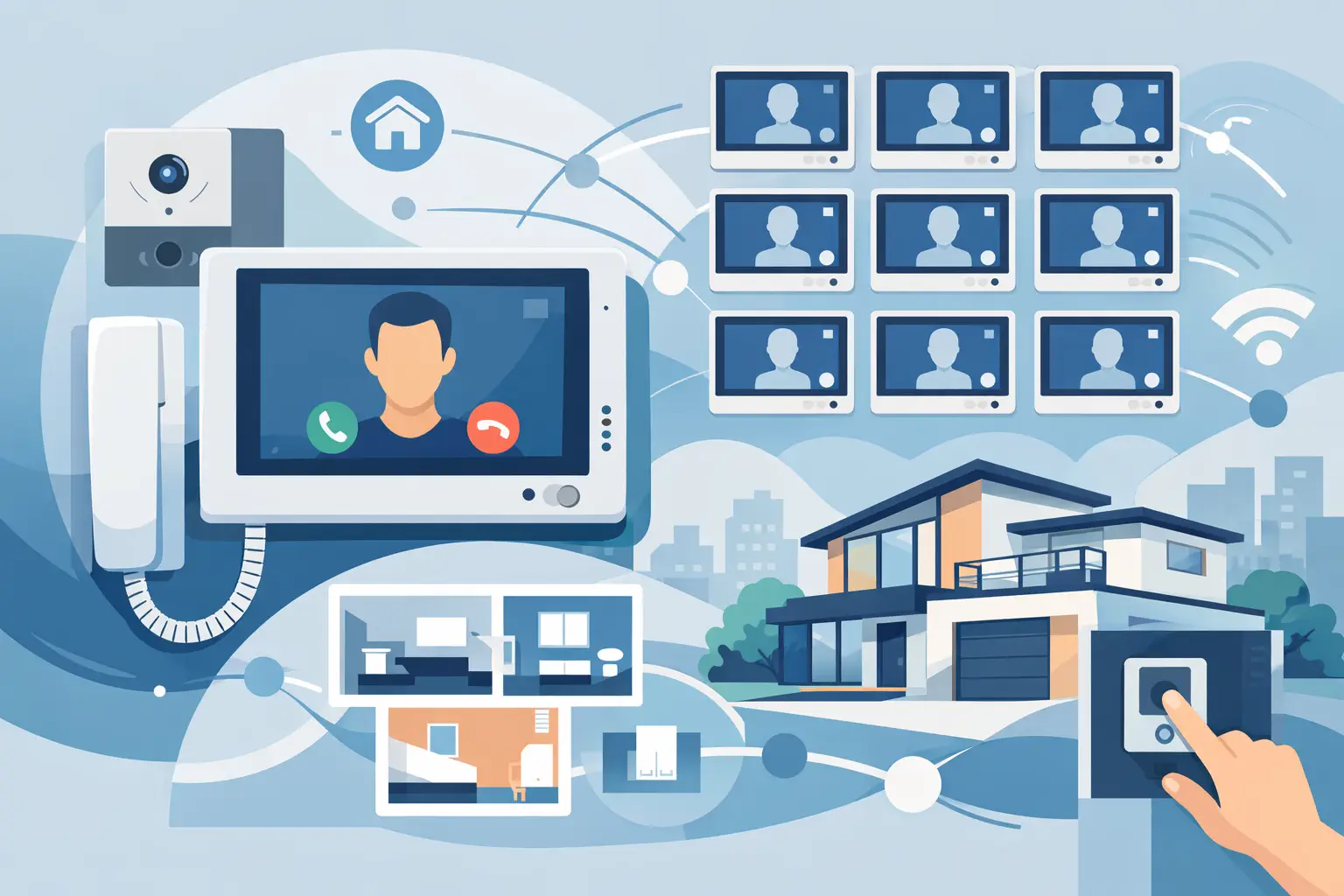
A 12-room intercom is rarely just a communication purchase. It is usually part of an entry-control decision: who can call whom, who can release a door, how visitors are identified, and what happens when a station needs service. This 12 room intercom system review focuses on the factors that determine whether a system will work properly in an apartment property, office, school wing, clinic, or light industrial facility.
The right system depends less on the number 12 than on the building layout, the desired door-control functions, and the cable routes available before installation begins. A system that works well for 12 private offices may be a poor fit for 12 apartment units with a shared entrance. Capacity is only the starting point.
What a 12-room system should mean
In intercom specifications, the word “room” can be misleading. One manufacturer may describe a system by its number of indoor stations, while another counts tenant stations, master stations, or door stations differently. Before comparing equipment, confirm exactly what the listed capacity includes.
For most properties, a 12-room configuration means one entrance panel or door station serving up to 12 indoor call stations. Each room, office, suite, or unit receives a dedicated station. A visitor selects the destination at the entrance, the station rings, and an authorized user can communicate with the visitor and, when equipped for it, release an electric strike, magnetic lock, or other compatible locking device.
That simple arrangement becomes more complex when the site needs two entrances, a rear delivery door, a gate station, a receptionist station, or communication between indoor locations. Those additions may reduce available capacity or require a system designed for expansion. A 12-station package is not automatically a 12-station system after multiple doors are added.
Wired audio intercoms: the practical baseline
For many commercial and multifamily applications, a wired audio intercom remains the most direct and serviceable choice. It provides call communication and door release without relying on Wi-Fi coverage, mobile apps, or ongoing cloud services. For buildings where the primary requirement is controlled visitor access, that simplicity is an advantage.
Audio systems are especially suitable when the entrance is close enough to the rooms for practical cable routing and visual visitor verification is not required. They are common in small apartments, offices, employee entrances, warehouses, and school administrative areas.
The trade-off is obvious: audio alone does not show who is at the door. Users must rely on voice recognition, a nearby camera system, or a separate viewing method. For a property with frequent deliveries, unfamiliar visitors, or security-sensitive entry points, that limitation deserves careful consideration.
A professional-grade wired system should be evaluated for its cable requirements, maximum cable distance, number of conductors, power supply requirements, and lock output capability. These details affect labor cost as much as the equipment price. Reusing existing low-voltage cable can reduce installation work, but only if its conductor count, condition, and routing meet the system requirements.
Video systems add verification, not just a screen
Video intercom systems are often the better option when staff, residents, or tenants need to see a visitor before releasing the door. At a front entrance, camera verification helps reduce accidental releases and gives the user more confidence when dealing with deliveries, contractors, and unknown visitors.
For a 12-room deployment, check the monitor format, camera viewing angle, low-light performance, and whether each indoor station can control the lock. Some applications require every room to release the door. Others should limit release authority to a front desk, manager, or secured office. The hardware must match that operating policy.
Video can also create infrastructure demands that an audio system does not. Depending on the platform, installation may require dedicated multi-conductor cable, network cabling, PoE switches, local power at each monitor, or a combination of these. IP video intercoms can be highly flexible, especially where existing network infrastructure is well managed, but they also require attention to network segmentation, power backup, device addressing, and future support.
A basic video system is not necessarily the best choice simply because it has a camera. A narrow camera angle can miss a visitor standing off-center. Poor lighting can make identification difficult. A system with a good entrance camera, correctly positioned lighting, and reliable lock control is more useful than a larger monitor with weak door-station coverage.
Door release is where compatibility matters most
The intercom and locking hardware must be planned as one system. A door station may provide a dry contact relay, but that does not mean it can directly power every lock. Electric strikes, electromagnetic locks, electric deadbolts, and gate operators have different voltage, current, and fail-safe or fail-secure requirements.
An electric strike is often practical for a standard swinging door where the door remains latched mechanically and the strike releases upon authorization. A magnetic lock is frequently used on aluminum storefront doors and access-controlled openings, but it normally requires proper life-safety planning, release devices, and fire alarm interface where applicable. Gate operators may need a momentary relay connection and may have their own safety and access-control requirements.
For any 12-room intercom installation, verify the following before ordering:
- Lock type, voltage, current draw, and fail-safe or fail-secure operation
- Door condition, including latch alignment, closer operation, and weather exposure
- Whether the intercom relay is rated to switch the lock load or should control a separate power relay
- Required exit hardware, fire alarm release, and local code considerations
- Battery backup needs for the intercom, lock power supply, and network equipment
A door that does not close and latch reliably will remain a security problem regardless of the intercom selected. Entry hardware should be inspected early, particularly on older apartment and commercial properties.
How the 12 room intercom system review changes by property type
A 12-unit apartment building generally needs a clear directory, tamper-resistant entrance panel, reliable resident calling, and controlled main-entry release. Video is often preferred where residents receive frequent deliveries, while wired audio may be appropriate for a straightforward, budget-conscious retrofit. If the building has a rear entrance or parking gate, select a platform that supports multiple door stations without compromising the resident-station count.
An office environment may place greater value on receptionist control than on calling every office individually. A master station at reception can screen visitors and transfer or announce calls internally. In this case, a 12-room system should support the actual workflow, not merely assign one station to every room. Some offices benefit from several call points; others are better served by a central station and a few strategic substations.
Schools, churches, clinics, and community facilities should consider operational control carefully. It may be inappropriate for every room to release an exterior door. A monitored main office station, restricted release permissions, and integration with existing surveillance cameras may provide a more controlled arrangement. For these sites, emergency procedures and access authority matter as much as call capacity.
Industrial sites and warehouses often have the longest cable runs and harshest entry conditions. Outdoor door stations need protection from weather, dust, impact, and vehicle noise. A gate location may require a separate station with enough camera coverage to identify drivers and deliveries. The intercom should be chosen for the site environment, not just the number of indoor endpoints.
Installation decisions that prevent service calls
Most avoidable intercom problems begin before the equipment is mounted. The installer should map every station, entrance, lock, power supply, and cable path. Labeling cables at both ends is a small step that saves substantial time during testing and future service.
Cable distance needs special attention. Voltage drop, video signal limitations, and communication quality can change as runs get longer. Do not assume that a cable type suitable for a short interior run will perform the same way from a detached gate or remote building. Manufacturer distance limits should be checked against the actual path, not a rough estimate.
Power should also be separated logically. The intercom may use one supply, while the electric lock requires another. If the site needs continued entry control during a power outage, determine which components need battery backup. Supporting only the indoor monitors while leaving the locking circuit unpowered may not meet the property’s operational needs.
For networked systems, involve the person responsible for the network before installation. Confirm switch capacity, PoE budget, IP address management, remote-access policy, and whether the intercom devices should be isolated from general office traffic. A video intercom can be dependable on a properly planned network; it can also become difficult to support when added to an unmanaged network as an afterthought.
Buying guidance: package price versus usable system
A lower package price can be attractive, but compare what is actually included. A usable 12-room system may require indoor stations, door panel modules, power supplies, surface or flush-mount boxes, rain shields, cable, lock hardware, transformers, relays, exit devices, and backup power. If these components are excluded, the initial price may not represent the installed cost.
Also consider replacement parts and expansion. Door stations are exposed equipment, and indoor stations may eventually need replacement after years of use. Selecting a system with available parts and a clear support path is often more economical than replacing an entire installation because one component is no longer supported.
For installers and property managers, the best value is usually a system that fits the building correctly, uses serviceable components, and leaves a clear record of wiring and programming. UnikCCTV can help match intercom, entry hardware, and supporting access-control equipment to the site rather than forcing a one-size-fits-all package.
Before approving a 12-room intercom, walk the property with the entry workflow in mind. Identify every door, every user who needs release authority, and every condition that could affect cabling or lock operation. That preparation leads to an intercom system that is easier to install, easier to support, and far more useful on the day it is needed.


 No products in the cart.