

Most rural property owners discover the same problem at the worst possible time: a gate was left open, equipment went missing overnight, or trespassers crossed a field boundary, and not a single camera captured any of it. Traditional wired CCTV systems, which work brilliantly for homes and commercial buildings, are nearly useless across 50 acres of farmland or a sprawling private estate. The infrastructure simply does not exist to support them. That is exactly where using a trail camera for security changes the equation. Originally built for wildlife observation, today’s trail cameras have quietly become one of the most practical, cost-effective tools for rural property security, and most property managers have not figured this out yet.
Table of Contents
- Quick Takeaways
- Why Trail Cameras Work Where CCTV Fails
- Unexpected Security Uses for Trail Cameras
- Wildlife Camera Surveillance for Perimeter Monitoring
- Rural Property Security Camera Placement Strategy
- Cellular vs. SD-Card Trail Cameras for Security
- Integrating Trail Cameras with a Full Security System
- Frequently Asked Questions
- References
Quick Takeaways
| Key Insight | Explanation |
|---|---|
| Trail cameras operate without wiring or Wi-Fi | They run on batteries and store images locally or transmit via cellular networks, making them ideal for remote locations with no power infrastructure. |
| Motion-triggered capture saves storage and battery | Unlike continuous-recording CCTV, trail cameras only activate when something moves, dramatically extending battery life and reducing footage to review. |
| Cellular trail cameras send alerts in real time | Modern cellular models push image alerts to your phone the moment motion is detected, removing the need to physically visit the camera to retrieve footage. |
| Night vision is standard, not premium | Most trail cameras include infrared or no-glow night vision, capturing activity in complete darkness without alerting intruders to the camera’s presence. |
| Trail cameras cover ground no CCTV system can | A single cellular trail camera mounted on a fence post or tree can monitor a remote gate, field entrance, or equipment shed a quarter mile from the nearest building. |
| Bulk deployment is cost-effective for large estates | Multiple trail cameras covering different zones cost far less than running cable or installing wireless CCTV infrastructure across large rural acreage. |
| Trail cameras complement, not replace, a full security system | For entry points, gate access control, and building interiors, purpose-built security equipment from specialists like UnikCCTV remains the right tool. |
Why Trail Cameras Work Where CCTV Fails
Traditional wired CCTV systems are engineered for buildings. They need power runs, cable conduit, network infrastructure, and a relatively short distance between camera and recorder. On a rural property or large estate, none of those conditions exist. Running cable to a remote barn, a back-gate entrance, or a timber boundary line is either cost-prohibitive or physically impossible.
Trail cameras were built for exactly these conditions. They are weatherproof, self-powered by batteries, and require no internet connection to function. The better models offer months of standby battery life, meaning a camera mounted on a fence post in February can still be capturing images in May without intervention. That kind of autonomy is not something any traditional CCTV system can match at remote locations.
As noted in research shared by Browning Trail Cameras, most conventional security cameras rely on a stable Wi-Fi connection to transmit images, and without that connection, they simply cannot function. This leaves remote property owners with a significant blind spot that trail cameras are uniquely positioned to fill.
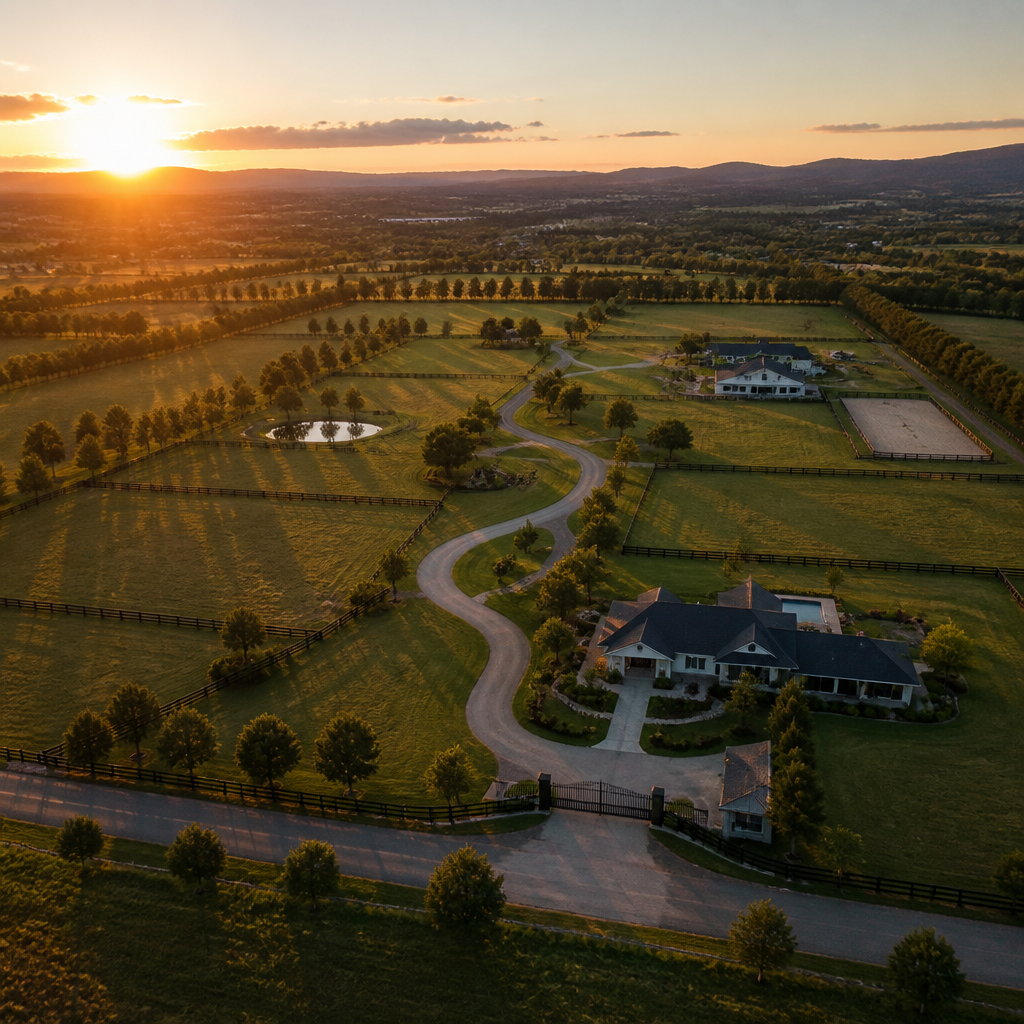
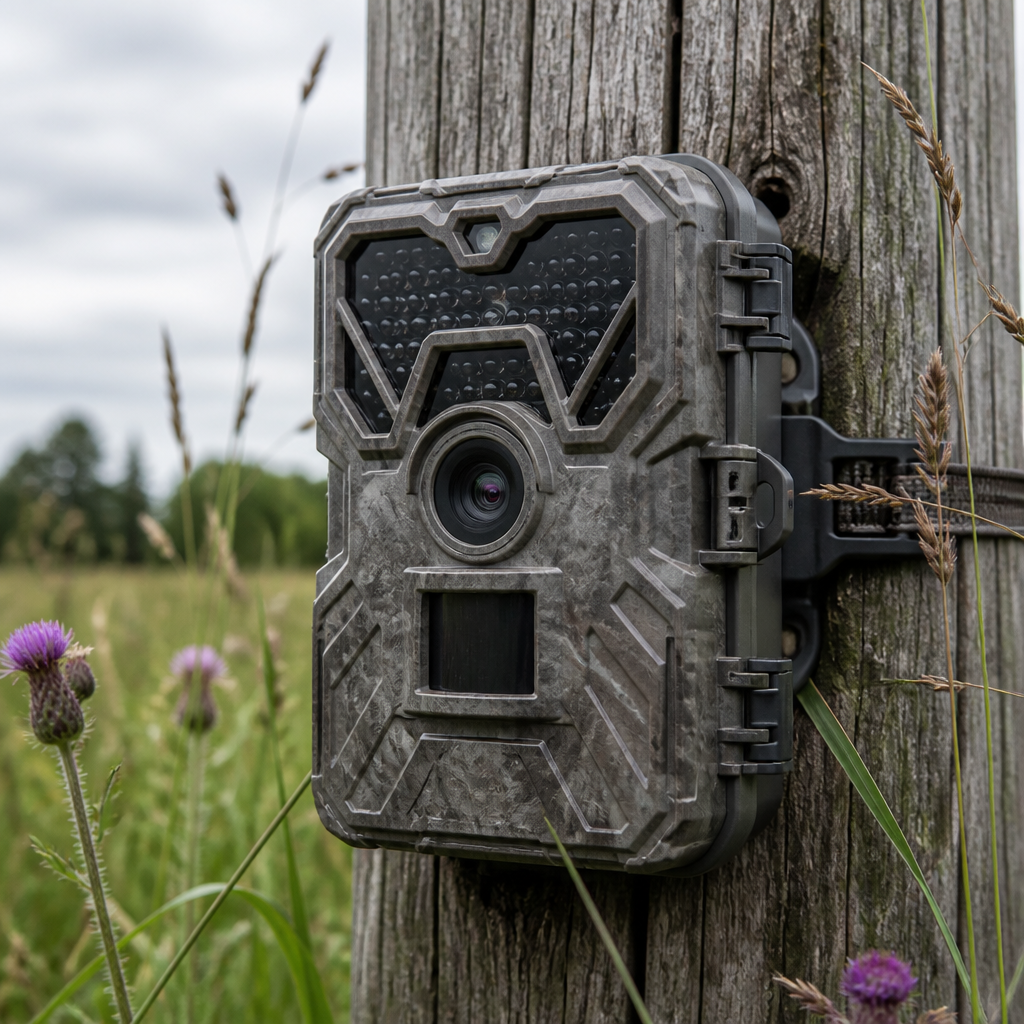
The practical result is that a property manager overseeing a large rural estate can deploy trail cameras at every meaningful entry point, field edge, and equipment storage area without hiring an electrician or running a single cable. The setup time per camera is measured in minutes, not days.
Pro tip: Choose trail cameras with a trigger speed under one second. Faster trigger speeds mean the camera captures a clear image of a person’s face or a vehicle’s license plate before they move past the detection zone, rather than catching only the back of their head.
Unexpected Security Uses for Trail Cameras
Most people associate trail cameras with hunters checking deer movement before season opens. That use case is real, but it has nothing to do with why property managers and facility operators should pay attention to this technology. The security applications are the genuinely useful part.
Monitoring Equipment Yards and Storage Areas
Agricultural equipment theft is a persistent problem on farms and rural estates. Tractors, ATVs, generators, and irrigation hardware represent tens of thousands of dollars in assets, and they are typically stored far from any building with existing security coverage. A trail camera mounted on a tree or post overlooking an equipment yard captures every vehicle and person who enters that area, day or night, with zero ongoing power cost.
A common mistake is placing a single camera at the entrance to a large storage area. A better approach is two cameras at opposing angles, eliminating any blind spot an intruder might use to stay out of frame.
Illegal Dumping Detection
Rural roadsides and private property boundaries are frequent targets for illegal dumping. The damage is expensive to clean up, and without evidence, there is no way to pursue the responsible party. A trail camera positioned to cover a vulnerable stretch of fence line or road access creates a timestamped record of every vehicle that stops in that area. That evidence is directly usable in enforcement and legal proceedings.
Monitoring Hunting Lease Boundaries
For landowners who lease hunting rights, trail cameras serve double duty. They verify that leaseholders are staying within agreed boundaries and simultaneously flag any unauthorized access by outside parties. This is one of the few security applications where wildlife camera surveillance and access monitoring genuinely overlap.
Remote Cabin and Seasonal Property Checks
A property that sits empty for months at a time is a different security problem than one with daily occupancy. Trail cameras positioned at the driveway entrance and at the main structure give the owner a way to verify whether anyone has approached or entered the property without making the drive themselves. Cellular models push image alerts directly to a phone, so the owner knows within seconds if something happens.
The best security camera is the one that actually covers the location that matters, not the one that only works where infrastructure already exists.
Wildlife Camera Surveillance for Perimeter Monitoring
Wildlife camera surveillance is the original design intent of these devices, and that origin creates features that translate directly into security advantages. A camera built to capture a deer crossing at 3 a.m. in freezing temperatures is, by definition, excellent at capturing a person crossing a fence line under the same conditions.
Infrared and No-Glow Night Vision
Standard trail cameras use infrared LEDs to illuminate a scene at night without producing visible light. No-glow models take this further, using black LEDs that are completely invisible to the human eye. For security purposes, this matters a great deal. A camera that flashes red when triggered tells an intruder exactly where the camera is and that it just captured them. A no-glow model does neither.
For perimeter monitoring on a rural estate, no-glow infrared is the right choice. It captures clear images in complete darkness while remaining undetectable by anyone on the ground.
Wide Detection Angles and Long Detection Range
Wildlife cameras designed to cover large areas often feature detection angles of 90 degrees or wider and detection ranges exceeding 80 feet. For perimeter security, this means fewer cameras are needed to cover a given stretch of boundary, which reduces both cost and maintenance burden.
In practice, deploy wider-angle cameras at open field boundaries where coverage area is more important than precision, and use cameras with longer but narrower detection ranges at choke points like gates, gaps in fencing, or trail crossings where subjects are more predictably positioned.
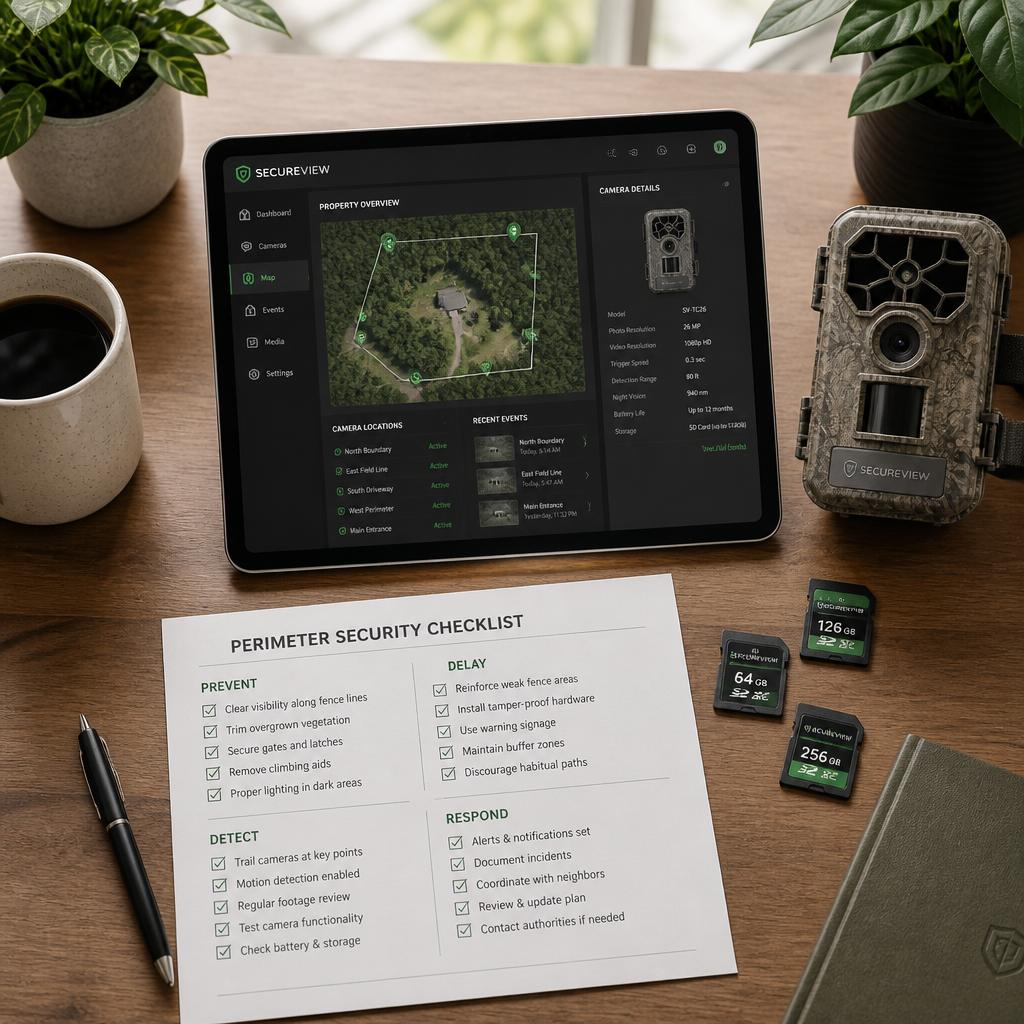
Pro tip: Position perimeter cameras at a slight downward angle and 6 to 8 feet above ground. This height captures faces clearly while keeping the camera out of easy reach. Cameras mounted at eye level are easier to tamper with and produce less useful identification angles.
Rural Property Security Camera Placement Strategy
Placement is where most rural property security deployments succeed or fail. The technology in the camera matters, but a well-placed average camera consistently outperforms a premium camera in the wrong spot. On a rural property security camera deployment, the goal is to create a series of chokepoints that any person or vehicle must pass through, rather than trying to cover every acre of open ground.
Prioritizing Choke Points Over Open Coverage
A choke point is any location where access is naturally funneled. On rural properties, these are driveways, gate openings, gaps in fencing, bridge crossings, and paths between natural features like tree lines or water bodies. Place cameras at choke points first. You will achieve far more actionable coverage per camera than trying to monitor open fields from a distance.
Layered Coverage at Entry Points
The main entry point of any rural property deserves more than one camera. A common professional approach is a camera covering the approach (capturing arriving vehicles before they reach the gate), a second camera at the gate itself (capturing faces and license plates), and a third camera facing back toward the entry from inside the property (capturing anyone leaving or anyone who bypassed the main entry). This three-camera entry cluster eliminates the gaps that single-camera installations leave.
For properties that also have active gate access control systems, trail cameras work well as a supplemental layer alongside intercom and smart lock systems installed at the main entrance. The trail cameras cover the perimeter while the controlled access hardware manages who actually enters.
Equipment and Asset Zones
After entry points, prioritize coverage of high-value asset locations. Equipment sheds, fuel storage, generator enclosures, and outbuildings that store tools or materials should each have at least one dedicated camera. Position these cameras to cover the approach to the asset, not just the asset itself. A camera that only sees the inside of a shed after the door is already open is far less useful than one that captures who approached the shed and when.
Cellular vs. SD-Card Trail Cameras for Security
The choice between a cellular trail camera and an SD-card-only trail camera is one of the most consequential decisions in any rural security deployment. Both have their place, but they serve different needs and come with different trade-offs.
| Feature | Cellular Trail Camera | SD-Card Trail Camera |
|---|---|---|
| Alert speed | Real-time push notification to phone | No alert, images reviewed on-site or after retrieval |
| Ongoing cost | Monthly cellular data plan required | No ongoing cost after purchase |
| Coverage dependency | Requires cellular network coverage at camera location | Works anywhere, no network needed |
| Battery life impact | Shorter due to cellular transmission | Longer, as no data transmission is needed |
| Best use case for security | Active monitoring of high-priority entry points and asset zones | Passive documentation of lower-priority perimeter locations |
For most rural security setups, a hybrid approach works best. Use cellular cameras at the two or three locations that matter most, such as the main gate, the equipment yard, and the primary access road. Deploy SD-card cameras across secondary perimeter points where real-time alerts are less critical. This balances cost, coverage, and the operational burden of checking images.
As Browning Trail Cameras notes, modern cellular trail cameras have become one of the most effective tools for monitoring remote property where internet access and power infrastructure may be limited. The key limitation remains cellular coverage: if the camera location has no signal, a cellular model is not a viable choice, and an SD-card model is the only practical option.
Integrating Trail Cameras with a Full Security System
Trail cameras are a powerful perimeter and outdoor monitoring tool, but they are not a complete security solution on their own. They have no deterrent effect (they document, they do not prevent), and they are not designed to manage who enters or exits a property. A genuinely secure rural property or large estate needs trail cameras working alongside controlled access hardware.
What Trail Cameras Do Not Replace
At any staffed or frequently accessed entry point, a gate access control system or intercom is the right tool. These systems actively control access, create an audit trail of who entered and when, and allow remote authorization for visitors. Trail cameras positioned near the same entry points add a visual record that complements the access log.
For buildings on the property, interior CCTV surveillance, smart locks, and biometric access systems provide a level of control and deterrence that no trail camera can match. Trail cameras are built for outdoor, uncontrolled environments. Inside a building or at a primary entry door, purpose-built security equipment is the appropriate choice.
Building a Layered Security Architecture for Rural Estates
A well-designed rural security system works in layers. The outermost layer is perimeter monitoring using trail cameras at boundary points and secondary access routes. The middle layer is gate and entry control using intercom systems, access control hardware, and CCTV at primary entry points. The innermost layer covers buildings and high-value interior spaces with smart locks, biometric access, and purpose-built surveillance cameras.
UnikCCTV’s range of gate access controls, wireless intercoms, and CCTV surveillance systems covers the middle and inner layers directly, and those systems pair naturally with a trail camera perimeter layer to create comprehensive coverage. For property managers and facility operators building out security for a large rural site, starting with an assessment of which layer each location belongs to is the most efficient way to avoid both gaps and redundant spending.
The wording from WO Sports’ research on large property monitoring makes the principle clear: many landowners choose to deploy multiple cameras across entrances, field edges, and equipment storage areas, using the appropriate tool for each zone rather than forcing one product type to cover every scenario.
Frequently Asked Questions
Can a trail camera be used as a security camera for a rural property?
Yes, and in many rural situations it is the most practical option available. Trail cameras are weatherproof, battery-powered, and require no wiring or internet connection. For remote gates, field boundaries, equipment yards, and other locations where traditional CCTV infrastructure cannot reach, a trail camera for security purposes is both effective and cost-efficient. The key is choosing a model with fast trigger speed, good night vision, and, where cellular coverage exists, cellular connectivity for real-time alerts.
What is the difference between a trail camera and a wildlife camera for surveillance purposes?
The terms are largely interchangeable. Both refer to the same category of motion-triggered, battery-powered outdoor cameras. “Wildlife camera” tends to be used more in ecological and observation contexts, while “trail camera” is more common in hunting and property monitoring contexts. For wildlife camera surveillance applied to security, the features to prioritize are identical: no-glow infrared, fast trigger speed, wide detection angle, and weather resistance.
How many trail cameras do I need for a large rural property?
The number depends on how many meaningful choke points the property has, not on total acreage. A 200-acre farm with two vehicle entry points, one equipment yard, and three remote field access gaps might be adequately covered with seven to ten cameras. Avoid the temptation to calculate cameras by square footage. Cover the choke points first, then add cameras for high-value asset locations. Open field coverage is the lowest priority because it yields the fewest actionable images per camera.
Do trail cameras work in complete darkness?
Yes. Most trail cameras include infrared night vision that illuminates a scene invisibly. Standard infrared LEDs emit a faint red glow that is visible up close. No-glow models use black infrared LEDs that produce no visible light at all. For security applications where you do not want to alert an intruder that they have been photographed, no-glow infrared is strongly preferred. Image quality in complete darkness is typically lower resolution than daylight shots, but sufficient for identification purposes at reasonable distances.
Where should trail cameras be placed for maximum security coverage?
Start at every point where a person or vehicle must pass to access the property, including driveways, gate openings, gaps in fencing, and paths between natural features. Mount cameras 6 to 8 feet above ground, angled slightly downward, and oriented so the detection zone aligns with the direction of approach rather than perpendicular to it. After entry points, prioritize camera placement at equipment storage areas, outbuildings, and fuel or material storage. Open fields and pasture areas are the lowest priority.
Do I need a cellular trail camera or will an SD-card model work for property security?
Both work, but for different purposes. A cellular trail camera sends images to your phone in real time, which is valuable at high-priority locations where you need to respond quickly to an intrusion. An SD-card model stores images locally, which you retrieve manually on-site. SD-card models cost less to run and have longer battery life, making them suitable for lower-priority perimeter locations. A practical rural security deployment typically uses cellular cameras at the most critical two or three locations and SD-card cameras everywhere else.
Have you deployed trail cameras as part of your property security setup? Share what has worked for your specific terrain and access challenges in the comments below.



 No products in the cart.