
Choosing the wrong gate access control system costs more than money. It costs you security incidents, frustrated residents, and expensive retrofits six months after installation. The gate access control comparison most property managers and homeowners face comes down to four main technologies: keypad entry, card or fob access, biometric readers, and app-based systems. Each has real strengths and real failure points. This article breaks down exactly what each system does well, where each falls short, and which type fits which property profile, so you make the right call before any hardware gets mounted.
Table of Contents
- Quick Takeaways
- Keypad Gate Entry Systems: Reliable but Limited
- Card and Fob Access Systems: The Workhouse of Commercial Properties
- Biometric Gate Access Systems: High Security with Real Trade-offs
- App-Based Gate Access Systems: The Modern Standard for Multi-Unit Properties
- Side-by-Side Comparison of All Four Gate Access System Types
- Which Gate Access System Fits Your Property Type
- Frequently Asked Questions
- References
Quick Takeaways
| Key Insight | Explanation |
|---|---|
| Keypads suit low-traffic single-family homes best | Simple PIN entry works well when a small group uses the gate and codes are changed regularly. Shared codes are the primary security weakness. |
| Card and fob systems scale easily but create credential management overhead | Lost cards must be deactivated immediately. Facilities with 50 or more users benefit from a credential management platform paired with card readers. |
| Biometric systems eliminate credential sharing but require clean installation environments | Fingerprint readers perform poorly in high-humidity or dusty outdoor environments. Facial recognition locks are the more durable biometric option for gate use. |
| App-based systems offer the strongest remote management capability | Property managers can grant or revoke access, view entry logs, and issue temporary visitor passes without being on-site. |
| Hybrid systems outperform single-method systems for mid-to-large properties | Pairing an app-based intercom with a keypad backup ensures access continuity when smartphones die or connectivity drops. |
| Installation environment drives technology choice as much as budget does | Outdoor gate readers must be rated IP65 or higher. Biometric readers rated below IP65 will degrade within one to two rainy seasons. |
| Total cost of ownership differs significantly from upfront hardware cost | Card systems have ongoing card replacement and management costs. App-based systems often charge monthly software fees. Keypads have the lowest ongoing cost. |
Keypad Gate Entry Systems: Reliable but Limited
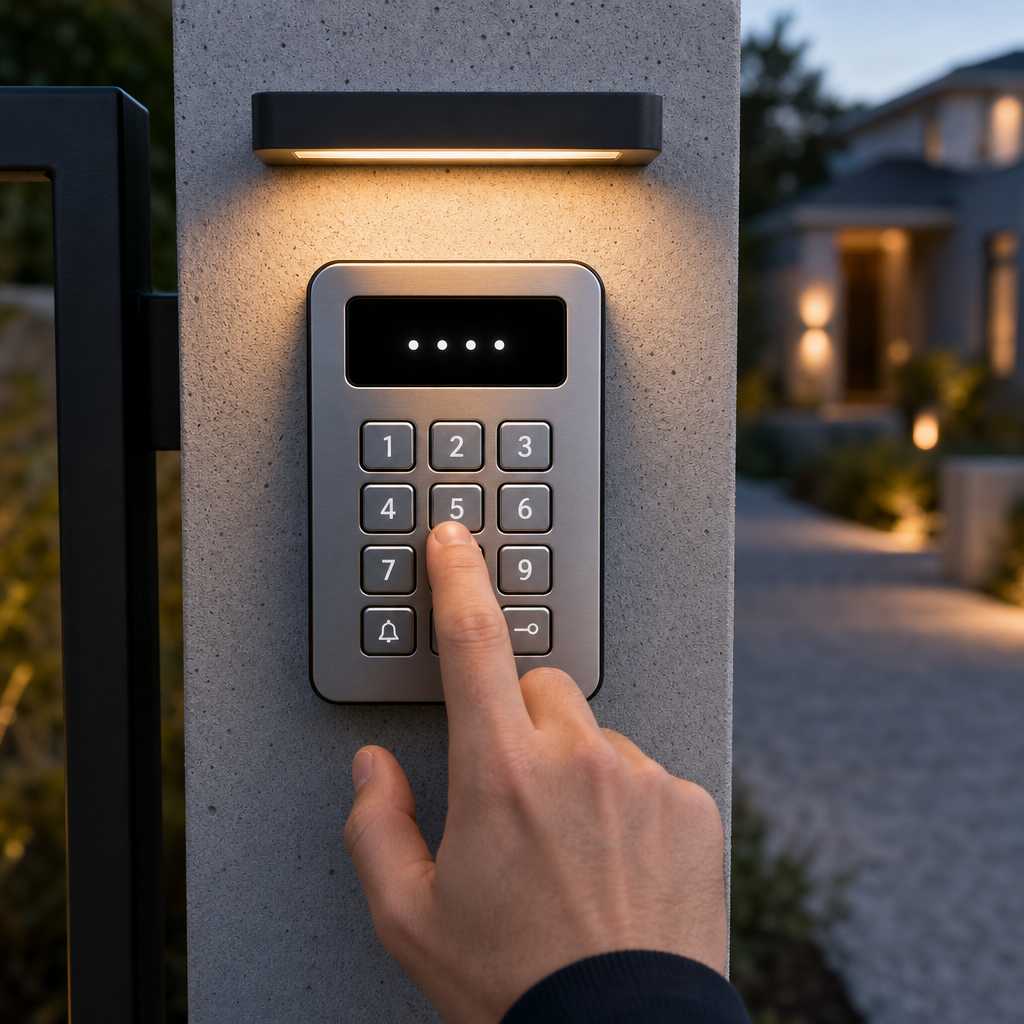
Keypad entry is the oldest and most widely deployed gate access technology on residential properties. A user enters a PIN on a numeric pad, and the gate opens. No card to lose, no app to install, no battery to charge. For a single-family home with a private driveway gate, a keypad is often the most practical entry point into residential gate security.
In practice, the biggest failure mode of keypad systems is code sharing. One household member gives the code to a contractor, who gives it to an assistant, and within three months the PIN is known to a dozen people who were never supposed to have access. A common mistake is treating a keypad code like a password that never needs changing. Best practice is to update codes every 60 to 90 days and assign separate codes per user where the keypad hardware supports it.
Where Keypads Work and Where They Break Down
Keypads work well in low-traffic environments: private residences, small commercial parking areas, and secondary gates on larger properties. They require no ongoing software subscription, no credential database, and no smartphone dependency. That simplicity is genuinely valuable in contexts where reliability matters more than granular access logging.
Where keypads consistently underperform is in multi-unit residential buildings and high-traffic commercial facilities. When 80 tenants all use the same entry code, there is no way to identify who entered when, no way to revoke one person’s access without changing the code for everyone, and no way to issue a temporary code to a visitor without that code potentially circulating indefinitely.
Pro tip: If you are installing a keypad on a residential gate, choose a model that supports multiple PINs and rolling code technology. This lets you assign a unique code to each household member and deactivate individual codes without affecting others.

Card and Fob Access Systems: The Workhouse of Commercial Properties
Card and fob-based gate entry uses RFID or proximity technology to authenticate a physical credential against a reader. The user taps or waves a card or key fob near the reader, and the gate opens. This technology has been the backbone of commercial access control for decades, and for good reason. It is fast, reliable, and supports individual credential management at scale.
The data consistently shows that RFID card systems dominate commercial and multi-tenant residential deployments. According to Statista’s security market research, physical access control remains the highest-volume segment of the global security hardware market, with card-based systems representing the largest installed base globally as of recent years.
Managing a Card-Based System at Scale
The administrative advantage of card systems is that each credential is unique and individually revocable. When a tenant moves out or an employee is terminated, that specific card is deactivated in the system within seconds. No need to reissue credentials to everyone else. For property managers overseeing 30 or more units, this individual revocation capability is not a nice-to-have. It is a baseline security requirement.
The ongoing cost comes from physical credential replacement. Cards get lost, damaged, and occasionally demagnetized. Budget approximately 10 to 15 percent of your initial card inventory per year for replacements. Fobs tend to be more durable and have lower replacement rates than standard proximity cards.
A common mistake with card systems is deploying them without an access control management platform. Standalone card readers with no software backend make it nearly impossible to audit entry logs, push updates, or manage credentials across multiple gates. Pairing card readers with a management system is where the real operational value appears.
Biometric Gate Access Systems: High Security with Real Trade-offs
Biometric gate access uses a physical characteristic, most commonly a fingerprint, palm vein pattern, or facial geometry, to verify identity. The core security advantage is that biometric identifiers cannot be shared, loaned, or forgotten. You cannot hand your fingerprint to a visitor the way you can hand over a card or text someone a PIN code.
For high-security applications, biometric systems deliver measurably stronger access control. A 2023 report from the National Institute of Standards and Technology noted that modern facial recognition algorithms achieve false acceptance rates below 0.1 percent in controlled conditions, making them among the most accurate identity verification methods available at consumer price points.
Fingerprint vs. Facial Recognition for Outdoor Gate Use
Fingerprint readers are the most common biometric option, but they present a specific problem for outdoor gate installations. Rain, humidity, dirt, and sunscreen residue all degrade read accuracy. In practice, fingerprint readers mounted at outdoor vehicle gates in humid climates show rejection rate increases of 15 to 25 percent during wet seasons, creating real access friction for legitimate users.
Facial recognition locks handle outdoor conditions better because the sensor has no physical contact point to contaminate. Modern facial recognition locks use infrared sensors that function in low-light and variable weather conditions. For gate applications where users are approaching in vehicles, however, camera angle and mounting height require precise calibration during installation.
Pro tip: For outdoor biometric gate readers, always specify a unit with an IP65 or higher ingress protection rating. Any reader with a lower rating will degrade within one to two wet seasons, and replacement costs will exceed what a properly rated unit would have cost upfront.
Enrollment and Ongoing Management
Biometric systems require an enrollment step where each user’s biometric data is registered in the system. For a 200-unit apartment building, this means coordinating enrollment sessions with every tenant, which creates a meaningful operational lift at move-in and during tenant turnover. Budget for this enrollment overhead in your implementation plan or it will cause delays.

App-Based Gate Access Systems: The Modern Standard for Multi-Unit Properties
App-based gate access systems use a smartphone application to authenticate users and communicate with gate hardware, either through Bluetooth, Wi-Fi, or cellular connection. The gate reader verifies the user’s digital credential, which lives on the phone, and opens on confirmation. More sophisticated systems combine an app-based intercom with camera-equipped entry panels, so residents can see and speak with visitors through the app and remotely grant access from anywhere with an internet connection.
This category represents the fastest-growing segment of the types of gate entry systems because it solves the remote management problem that keypads and standalone card systems cannot. A property manager overseeing multiple buildings can issue a temporary access code to a delivery driver, view a photo log of every gate entry, and disable a former tenant’s access credential, all from a phone without visiting the property.
Connectivity Dependency is the Biggest Risk Factor
The weakest point of app-based systems is connectivity dependency. If the gate controller loses internet access or the user’s phone battery dies, access is blocked. The best implementations address this by including a keypad backup on the same gate panel, so there is always a PIN-based fallback. Any app-based gate system deployed without a secondary access method is accepting unnecessary risk.
Bluetooth-based systems partially address the connectivity issue by not requiring internet access for the gate open command itself. The phone communicates directly with the gate reader over Bluetooth, which works without Wi-Fi or cellular signal. The trade-off is that Bluetooth range is typically limited to 10 to 30 feet, which affects how the gate hardware must be positioned relative to the vehicle approach lane.
Visitor and Delivery Access Management
One area where app-based systems genuinely outperform all other types is visitor management. Residents can issue time-limited digital access passes to guests through the app. A pass can be set to expire after a single use, after a specific date, or after a defined time window. This eliminates the security risk of giving a visitor a permanent PIN code or handing over a physical card that may never come back.
For properties that need to accommodate frequent deliveries, service technicians, or short-term rental guests, this time-limited credential capability is not a luxury feature. It is a core security requirement that only app-based systems deliver natively.
Side-by-Side Comparison of All Four Gate Access System Types
The table below compares the four main gate access technologies across the criteria that matter most for property selection decisions. Use this as a working reference, not a final answer. The right system for your property depends on traffic volume, user population, budget structure, and installation environment.
| Criteria | Keypad / PIN | Card / Fob (RFID) | Biometric | App-Based |
|---|---|---|---|---|
| Upfront Hardware Cost | Low ($100-$400) | Medium ($300-$1,200) | High ($500-$2,500+) | Medium-High ($400-$1,800) |
| Ongoing Cost | Very Low | Low-Medium (card replacements) | Low (maintenance) | Medium (software subscription) |
| Security Level | Low-Medium | Medium | High | Medium-High |
| Remote Management | None (unless cloud-enabled) | Limited | Limited | Full |
| User Convenience | High | High | Medium (enrollment required) | High (smartphone required) |
| Visitor Access Capability | Poor | Poor | Poor | Excellent |
| Outdoor Durability | High | High | Medium (depends on IP rating) | High |
| Scales to 50+ Users | No | Yes | Yes (with planning) | Yes |
Which Gate Access System Fits Your Property Type
The best gate access system for a given property is determined by three intersecting variables: user volume, management model, and security requirement level. Here is a direct set of recommendations based on property type, not a hedge.
Single-Family Residential Homes
For a private home with a driveway or estate gate, a keypad system is the most cost-effective starting point. If the homeowner wants remote access control and visitor management, pairing a wireless intercom with an app-based gate opener adds the necessary functionality without overengineering the installation. A standalone biometric system is generally overkill for single-family residential gate use unless there is a documented high-security requirement.
UnikCCTV’s range of wireless intercoms and smart lock systems is designed specifically for this use case, offering homeowners a path from basic keypad entry to full app-controlled gate management without needing to replace the entire gate hardware.
Multi-Unit Residential Buildings and Apartment Complexes
Multi-unit residential properties need individual credential management and visitor access capability. An app-based system paired with a card or fob backup is the most operationally efficient solution. The app handles residents and visitor passes. The card system handles users who cannot or will not use a smartphone. A keypad provides the emergency fallback.
For buildings with 100 or more units, an access control management platform that integrates with the building’s property management software is worth the additional investment. Entry log data becomes a valuable incident investigation tool, and automated credential provisioning at tenant move-in reduces administrative time significantly.
Commercial Properties, Warehouses, and Industrial Facilities
High-traffic commercial gates need durable readers, fast throughput, and detailed audit logging. Card and fob systems with a backend management platform handle these requirements well. For facilities with strict security requirements, adding biometric verification as a second factor on top of card access, creating a two-factor gate authentication setup, is the most robust approach available without moving to full vehicle recognition systems.
“Access control is not just about keeping the wrong people out. It is about knowing exactly who came in, when they came in, and whether they were supposed to be there.” – Security Industry Association, Physical Access Control Systems Market Overview
UnikCCTV’s biometric access systems and time attendance clocks are built for exactly this commercial deployment model, offering both gate access control and workforce verification in compatible hardware configurations.

Gated Communities and Homeowner Association Properties
Gated communities face a unique challenge: a large, rotating population of residents, guests, service providers, and delivery personnel all needing calibrated access levels. App-based systems with guest pass functionality are the strongest fit here. The ability to issue time-limited visitor credentials without staff involvement at the gate booth reduces operating costs and eliminates the security gaps created by manual access processes.
For communities that also have a staffed guardhouse, pairing an app-based entry system with a video intercom at the gate panel gives guards a visual verification capability and creates a photographic entry log for every vehicle. This combination is significantly more defensible from a liability standpoint than a PIN-only gate with no entry record.
Frequently Asked Questions
What is the most secure type of gate access control system?
Biometric systems are the most secure single-factor option because credentials cannot be shared or duplicated. However, the most secure overall configuration is a two-factor system combining a card or fob with a biometric reader, or combining an app credential with a PIN. Two-factor gate access is standard practice for high-security commercial and government facilities and is increasingly available at consumer-accessible price points.
Can I install a gate access system without running new wiring?
Yes, in many cases. Wireless intercom systems and some app-based gate controllers communicate over Wi-Fi or cellular, eliminating the need for new low-voltage wiring runs between the gate panel and the main controller. Battery-powered keypad units are also available for gates where running power to the entry panel is impractical. The trade-off is that wireless systems require periodic battery maintenance and depend on network connectivity.
How do app-based gate systems handle users who do not have smartphones?
The best app-based systems include a PIN keypad as a built-in alternative on the same gate panel. Some systems also support RFID card readers integrated into the same unit, so a single entry panel covers all three credential types: app, keypad, and card. For property managers, this multi-method approach is the only responsible deployment model because relying solely on smartphones excludes elderly residents and users who choose not to own a smartphone.
What is the difference between a proximity card and a smart card for gate access?
Proximity cards, also called Prox cards, use 125 kHz RFID technology and transmit a fixed credential code. They are easy to clone with inexpensive equipment, which is a meaningful security vulnerability. Smart cards use 13.56 MHz technology, support encrypted communication between the card and reader, and are significantly harder to clone. For any new installation, smart card technology is the correct choice. Proximity cards should only be retained in existing systems where a full replacement is not budgeted.
How much does a complete gate access control system cost to install?
A basic residential keypad gate controller runs $150 to $500 for hardware, plus $200 to $400 for professional installation. A mid-grade app-based intercom and gate control system for a small apartment building costs $800 to $2,500 for hardware, plus $500 to $1,500 for installation, plus ongoing software fees ranging from $30 to $150 per month depending on the platform. A commercial biometric gate system for a high-security facility starts at $2,000 for hardware and can reach $10,000 or more for multi-gate deployments with a management platform.
Do biometric gate systems store fingerprint images on the device?
Most modern biometric access systems do not store actual fingerprint images. Instead, they convert the fingerprint scan into a mathematical template, a numerical representation of the fingerprint’s unique feature points, which is stored instead of the image. This template cannot be reverse-engineered back into a fingerprint image. For properties concerned about biometric data privacy compliance, confirm with the manufacturer that the device uses template-only storage and clarify where that data is stored, on the device locally or in a cloud database.
Is it possible to integrate a gate access system with existing CCTV cameras?
Yes. Integration between gate access control and CCTV surveillance is a standard feature in professional-grade systems. When a gate entry event is logged, the system can automatically pull and timestamp the corresponding camera footage, creating a synchronized access and video record. This integration is particularly valuable for incident investigation and liability documentation. UnikCCTV’s product range is designed with this interoperability in mind, allowing gate entry hardware to work alongside existing or new CCTV surveillance equipment without requiring a complete system replacement.
Have you recently upgraded your gate access system or are you evaluating options for a new property? Share what factors mattered most in your decision, your feedback helps others working through the same comparison.
References
- National Institute of Standards and Technology, technology and security standards reference for biometric and access control systems
- Statista, global physical access control and security hardware market data and trends
- Forbes, business technology coverage including smart building security and access control system trends
- Security Industry Association, physical access control market research and industry standards documentation
- U.S. Department of Energy, facility security and physical access control guidelines for government and commercial properties


 No products in the cart.