
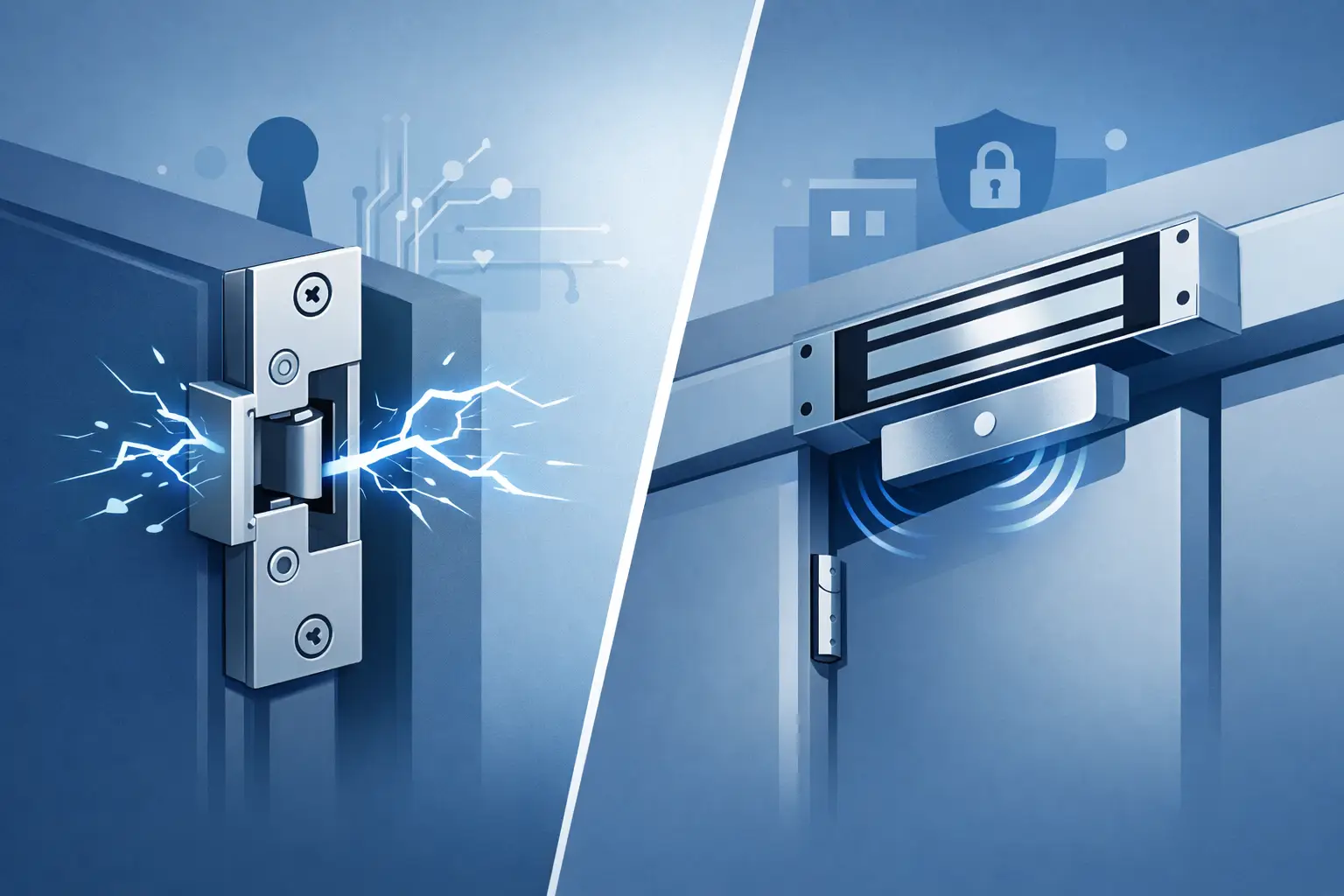
A door that looks simple on the plans can become the hardest part of an access-control job once hardware starts getting specified. The real question behind electric strike versus maglock is not which one is better in the abstract. It is which one fits the door, the code path, the traffic pattern, and the level of security the site actually needs.
For installers, property managers, and facility teams, this choice affects more than lock performance. It changes wiring strategy, life-safety compliance, credential behavior during a power loss, and how the opening feels in daily use. A lock that works well on a storefront aluminum door may be the wrong answer on a hollow metal fire-rated opening or a high-abuse school entry.
Electric strike versus maglock: the basic difference
An electric strike is installed in the frame and works with a mechanical lockset or latch. Instead of replacing the lock on the door, it changes how the latch is released. When the strike is energized, the keeper pivots or releases so the door can open while the latch hardware remains in place.
A maglock, or electromagnetic lock, holds the door closed with magnetic force between a magnet mounted on the frame and an armature plate mounted on the door. There is no latch engagement in the usual sense. The door stays secure because the magnet is powered and holding.
That difference matters right away. Electric strikes usually preserve the normal look and function of a latched opening. Maglocks create a holding force system that depends on continuous power and separate egress hardware. In practice, that means each option pushes the rest of the opening toward a different hardware and code solution.
Where electric strikes make more sense
Electric strikes are often the more natural fit when the opening already has a latch-based lock and the goal is to add controlled entry without changing how people exit. On many commercial doors, apartment entries, side doors, and smaller office openings, that is a strong advantage.
Because the door still latches mechanically, an electric strike can maintain security even when the opening is not being actively released. It also tends to give a cleaner day-to-day user experience. The door closes, latches, and stays aligned the way people expect. For buildings with regular traffic and repeated cycles, that familiar operation can reduce complaints and service calls.
Another advantage is appearance. On many openings, an electric strike is less visually intrusive than a surface-mounted maglock. For architects and property owners who do not want the lock hardware to dominate the top rail of the door, that can matter.
Electric strikes also work well in intercom and buzzer-entry applications. A visitor is identified, the strike releases, and the person pulls or pushes through using the existing latch hardware. That setup is common for multifamily, mixed-use, and smaller commercial sites where controlled entry is needed but the opening still needs conventional lock behavior.
Where maglocks make more sense
Maglocks are often chosen when a door does not lend itself well to an electric strike, or when high holding force is a priority. Certain glass aluminum storefront doors, gate applications, or openings without practical latch modification may point toward a maglock solution.
They can also be useful when the project needs a surface-mounted approach with less frame cutting. Some retrofit environments favor that. If the frame condition is poor, the door prep is limited, or there is no practical path for strike alignment, a maglock may reduce mechanical complications.
In some high-traffic situations, maglocks are appealing because there is no keeper cavity dealing with latch entry and release on every cycle. But that does not mean they are maintenance-free. Door alignment, bracket condition, armature contact, and power quality all affect performance. A maglock that looks easy on paper still needs proper installation to hold consistently.
The code and life-safety issue
This is where many comparisons stop being theoretical. The biggest practical difference in electric strike versus maglock often comes down to egress and code compliance.
Electric strikes usually integrate more naturally into a door that already has free egress through the mechanical lever or panic device. If the hardware allows people to leave without special knowledge or extra action, the opening may be easier to configure properly from a life-safety standpoint. That does not remove the need to verify local code, fire rating, and hardware compatibility, but it often means fewer layers of release logic.
Maglocks usually require more attention to code-mandated releasing methods. Depending on the occupancy and authority having jurisdiction, that may involve request-to-exit devices, motion sensors, push-to-exit buttons, fire alarm release, and power interruption under specific conditions. In other words, the lock is only one part of the system. The egress package around it is what makes it legal and usable.
That is why many professionals treat maglocks cautiously on occupied buildings. They can be the right answer, but only when the complete opening is designed around them. A strong holding force does not help if the release sequence is wrong or inspection fails.
Power loss, fail-safe, and fail-secure behavior
Power behavior is another major decision point. Maglocks are inherently fail-safe. When power drops, they release. That can be useful for life safety, but it can also be a security drawback if the opening must stay locked during an outage.
Electric strikes can be selected in fail-safe or fail-secure versions, depending on the application and hardware set. That flexibility is one reason they are widely used in mixed security environments. A property manager may want one opening to release on power loss and another to remain secure while still allowing safe egress. An electric strike can often support that plan more easily.
The right answer depends on the site. A tenant entry, school vestibule, interior office door, and warehouse side door may all require different power-loss behavior. It is not enough to ask what the lock does. You have to ask what the opening should do when the building loses power, when the fire alarm activates, and when the access panel changes state.
Door type, frame condition, and installation reality
On site, hardware choice is usually constrained by the opening itself. Electric strikes need compatible locksets, latch dimensions, frame depth, and proper alignment. The frame may need cutting, reinforcement, and careful prep. On some steel frames that is routine. On others, especially older frames or unusual profiles, it can become labor-heavy.
Maglocks shift the challenge. They often avoid strike cavity modification, but they introduce bracket selection, top-of-door mounting considerations, door closer interference, and aesthetics. Glass doors, narrow rails, out-swing configurations, and header limitations may require special brackets or alternate mounting approaches.
This is where experienced distributors and installers save time. The wrong lock choice is often made before anyone checks the actual opening, handing, closer position, latch style, or fire label. A quick spec shortcut can create hours of rework later.
Security performance is not just holding force
Maglocks are often marketed with impressive holding-force numbers. That specification has value, but it should not end the conversation. Real security depends on the entire opening, including door construction, frame anchoring, hinges, exit hardware, and whether the lock can be defeated by losing power.
Electric strikes do not usually lead with a dramatic pound-force figure, yet they can provide a very strong real-world solution because the door remains mechanically latched. On many commercial openings, that is a more balanced security model.
There are trade-offs. If a door is prone to misalignment or slamming abuse, strike performance may suffer unless the hardware is selected carefully. If a maglock is mounted on a poorly reinforced frame or paired with weak release controls, the overall system may still be compromised. Product choice only works when the opening is treated as a system.
Integration with access control and intercoms
Both lock types can integrate with card readers, keypads, telephone entry, and networked access-control systems. The difference is usually in how much supporting hardware is needed.
Electric strikes are straightforward in many intercom entry applications because the unlock event simply releases the latch momentarily. Maglocks often need a broader release setup, especially where legal egress and fire interface are part of the design. That can increase parts count, wiring complexity, and troubleshooting time.
For multi-tenant properties, schools, and commercial offices, simpler control logic often means fewer service calls later. That does not automatically favor the strike every time, but it does mean the lowest hardware price is rarely the true installed cost.
So which one should you choose?
If the opening already uses a mechanical latch, if code simplicity matters, and if you want a more traditional locked-door function, an electric strike is often the stronger choice. If the door geometry makes strike prep difficult, if a surface-mounted solution is more practical, or if the application clearly supports fail-safe magnetic locking with the proper release package, a maglock may be the better fit.
For most professional buyers, the decision should start with four questions: what kind of door and frame is on site, how must the opening behave during egress, what should happen on power loss, and what code path applies to that occupancy. Once those are answered, the hardware choice gets much clearer.
At UnikCCTV, that is usually where productive conversations begin – not with a generic preference, but with the actual opening, the use case, and the hardware that has to work every day after install. The best lock choice is the one that fits the door, passes inspection, and keeps doing its job long after the first credential is programmed.


 No products in the cart.