
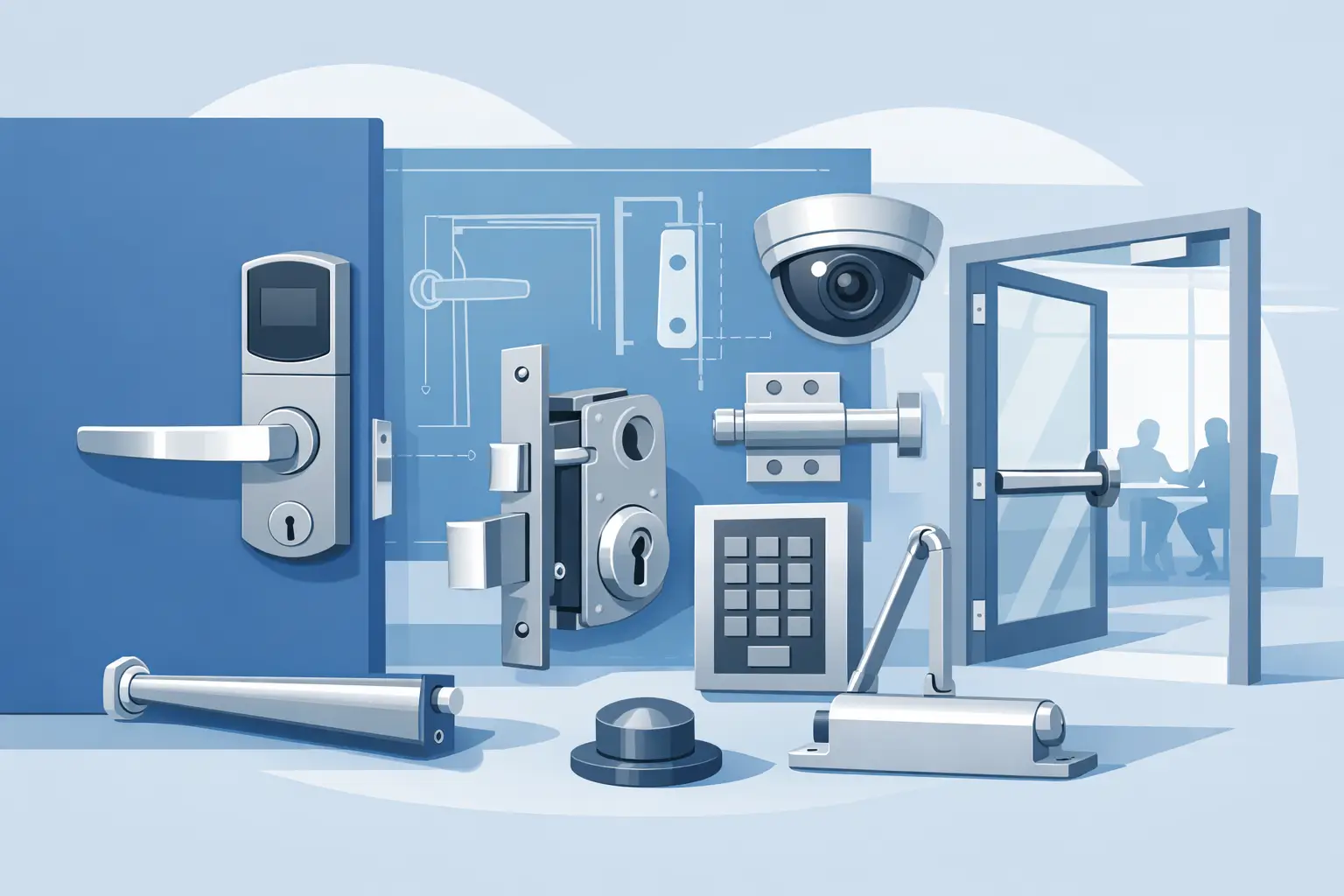
A door that gets used 300 times a day cannot be treated like a door that opens twice before lunch. That is where a commercial door hardware guide becomes useful – not as a catalog of parts, but as a way to match hardware to traffic, code, security, and day-to-day operation.
For installers, property managers, and facility teams, the real issue is rarely one piece of hardware in isolation. It is how the lock, closer, exit device, hinge, credential method, and frame condition work together. A strong opening is a system. If one component is undersized, incompatible, or poorly selected for the environment, the entire opening becomes a service call waiting to happen.
What a commercial door hardware guide should help you solve
Most buying mistakes happen when hardware is selected by appearance or price before the application is defined. A school corridor, apartment entry, medical office, retail back room, and warehouse side door may all use commercial doors, but the hardware requirements are very different.
Start with four questions. How many cycles will the opening see each day? Does the door need free egress at all times? Will it remain mechanically keyed, move to electronic access, or need both? And what code requirements apply to the occupancy and path of egress? Those answers narrow the field quickly.
A narrow aluminum storefront door, for example, limits your hardware options compared with a hollow metal door in a steel frame. A stairwell opening may require fire-rated hardware and positive latching. A front office entrance may prioritize controlled access, door position awareness, and visitor management. The right hardware package depends on the opening, not just the building.
Core hardware categories in a commercial door hardware guide
The lockset usually gets the most attention, but it should not be chosen first. Begin with the function of the opening and then build the hardware set around it.
Locks and latching hardware
Cylindrical locks are common for light to medium commercial use, while mortise locks are typically chosen when durability, trim options, and function flexibility matter more. Interconnected locks can support single-motion egress where needed. For higher-use openings, the extra upfront cost of better-grade hardware usually pays for itself in lower maintenance and fewer replacements.
Electric strikes, magnetic locks, electrified locksets, and electrified panic devices add another layer. They can support buzz-in entry, credentialed access, scheduled unlocks, and remote control. But they also require the opening to be evaluated as a complete electronic access point, including power transfer, request-to-exit, door status monitoring, and life-safety compliance.
Exit devices and panic hardware
If the opening is part of an egress path and occupancy requires panic hardware, there is little room for improvisation. Rim exit devices are common and practical. Vertical rod devices may be needed on pairs or where top and bottom latching are required, although they can be more maintenance-sensitive in high-abuse locations.
Electrified panic devices make sense when you need controlled entry from the exterior while maintaining safe, code-compliant exit from the interior. They cost more and require better planning, but they often solve the access-versus-egress problem cleanly.
Door closers and control components
A good closer is not optional on many commercial openings. It protects the door, maintains latch performance, supports fire-door operation where applicable, and reduces wear on locks and hinges. The challenge is matching the closer to the door size, weight, wind exposure, and traffic pattern.
An interior office door may perform well with a standard surface closer. A vestibule or exterior side entrance often needs more control due to stack pressure or wind load. In some locations, adding a stop, coordinator, or overhead holder is just as important as the closer itself.
Hinges, pivots, and door support
Heavy doors, high-cycle doors, and doors with closers put constant stress on support hardware. Standard hinges may be fine for low-demand openings, but high-traffic or overweight conditions often justify heavy-duty ball-bearing hinges, continuous hinges, or pivots.
Sagging doors, latch misalignment, and frame wear are often blamed on the lock, when the actual problem is inadequate door support. This is one of the most common field issues on retrofits.
Matching hardware to the opening type
A useful commercial door hardware guide has to account for opening construction. Hardware that performs well on hollow metal may not translate directly to glass aluminum storefront, wood doors, or gate applications.
Storefront doors often need narrow stile hardware, compatible deadlatches or hook bolts, and access control devices sized for limited rail space. Hollow metal doors allow broader lock and closer options and are typically more forgiving in high-security retrofits. Wood doors may require attention to reinforcement, fire labels, and hardware prep. Gates introduce weather, vibration, and alignment issues that change hardware selection entirely.
Retrofit work adds another variable. Existing preps, frame depth, strike locations, and wire paths can either save labor or create constraints. In older buildings, the smartest hardware choice is often the one that fits the opening with the least compromise while still meeting security and code requirements.
Mechanical versus electronic hardware
Not every opening needs electrified hardware. In fact, many sites work best with a mixed approach.
Purely mechanical hardware still makes sense for storage rooms, utility spaces, low-traffic service doors, and budget-sensitive projects where audit trails and scheduled access are unnecessary. It is simpler to service, easier to stock, and less dependent on power and wiring conditions.
Electronic hardware becomes more valuable when multiple users need managed access, when credentials change often, or when the site wants to reduce key control problems. Apartment common doors, school entries, office suites, and industrial employee entrances often benefit from card, keypad, or intercom-linked release systems.
The trade-off is straightforward. Electronic openings can improve control and reduce rekeying, but they require planning around power supplies, fail safe versus fail secure behavior, fire alarm interface, and long-term serviceability. If the site lacks stable infrastructure or maintenance support, a simpler hardware package may perform better over time.
Code, life safety, and rating considerations
Commercial hardware decisions should never ignore code. Egress requirements, ADA considerations, fire-door listings, and local authority interpretation all affect what can be installed.
A common mistake is focusing on access control first and egress second. That order should be reversed. People must be able to exit safely and legally under normal and emergency conditions. Once that path is clear, controlled entry can be layered onto the opening.
Fire-rated openings need compatible listed hardware, proper latching, and closing action. Delayed egress, maglocks, and special locking arrangements may be allowed in some occupancies but not in others, or only with additional release and monitoring requirements. If the opening serves a school, multifamily property, healthcare environment, or assembly space, the details matter.
Serviceability matters more than specs on paper
A hardware package can look excellent in a submittal and still create ongoing problems if replacement parts are hard to source or if field adjustment is overly complex. Buyers who manage multiple openings should think about standardization whenever possible.
Using hardware families that your maintenance team or installer already knows can shorten service time and reduce stocking headaches. It also helps when you need matching trims, cylinders, strikes, arms, or electrified components later. The best choice is not always the most feature-heavy item. It is often the one that fits the application, can be supported locally, and will still be practical to service years from now.
That is one reason experienced distributors matter. A supplier like UnikCCTV can help identify compatibility issues before the order is placed, especially when a project involves access control, intercom integration, replacement parts, or unusual opening conditions.
How to use this commercial door hardware guide on real projects
When reviewing a door, document the opening before selecting hardware. Note door material, size, handing, frame type, fire label, traffic level, locking function, and whether the site wants mechanical keying, keypad access, card access, or intercom release. Then confirm code and egress requirements. Only after that should you choose the lock, closer, exit device, and supporting components.
If the opening already has alignment issues, resolve those first. New hardware will not fix a twisted frame, failing hinge reinforcement, or a door that does not latch correctly. On electronic openings, plan the full path – credential, controller, locking device, power, release, monitoring, and user behavior.
The goal is not to buy more hardware. It is to build an opening that works every day with fewer callbacks, fewer compromises, and fewer surprises once people start using it. That is the standard commercial buyers should expect, and it is usually achieved before the box ever gets opened.



 No products in the cart.