
Most property owners only think about driveway security after something goes wrong. A package is stolen, a vehicle is scratched in the night, or an unwanted visitor gets too close to the front door before anyone inside notices. A driveway alarm system solves exactly this problem. It gives you advance warning before anyone reaches your door, your garage, or your gate. But the market is packed with options that range from simple magnetic sensors to solar-powered passive infrared (PIR) systems with half-mile transmission ranges. Choosing wrong means constant false alerts, dead batteries, or a sensor that stops working the first time it rains. This guide walks you through every factor that actually matters.
Table of Contents
- Quick Takeaways
- What Is a Driveway Alarm System and How Does It Work
- Types of Driveway Alert Sensors
- Key Buying Factors for a Wireless Driveway Bell or Wired Setup
- Comparison of Driveway Alarm Approaches
- Installation and Placement: Where Most People Get It Wrong
- Integrating a Driveway Alarm with Gate and Access Control Systems
- Frequently Asked Questions
- References
Quick Takeaways
| Key Insight | Explanation |
|---|---|
| PIR sensors reduce false alarms better than magnetic probes | Passive infrared sensors detect heat signatures, filtering out wind-blown debris and small animals more reliably than basic magnetic or pressure-based systems. |
| Transmission range is not detection range | A sensor may detect movement at 30 feet but transmit its alert up to half a mile to the indoor receiver. Confusing these two specs is the most common buying mistake. |
| Solar-powered units eliminate battery anxiety | Solar driveway alarms with a built-in rechargeable battery handle overcast days and still stay operational, making them a strong choice for high-exposure outdoor positions. |
| Adjustable sensitivity is not optional for busy driveways | Without sensitivity adjustment, a system placed near a road will trigger constantly from passing traffic or neighborhood pets. |
| Expandability future-proofs your investment | Systems that accept additional sensors let you add coverage to a side gate, back path, or secondary entrance without buying a second system. |
| A driveway alarm is only as useful as where you hear it | The indoor receiver volume, wireless range through walls, and ability to add plug-in range extenders all determine whether alerts actually reach you in time. |
| Integration with gate access and CCTV multiplies security value | A standalone driveway alert sensor tells you someone is there. Pairing it with a camera or intercom tells you who it is and lets you respond before they reach the door. |
What Is a Driveway Alarm System and How Does It Work
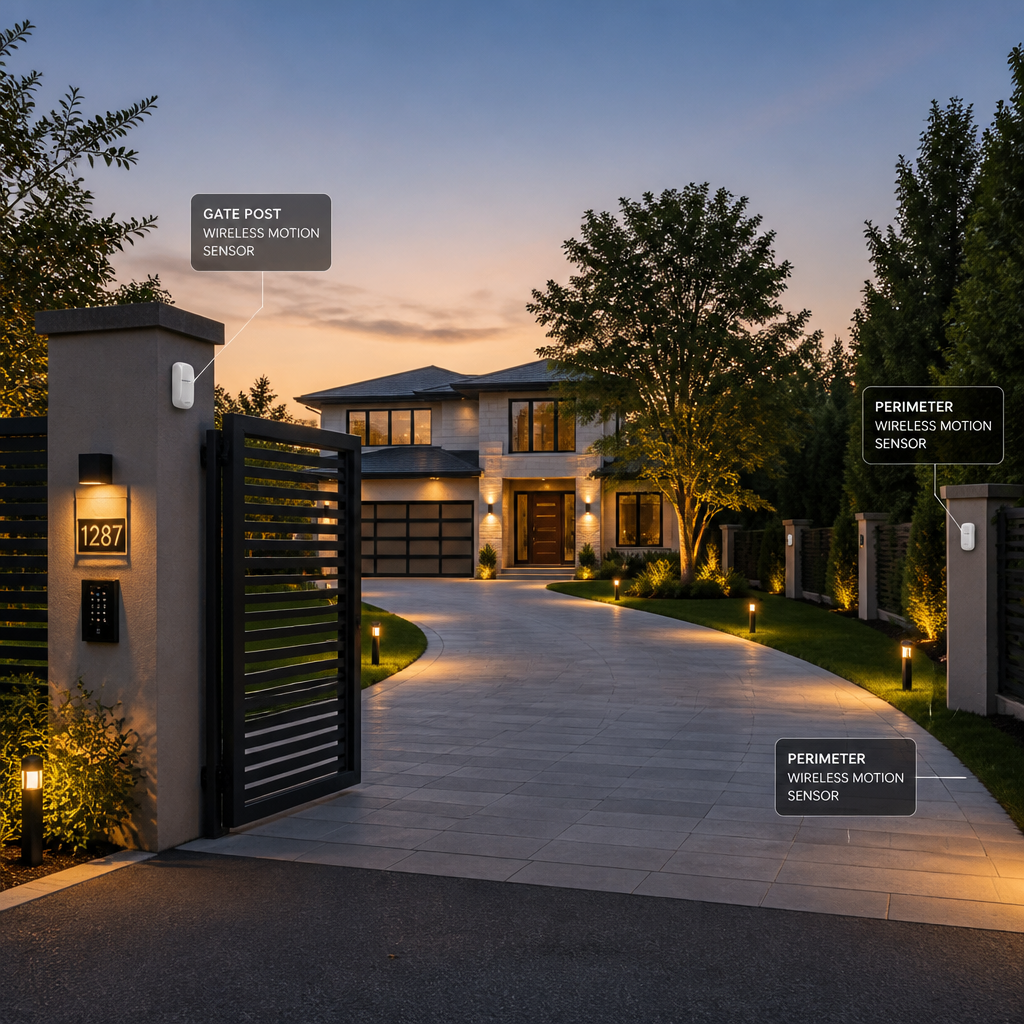
A driveway alarm system is a two-part device. One component, the sensor, sits outside and monitors a defined zone, typically the entrance to your driveway, a gate, or a footpath. The second component, the receiver, stays inside and produces an audible or visual alert the moment the sensor is triggered. In wireless systems, these two parts communicate via radio frequency. In wired systems, a cable runs between them.
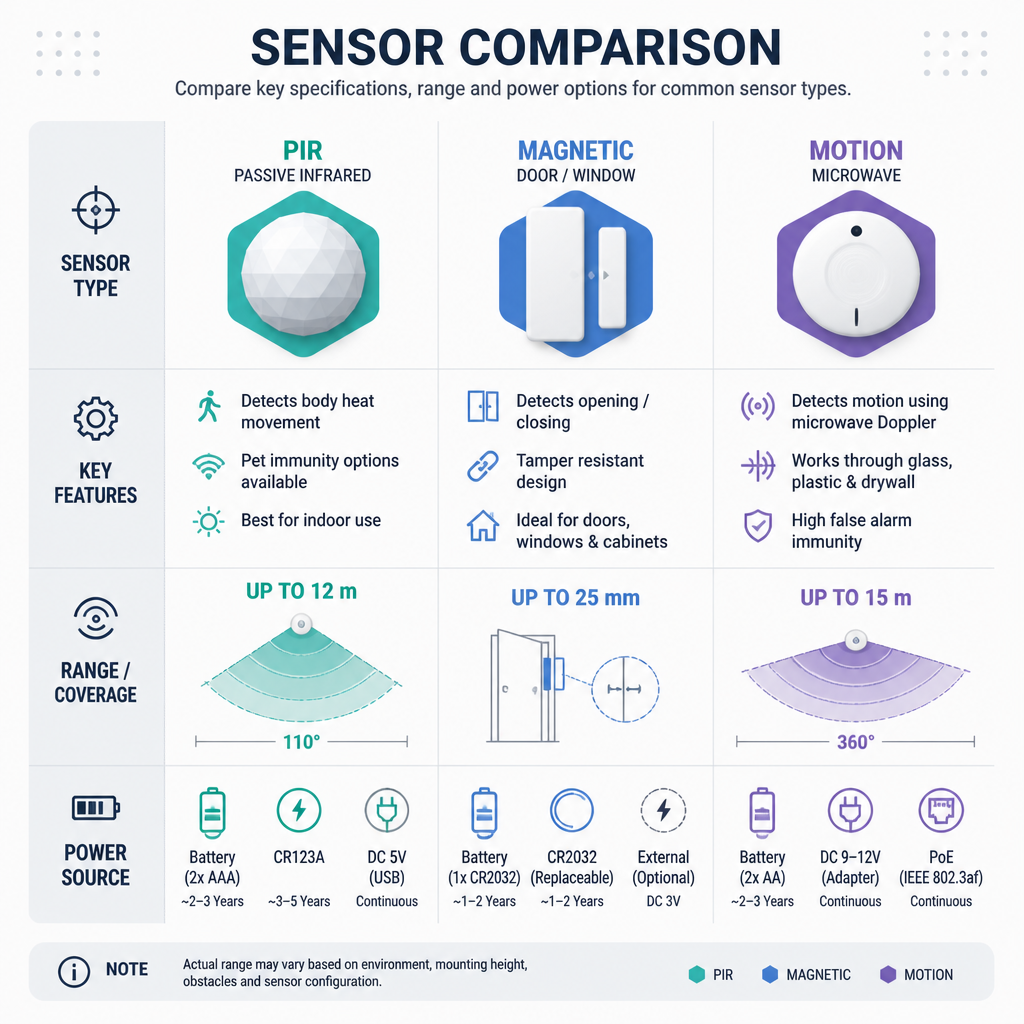
The sensor detects activity using one of several methods: passive infrared (heat and motion), magnetic induction (metal vehicles), rubber hose pressure, or a simple beam break. When the detection threshold is crossed, a signal fires to the receiver, which then sounds a chime, buzzer, or alarm tone. Some receivers can also push notifications to a smartphone app if the system supports Wi-Fi or cellular connectivity.
This early-warning function is what separates a driveway alarm from a standard doorbell. A visitor triggers the alarm the moment they enter your property, not when they have already walked up to your door. For property managers overseeing large sites, homeowners with long driveways, or business operators monitoring a delivery entrance, that extra time is the entire point.
Types of Driveway Alert Sensors
The sensor technology you choose determines what the system reliably detects, and what it ignores. Getting this wrong generates so many false alarms that people end up switching the system off entirely.
Passive Infrared (PIR) Sensors
PIR sensors are the most widely used type for residential and light commercial driveway alarm applications. They detect changes in heat radiation, which means they respond to warm-bodied objects: people, vehicles with warm engines, and large animals. The detection range for quality PIR units typically runs from around 16 feet up to 50 feet. Models like the eMACROS solar wireless system, which has been independently tested by multiple reviewers, demonstrate that well-designed PIR units can match their advertised range under real-world conditions, including properties with trees and shrubbery.
The key advantage of PIR is adjustable sensitivity. You can tune the sensor to ignore a cat crossing the driveway while still catching a person or a vehicle. For a property facing a busy street, this tuning capability is not a nice-to-have, it is essential.
Magnetic Vehicle Sensors
Magnetic sensors are buried beneath the driveway surface and detect the ferrous metal mass of a vehicle passing over them. They produce virtually zero false alarms from pedestrians or animals. The trade-off is that they only detect vehicles, which makes them unsuitable as a general intruder alert. They also require digging, which adds installation cost and makes them impractical for renters or anyone who does not own the ground they are modifying.
Rubber Hose and Pressure Sensors
A rubber pneumatic hose is stretched across the driveway. When a vehicle wheel rolls over it, air pressure triggers a contact switch. These are common in parking lots and commercial settings where vehicle counting matters. For home or small-business use, they are overkill, and they can be damaged by foot traffic, bicycles, or repeated exposure to sharp edges on the road surface.
Beam-Break Sensors
An infrared transmitter sends a beam to a receiver across the driveway entrance. When the beam is interrupted, the alarm fires. Beam-break systems are highly accurate and do not produce heat-based false alarms. The downside is that they require two units to be installed facing each other, which complicates placement on wide or irregular entrances.
Key Buying Factors for a Wireless Driveway Bell or Wired Setup
Most buyers focus on the wrong specifications. Detection range gets all the attention, but it is only one of five factors that determine whether a system performs reliably over months and years.
Transmission Range vs. Detection Range
Detection range is how far the sensor can reliably sense movement. Transmission range is how far the wireless signal travels from the sensor to the receiver inside your home or building. A sensor with a 30-foot detection range and a half-mile transmission range means it detects a person 30 feet away and sends that alert reliably to a receiver up to half a mile away through walls and floors. These two numbers are not interchangeable, and product listings that blur them are common. Always check both figures separately.
Power Source: Battery, Solar, or Hard-Wired
Battery-powered sensors are easy to install anywhere, but they require periodic battery replacement. In a system mounted at the end of a long driveway, forgetting to check the battery is a real operational risk.
Solar-powered sensors with a built-in rechargeable lithium-ion battery, such as several models reviewed by Bob Vila and NerdTechy, solve this problem. They charge in sunlight and fall back on the stored charge during cloudy periods. The practical result is a system that operates for extended periods without any maintenance intervention.
Hard-wired sensors offer the most reliable power but require running cable from the sensor to a power source, which increases installation complexity and cost.
Weather Resistance Rating
Any sensor mounted outdoors must carry a proper IP weatherproofing rating. In practice, a sensor without a confirmed waterproof rating will start failing within a single rainy season. Look for explicitly waterproof construction, not just “weather resistant,” especially if the sensor will be exposed rather than mounted under an overhang.
Expandability
A system that supports multiple sensors allows you to cover a secondary entrance, a side gate, or a footpath with the same receiver. Systems like the eMACROS support adding sensors beyond the base unit. If you start with one entry point and anticipate adding coverage later, buying an expandable system from the start is significantly cheaper than buying a second standalone system.
Alert Type and Volume Control
The receiver needs to be loud enough to hear from anywhere inside your property. Many quality receivers include volume adjustment. For commercial or multi-floor buildings, look for receivers that accept additional plug-in range extenders or that connect to existing intercom or PA infrastructure.
A driveway alarm that triggers when the threat has already arrived is not an early-warning system. Placement and transmission range, not just sensor sensitivity, determine whether the alert gives you time to respond.
Pro tip: If your indoor receiver is more than one or two walls away from where you spend most of your time, test the signal strength before finalizing installation. Concrete walls and metal roofing attenuate radio frequency signals significantly more than wood-frame construction.
Comparison of Driveway Alarm Approaches
The table below compares the three most practical driveway alarm configurations for homes, small businesses, and managed properties. It is not an exhaustive product comparison, but a practical breakdown of what each approach delivers and where it falls short.
| Approach | Best For | Key Limitation |
|---|---|---|
| Wireless PIR Solar Sensor (e.g., eMACROS-style systems) | Homeowners and small business owners who want easy DIY installation, long transmission range, and minimal maintenance. Works well for driveways up to half a mile from the receiver. | Bulkier sensor housing than beam-break units. PIR can still trigger on large animals if sensitivity is not calibrated. Requires direct sun exposure for reliable solar charging. |
| Buried Magnetic Vehicle Sensor | Commercial lots, gated communities, or any property where only vehicle detection is needed and foot-traffic false alarms must be eliminated entirely. | Installation requires ground excavation. Does not detect pedestrians. Not suitable for renters or temporary setups. Higher installation cost. |
| Integrated Driveway Alert + Gate Access Control System | Property managers and facility operators who need both early warning and the ability to verify and control who enters. Pairs a driveway sensor with an intercom, smart lock, or gate controller. | Higher upfront cost and more complex installation. Requires compatible equipment from a coordinated product ecosystem or professional integration. |
Installation and Placement: Where Most People Get It Wrong
The most capable sensor on the market will underperform if it is mounted in the wrong position. This is where the majority of failed driveway alarm installations originate. Not a faulty product, but a poor placement decision made during a five-minute install.
Height and Angle of the Sensor
PIR sensors have a detection cone that spreads horizontally and vertically from the sensor face. Mounting the sensor too high narrows the ground-level coverage and allows a person to walk beneath the detection zone. Mounting it too low increases ground-reflection false alarms from heat radiating off pavement. A mounting height of roughly three to four feet, angled slightly downward toward the driveway surface, is the standard starting point for a PIR unit. Adjust from there based on how the specific sensor’s detection cone is specified by the manufacturer.
Distance from the Street
If the sensor is placed right at your property line and faces a public road, you will receive alerts from every passing car and pedestrian. Set the sensor back from the road by enough distance that the detection zone covers your property rather than the street. Adjusting sensitivity down can help, but pulling the sensor back from the road edge is the cleaner solution.
Obstructions and Interference
Wireless driveway alarm sensors communicate on radio frequencies, typically in the 433 MHz or 915 MHz bands. Large metal objects, thick concrete walls, and certain electronic equipment can reduce transmission reliability. Before committing to a permanent mount, do a walk-test with the sensor in position and the receiver at its intended indoor location. Most systems include a test mode for exactly this purpose.
Pro tip: In properties with multiple metal gates or steel-frame structures between the sensor and the receiver, test signal strength at different receiver positions inside the building before drilling any mounting holes. Moving the receiver two rooms closer can often recover a marginal signal without requiring any changes to the sensor placement.
Integrating a Driveway Alarm with Gate and Access Control Systems
A standalone driveway alert sensor tells you that something or someone crossed your driveway threshold. What it does not tell you is who it is, whether they are authorized, or what you should do about it. For homeowners with a simple single driveway, that alert is often enough. For property managers, business operators, or anyone overseeing a multi-tenant or multi-entrance property, that answer is not enough.
Pairing a driveway alarm with a gate access control system changes the security model entirely. The driveway sensor triggers the early warning. The gate controller, intercom, or keypad then handles identity verification and access decision. A visitor approaches, the driveway alarm alerts the operator, the operator checks the intercom camera feed, and either grants or denies access remotely. That sequence is far more useful than a chime alone.
What Integration Looks Like in Practice
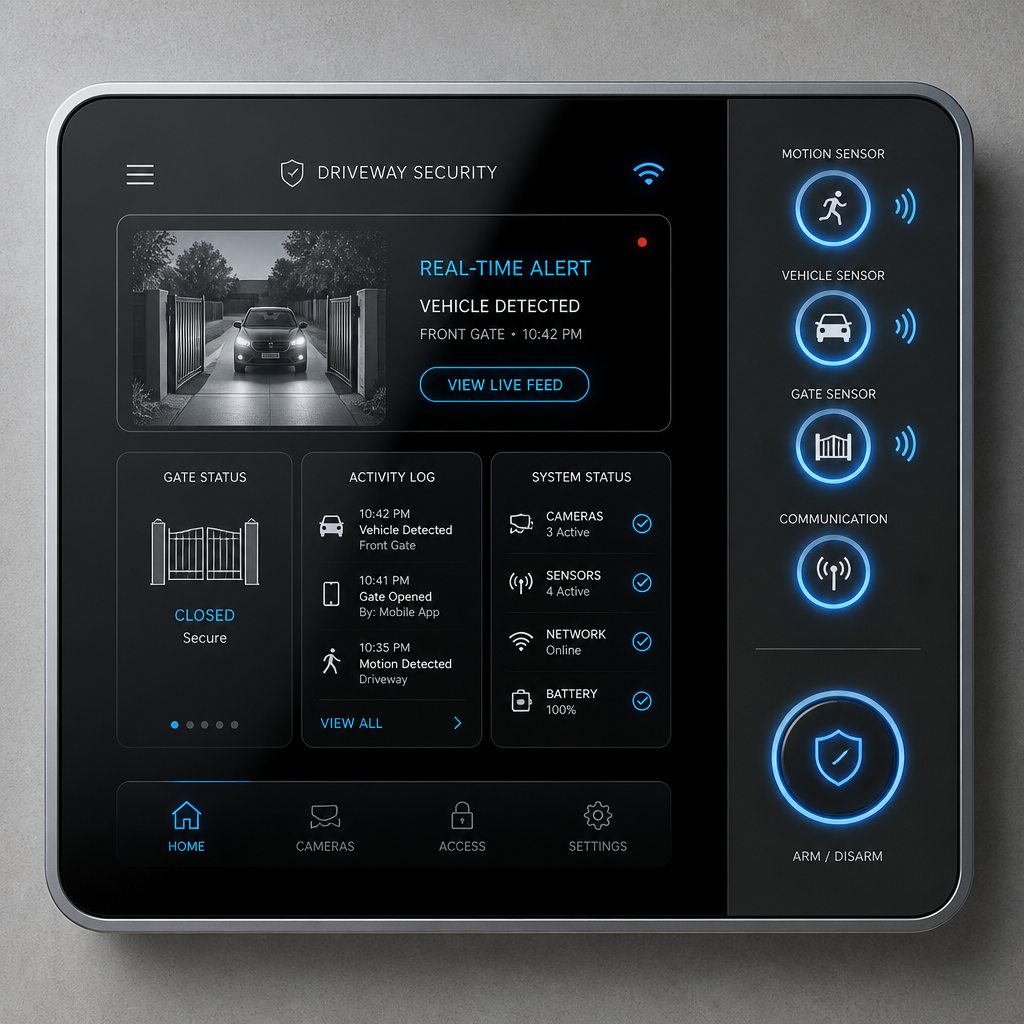
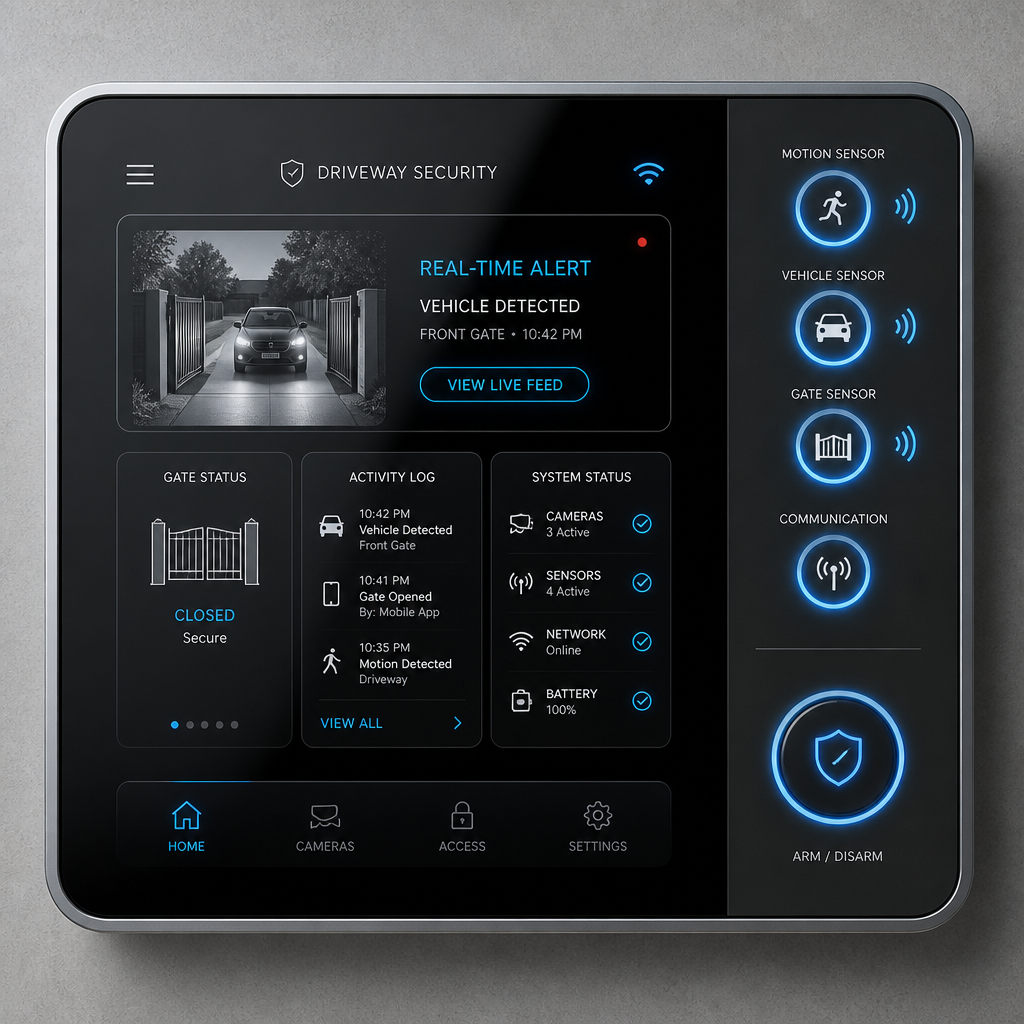
At the simplest level, integration means positioning a CCTV camera to cover the same zone as the driveway sensor. When the alarm fires, you already have a live feed to check. At a more sophisticated level, systems can connect a driveway sensor to a smart intercom or a gate controller with remote open capability, so the entire visitor management sequence happens from a single interface, often a smartphone or a wall-mounted control panel.
UnikCCTV’s product range, which covers wireless intercoms, gate access controllers, CCTV systems, and smart locks, is specifically designed to serve this kind of layered security architecture. Rather than buying a driveway alarm from a general retailer and hoping it works alongside a separate intercom from another brand, sourcing from a specialist provider means the components are designed to work together. That matters more than most buyers realize until they are troubleshooting a compatibility issue at 11pm.
Biometric and Facial Recognition at the Driveway Perimeter
For higher-security applications, the driveway alarm can serve as the outer trigger for a biometric access system. The alarm notifies a guard station or control room of an approach. The biometric reader at the gate then handles identity verification. This two-stage model is common in commercial facilities, gated communities, and any property where access logs matter for compliance or liability purposes. UnikCCTV’s access control systems include biometric and facial recognition options that fit into exactly this kind of layered setup.
Frequently Asked Questions
What is the difference between a driveway alarm system and a motion sensor light?
A motion sensor light activates a visual deterrent when it detects movement, but it does not alert anyone inside the building. A driveway alarm system sends an active notification to a receiver inside your home or building, giving you time to respond before the visitor or intruder reaches your door. The two serve different purposes and work well together, but they are not substitutes for each other.
Can a wireless driveway bell work through thick concrete walls?
It depends on the radio frequency the system uses and the thickness and density of the concrete. In practice, most 433 MHz wireless systems experience meaningful signal degradation through reinforced concrete walls. The solution is either to position the receiver closer to an exterior wall, add a plug-in signal repeater if the system supports one, or choose a system that operates on a frequency better suited to your building’s construction. Always test before permanently mounting the receiver.
How do I stop my driveway alert sensor from triggering false alarms?
Start by reducing sensitivity on the sensor itself, most quality PIR units include a sensitivity dial or switch. Then review the sensor’s aim: if it is pointed even slightly toward a road or a neighbor’s yard, passing vehicles and people will trigger it. Pulling the sensor back from the property edge and angling it more toward the driveway surface resolves the majority of false alarm complaints. For properties with large wildlife, some units allow you to set a minimum trigger size that filters out animals below a certain heat mass.
Do driveway alarm systems work at night?
Yes. PIR sensors detect heat signatures, not visible light, so they perform the same at night as during the day. In fact, nighttime is often when PIR detection is most reliable because the contrast between ambient temperature and a warm human or vehicle body is greater than during a hot afternoon. The indoor receiver chime or alert functions regardless of time of day.
Should I choose a solar-powered driveway alarm or a battery-powered one?
For any sensor that will be mounted in a location with reasonable sun exposure, solar-powered is the better long-term choice. A solar unit with an onboard rechargeable battery handles overcast periods and eliminates the operational risk of a dead battery disabling your sensor without you noticing. Battery-only units are better suited for shaded locations, indoor mounting positions, or situations where you want an extremely compact sensor housing. If the sensor will be in full shade year-round, hard-wired power is the most reliable option.
Can a driveway alarm system be integrated with an existing CCTV or intercom setup?
Yes, though the level of integration depends on the specific products involved. At minimum, positioning a CCTV camera to cover the same detection zone as the driveway sensor gives you a visual feed to check whenever the alarm fires. At a deeper level, some systems can trigger a camera to begin recording automatically when the sensor activates. Sourcing your driveway alarm and your intercom or CCTV equipment from the same specialist provider, rather than mixing brands from general retailers, gives you a far higher chance of meaningful integration without custom wiring or workarounds.
Have you installed a driveway alarm system at your property? Share what worked, what did not, and what you wish you had known before buying in the comments below.


 No products in the cart.