
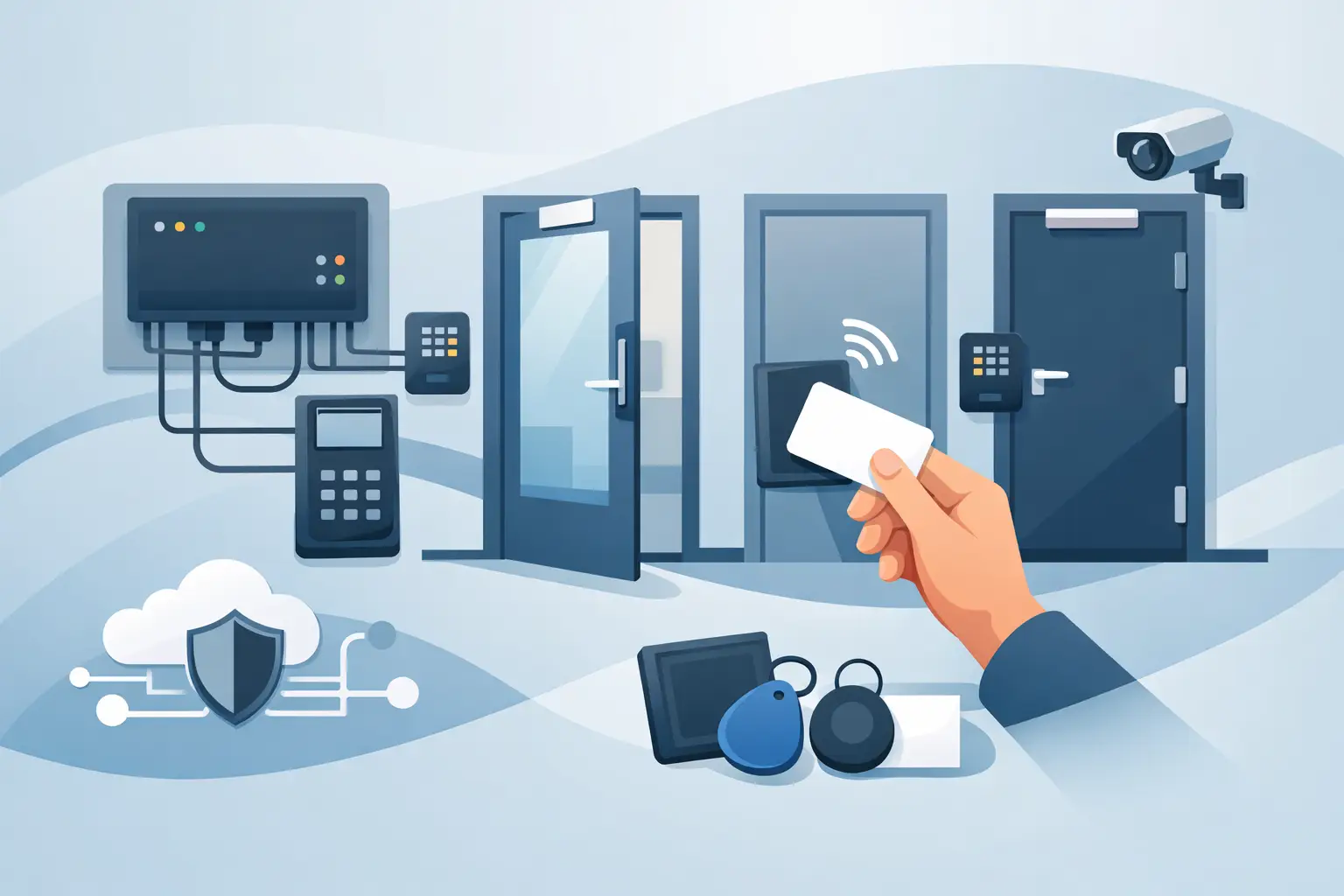
When one secured opening turns into four, eight, or twelve, the buying process changes fast. A multi door access control kit is not just a bigger version of a single-door setup. It has to coordinate readers, locks, credentials, power, wiring paths, and software logic across a property that may have very different traffic patterns from one entrance to the next.
For installers and property decision-makers, that usually means the real question is not which kit looks complete on paper. It is which system fits the site, the lock hardware already in place, and the way people actually move through the building every day.
What a multi door access control kit should actually include
A proper multi door access control kit starts with the control panel or network of controllers that manages multiple openings from one platform. Beyond that, the core package often includes card readers or keypad readers, request-to-exit devices, power supply equipment, credentials, and software for user management and event tracking. Some kits also include electric strikes or maglocks, while others leave lock hardware open because door construction and life safety requirements vary too much from site to site.
That last point matters. Many access control problems start when buyers expect one lock type to work everywhere. A storefront aluminum door, a hollow metal fire-rated door, and a perimeter gate may all be on the same system, but they rarely use the same field hardware. A kit can unify control, but the door hardware still has to match each opening.
The best approach is to treat the kit as the system backbone, then confirm each door condition individually. That is especially true in mixed-use properties, schools, apartment buildings, and industrial sites where interior and exterior openings serve different functions.
Where a multi door access control kit makes the most sense
The value of a multi door access control kit shows up when a property needs centralized control instead of stand-alone devices scattered across the building. Offices use it to manage employee entry, server rooms, and storage areas. Schools use it to separate public access points from staff-only corridors and administrative spaces. Apartment and mixed-use buildings often use it across lobby doors, amenity spaces, side entrances, and management areas.
Commercial sites also benefit when turnover is frequent. Re-keying multiple openings every time a staff member leaves is expensive and disruptive. With a managed access system, credentials can be added or removed in software, and schedules can be adjusted without changing physical locks at every door.
That said, not every site needs a large integrated platform. A small owner-occupied building with only two controlled openings may be better served by a simpler controller and reader package than by a feature-heavy enterprise system. Bigger is not automatically better. The right fit depends on door count, credential volume, reporting needs, and expected growth.
Start with the doors, not the software
Buyers often focus first on mobile credentials, cloud management, or reporting dashboards. Those features matter, but the door itself still determines what will work reliably. Before selecting a kit, it is worth confirming door material, frame condition, fire-rating requirements, exit hardware, and whether the opening is fail-safe or fail-secure.
A maglock may be practical on one opening and completely wrong on another. An electric strike may work well where there is compatible latch hardware but add unnecessary labor where the frame condition is poor. Some doors already have panic hardware that needs electrified trim or a different release method. If those conditions are ignored early, the project can turn into a change-order problem later.
This is one reason experienced buyers prefer distributor support over generic bundled products. The kit may look straightforward, but compatibility at the opening decides whether installation stays on budget.
Power, wiring, and expansion are where projects often succeed or fail
On a multi-door system, power planning is not a minor detail. Locks, readers, controllers, and request-to-exit devices all have current requirements, and those requirements can change depending on distance, cable gauge, and lock type. If multiple devices are sharing power without proper calculation, intermittent failures are almost guaranteed.
Centralized power supplies can make service easier, but they also require thoughtful cable runs and enclosure planning. Distributed power near remote doors may reduce voltage drop, though it can add equipment locations to manage. There is no universal answer. The cleaner choice depends on building layout and service expectations.
Expansion matters too. A four-door installation today may become eight doors after a tenant improvement or facility remodel. If the selected platform tops out too quickly, the customer may end up replacing major components earlier than expected. On the other hand, specifying a much larger system than the site will ever need can add cost without improving operation.
A good multi-door plan leaves room for reasonable growth while staying proportional to the job.
Credentials, readers, and user management
Reader choice affects both convenience and security. Some properties still run basic cards or fobs because they are inexpensive and familiar for staff. Others want keypad plus card authentication for sensitive areas. In some environments, mobile credential support may reduce replacement costs and simplify user onboarding.
The practical issue is not which credential sounds newest. It is whether the reader technology matches the security level, user behavior, and replacement cycle of the site. For a warehouse with shift changes and moderate traffic, durable fobs may be perfectly suitable. For administrative areas with audit concerns, stronger credential formats and tighter user permissions may be a better fit.
Software should also be judged by how the customer will actually use it. A facilities manager may need quick badge changes and door schedules, not a deep enterprise feature set that no one on site will maintain. A school administrator may care more about lockdown capability and time-zone control than advanced visitor analytics. Operational fit matters more than feature count.
Multi-site and mixed-use properties need a different mindset
Some installations are not just multi-door. They are multi-tenant, multi-building, or mixed-use. That changes system design. Shared entrances may need one credential policy while private suites or restricted utility rooms need another. A property manager may need oversight across all openings, while individual occupants should only control their own areas.
This is where permissions architecture becomes just as important as hardware. The system should support clear partitioning without creating administrative confusion. If every user, door, and schedule is handled in an improvised way, routine management becomes difficult long after the installation is complete.
For these projects, planning ahead on user groups, access levels, and reporting rights saves time later. It also helps avoid one of the most common service calls: the system works, but no one is sure who should have access to what.
What to ask before you buy
A few questions can narrow the field quickly. How many doors need to be controlled now, and how many may be added later? Are the doors interior, exterior, gated, or fire-rated? Is there existing lock hardware that should be reused? Does the site need cloud management, local software, or a hybrid approach? Who will administer users after installation?
It is also worth asking how the kit handles outages. Battery backup, lock behavior during power loss, and emergency egress requirements should be clear before parts are ordered. This is especially important in schools, apartments, and commercial properties where code compliance and life safety are not negotiable.
Support should be part of the buying decision as well. Professional-grade access control is not a consumer gadget category. Installers and site managers often need help matching readers, boards, power supplies, credentials, and door hardware. That is where a specialized supplier with application experience can save real time. For buyers who need a practical path instead of trial and error, that support matters as much as the equipment itself.
Buying for reliability, not just for price
The cheapest kit is often the most expensive one to service. Poor enclosure layout, undersized power, weak software support, or mismatched lock hardware can create recurring labor costs that erase any upfront savings. A reliable system does not need to be overbuilt, but it does need to be correctly matched to the property.
That is why many professionals evaluate a multi door access control kit based on total deployment value. Can it be installed cleanly? Can it scale without replacing the core? Can the end user manage it without constant intervention? Are replacement parts and compatible accessories readily available? Those are the questions that usually separate a workable system from a problem account.
If you are planning a multi-door project, take the time to match the kit to the building, the doors, and the people who will use it every day. The right system should make control simpler for years, not just easier to quote this week.


 No products in the cart.