
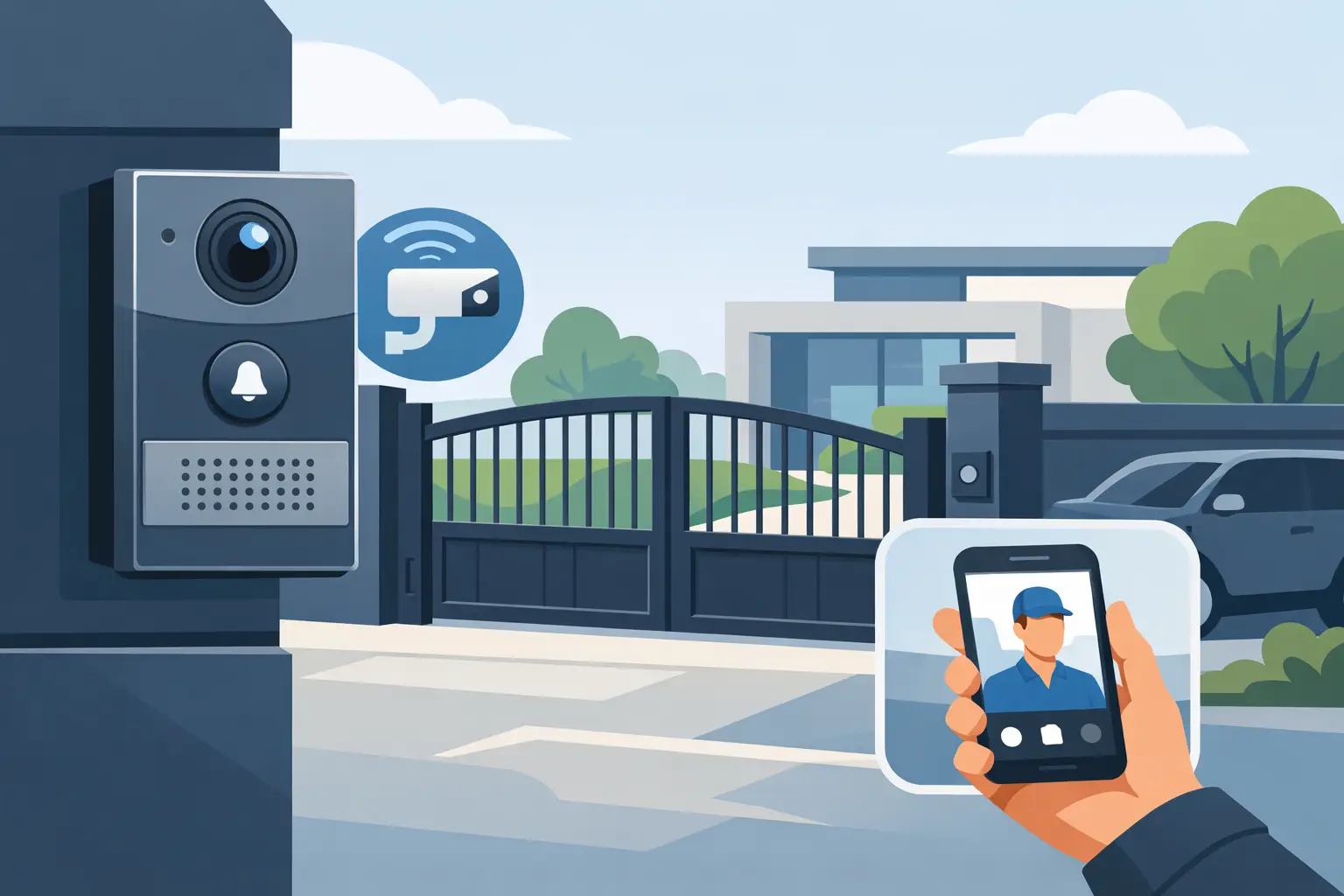
A gate that stays closed is only useful if the right people can get through it without delay. That is where a gate intercom system with camera earns its place. It does more than announce a visitor. It gives staff, tenants, residents, or security personnel a way to verify who is at the entrance, speak with them clearly, and trigger access from a safe location.
For most buyers, the challenge is not whether to add video at the gate. The real question is which type of system fits the property, the traffic pattern, and the access hardware already in place. A single-family driveway, a multi-tenant apartment entry, and an industrial vehicle gate may all need a gate intercom, but they do not need the same equipment.
What a gate intercom system with camera actually needs to do
The most effective systems are built around the site, not around a feature list. At minimum, the system has to capture a usable image of visitors, provide reliable two-way communication, and work with the gate release method. That may be a magnetic lock, electric strike, automatic gate operator, telephone entry controller, or a broader access-control platform.
Video quality matters, but so does placement. A high-resolution camera mounted at the wrong height can still give a poor view of a driver behind tinted glass or a visitor standing outside the call station frame. Audio is similar. If the gate sits near traffic, mechanical equipment, or wind exposure, microphone and speaker performance become just as important as the camera itself.
A practical buying decision also depends on distance. Some gates are close to the building and easy to wire. Others sit hundreds of feet from the main structure. That changes everything from power delivery to signal stability to surge protection.
Wired vs wireless gate intercom system with camera options
This is one of the first decisions that narrows the field. Wired systems are usually the better fit for professional installations because they offer more consistent performance, cleaner integration, and fewer problems over time. They are especially well suited for commercial sites, apartment properties, schools, and any location where uptime matters more than installation speed.
Wireless systems can be useful when trenching is difficult or when the gate location makes cabling expensive. That said, wireless is rarely a universal shortcut. Range claims do not always reflect field conditions. Trees, metal gates, masonry walls, electrical noise, and weather can all affect signal quality. If the site already has unstable connectivity, adding a video intercom to that environment may create more service calls than expected.
For many professional buyers, the choice comes down to this: if the system is mission-critical, wire it whenever practical. If the property has physical limitations and a wireless design is the only realistic path, make sure the signal path has been evaluated before equipment is selected.
Matching the system to the property type
Residential gate applications usually center on convenience and visitor verification. A homeowner may want a single call station, mobile app access, indoor monitor, and the ability to open a pedestrian gate or vehicle gate from inside the house. In that case, ease of use and image clarity are often more important than multi-entry scalability.
Multi-tenant properties have a different set of demands. Apartment buildings, condo communities, and mixed-use sites may need directory functions, call routing, tenant management, and support for many users. The gate station also has to withstand heavier daily traffic and more frequent use. In these settings, durability and user management are not extras. They are core requirements.
Commercial and industrial sites often need tighter integration with access credentials, scheduled entry, and vehicle control. A warehouse gate may need to handle delivery traffic, employee access, and after-hours verification. A school or campus entrance may require remote release from an office, front desk, or security station. These sites usually benefit from systems designed to work alongside existing access control rather than operate as standalone devices.
Camera and audio details that affect daily performance
Spec sheets can make products look similar, but field use exposes the differences quickly. A camera at a gate should handle backlighting, low light, and changing weather conditions. If the gate faces direct sun at certain hours, wide dynamic range can make the difference between identifying a visitor and seeing only silhouette and glare.
Night performance also deserves close attention. Some entrances have enough ambient lighting for full-color imaging, while others depend on infrared or supplemental illumination. The right choice depends on the site. A dark rural gate and a well-lit urban property will not produce the same results.
Audio should be evaluated with the environment in mind. Echo, road noise, gate motor sound, and wind can all interfere with speech. For high-traffic or noisy sites, stronger audio processing and well-designed station hardware are worth the investment. A gate call that has to be repeated three times slows entry and frustrates everyone involved.
Access control integration is where system value increases
A gate intercom system with camera should not be treated as an isolated device if the property already uses electronic access hardware. The best installations connect visitor communication with the actual door or gate control method in a clean, predictable way.
That may involve relay output to a gate operator, tie-in to an electric lock, integration with card or fob access, or coordination with a managed access-control panel. Some buyers also need event history, remote management, or the ability to assign permissions by user type. Those requirements should be identified early, because they affect product compatibility.
This is where many projects go off track. A buyer selects an intercom based on screen features or camera resolution, then discovers it does not interface properly with the operator, lock hardware, or tenant entry method. For installers and property managers, compatibility is not a detail to sort out later. It should shape the system choice from the start.
Installation conditions matter more than many buyers expect
Gate equipment lives in a harsher environment than indoor door stations. Heat, rain, snow, dust, vibration, and exposure to surges all influence reliability. Outdoor-rated housing is the baseline, not a premium feature. The mounting method also needs attention. A poorly positioned pedestal or surface mount can affect camera angle, visitor reach, and long-term durability.
Power planning is another frequent issue. Long cable runs, shared circuits, and voltage drop can all create erratic operation. If the installation includes locks, gate operators, keypads, or multiple devices at the entrance, power should be evaluated as a complete system rather than piece by piece.
For larger or more specialized properties, serviceability should also be part of the discussion. If a station is damaged or a component fails, can it be replaced without redesigning the whole entry point? Professional buyers usually prefer systems with available parts, expansion options, and technical support rather than closed products that become disposable when one part goes down.
What buyers should clarify before purchasing
The fastest way to narrow options is to define the application in plain operational terms. Start with who will use the gate, how many entry points are involved, and where calls need to be answered. Then consider whether the system needs to support mobile answering, indoor monitors, desk stations, or a mix of all three.
Next, confirm the gate hardware and the release method. A swing gate operator, sliding gate operator, maglock, and electric strike do not all interface in the same way. Distance between the gate and the building should also be documented, along with available conduit, power, and network access.
Finally, think about growth. A property that only needs one entrance station today may add another gate, a pedestrian door, or credentialed users later. A system that can scale without starting over is often the better commercial decision, even if the initial installation is modest.
For buyers who want a dependable, install-ready solution, this is where working with a specialized distributor makes a real difference. UnikCCTV serves contractors, property managers, and end users who need help matching intercom equipment to actual site conditions, not just comparing product boxes.
A good gate entry system should make daily access easier, not create another point of failure. If the camera view is clear, the audio is usable, and the release method works the first time, people notice. If any one of those pieces is wrong, they notice that even faster. The right choice is usually the one that fits the site honestly and leaves room for the property to operate without workarounds.
 No products in the cart.