
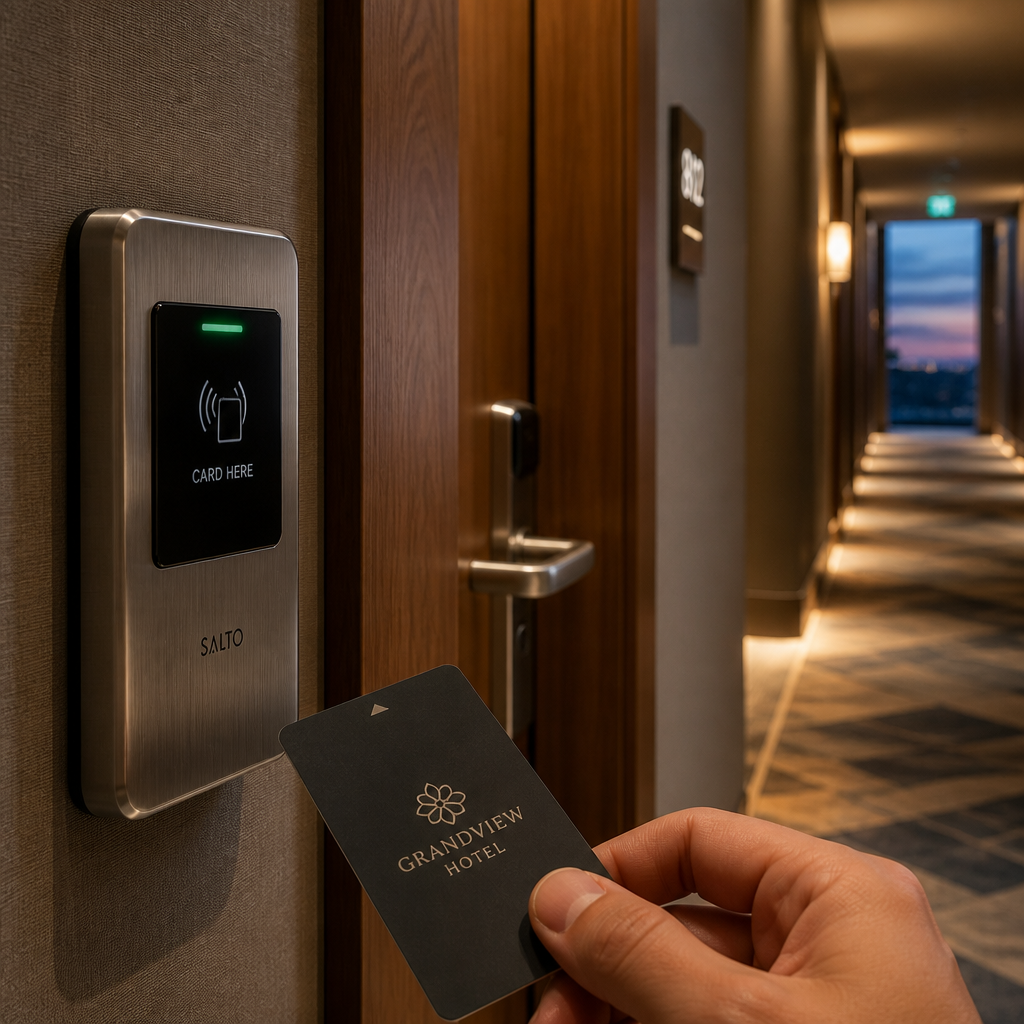
Somewhere in your building right now, a physical metal key is either lost, copied without permission, or sitting in a drawer after an employee left six months ago. That is the problem every property manager and facility operator inherits the moment they rely on traditional locks. A card operated door lock running on RFID technology solves all three of those problems at once, which is exactly why it has remained the dominant access control format across hotels, offices, and multi-tenant buildings for decades. This is not a “latest trend” story. It is an honest look at why RFID access control continues to outperform alternatives for most real-world security deployments, what its actual weaknesses are, and what to look for when selecting a system for your property.
Table of Contents
- How RFID Card Door Locks Actually Work
- Why RFID Dominates Hotel Door Lock Systems
- RFID Access Control for Offices and Commercial Buildings
- RFID Cards vs. Key Fobs vs. Mobile Credentials: Honest Comparison
- The Real Security Risks of RFID Cards and How to Address Them
- Choosing the Right Card Operated Door Lock System
- Frequently Asked Questions
- References
How RFID Card Door Locks Actually Work
An RFID card operated door lock functions through a straightforward radio frequency exchange. The door-mounted reader generates an electromagnetic field. When a card enters that field – typically within a few centimeters – the chip embedded in the card harvests energy from that field, powers up, and transmits its stored credentials back to the reader. The reader then checks those credentials against an authorized list. If there is a match, the lock releases. The whole process takes under a second.
The frequency at which this happens matters significantly. Older proximity cards operate at 125 kHz, a format introduced in the 1990s that carries minimal encryption and is straightforward to clone with inexpensive hardware. The vast majority of modern systems, including most hotel door lock systems installed in the past decade, have migrated to 13.56 MHz high-frequency cards operating under standards such as ISO/IEC 14443A. This frequency supports faster data transmission and more sophisticated authentication protocols, including the MIFARE and MIFARE DESFire chip families from NXP Semiconductors.
No wiring runs between the reader and the lock mechanism in most standalone RFID locks – the lock hardware is self-contained and battery-powered, which makes installation far simpler than wired electric strikes or magnetic locks. That said, networked RFID systems do connect readers to a central controller via wiring or wireless protocols, enabling real-time access log monitoring and remote credential management.
Pro tip: Before specifying any RFID system, confirm which card frequency and chip type the hardware supports. Mixing 125 kHz readers with 13.56 MHz cards – or vice versa – is one of the most common and costly installation mistakes, and the error is not always obvious until commissioning day.
Why RFID Dominates Hotel Door Lock Systems
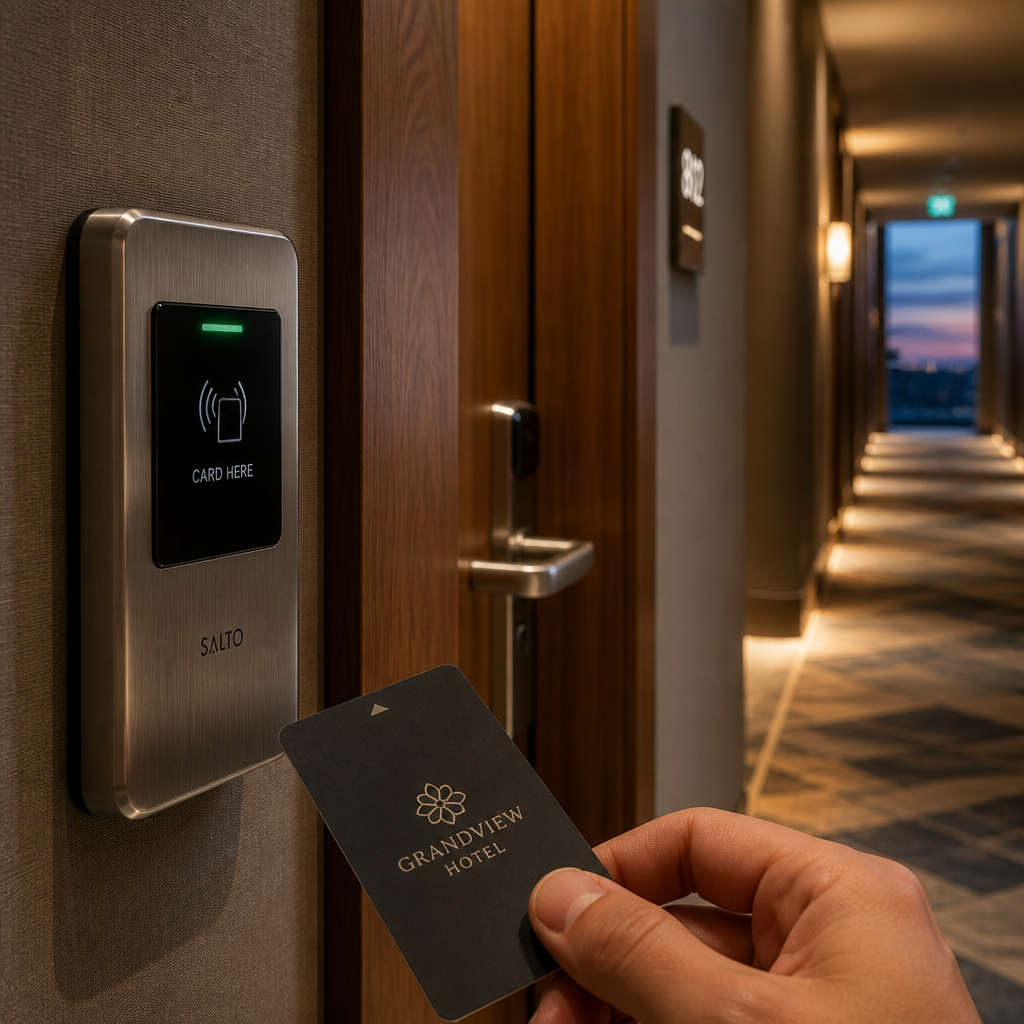
Walk into almost any mid-tier or upper-tier hotel and the room entry method is a contactless RFID card. This was not an accident. The hospitality industry adopted RFID-based hotel door lock systems because they solve a specific operational problem at scale: hundreds of guests checking in and out every day, each needing unique, time-limited access that expires automatically at checkout without staff intervention.
Integration with Property Management Systems
A well-implemented hotel door lock system connects directly to the property management system (PMS). When a reservation is created, the system pre-authorizes a card for that specific room and that specific date range. At check-in, front desk staff encode a fresh card in seconds using a card encoder. That card expires at checkout time. If a guest extends their stay, the card is re-encoded – no locksmith required, no lock cylinder replaced.
Major PMS platforms including Opera, Mews, and Cloudbeds support API integration with most enterprise RFID lock systems. The integration depth varies: some systems only handle credential creation and expiration, while others sync in real time for automated early check-in. The important operational detail is that when this integration works, hotel staff spend zero time on key management. When it does not work, the front desk becomes a permanent fire station.
Access Tiering Across the Property
A guest card should open one room door and nothing else. A housekeeper’s card should open assigned rooms during shift hours only. A maintenance card should access utility areas but not guest floors after hours. RFID hotel systems handle this access tiering natively, with different card profiles mapped to different zones and time windows. This granularity is difficult to achieve with physical keys and essentially impossible to manage at scale without an electronic system.
RFID key cards are also relatively inexpensive to purchase in bulk, and lost cards are deactivated from the management software rather than requiring a physical lock change. That combination of low replacement cost and instant remote deactivation is why hotels show no real inclination to abandon RFID, even as mobile key technology matures.
Pro tip: For hotels managing multiple access zones – pool gates, fitness center doors, parking barriers – ensure the RFID system you select supports multi-door credential assignment from a single card profile. Not all hotel lock vendors support this out of the box, and bolt-on integrations add both cost and failure points.
RFID Access Control for Offices and Commercial Buildings
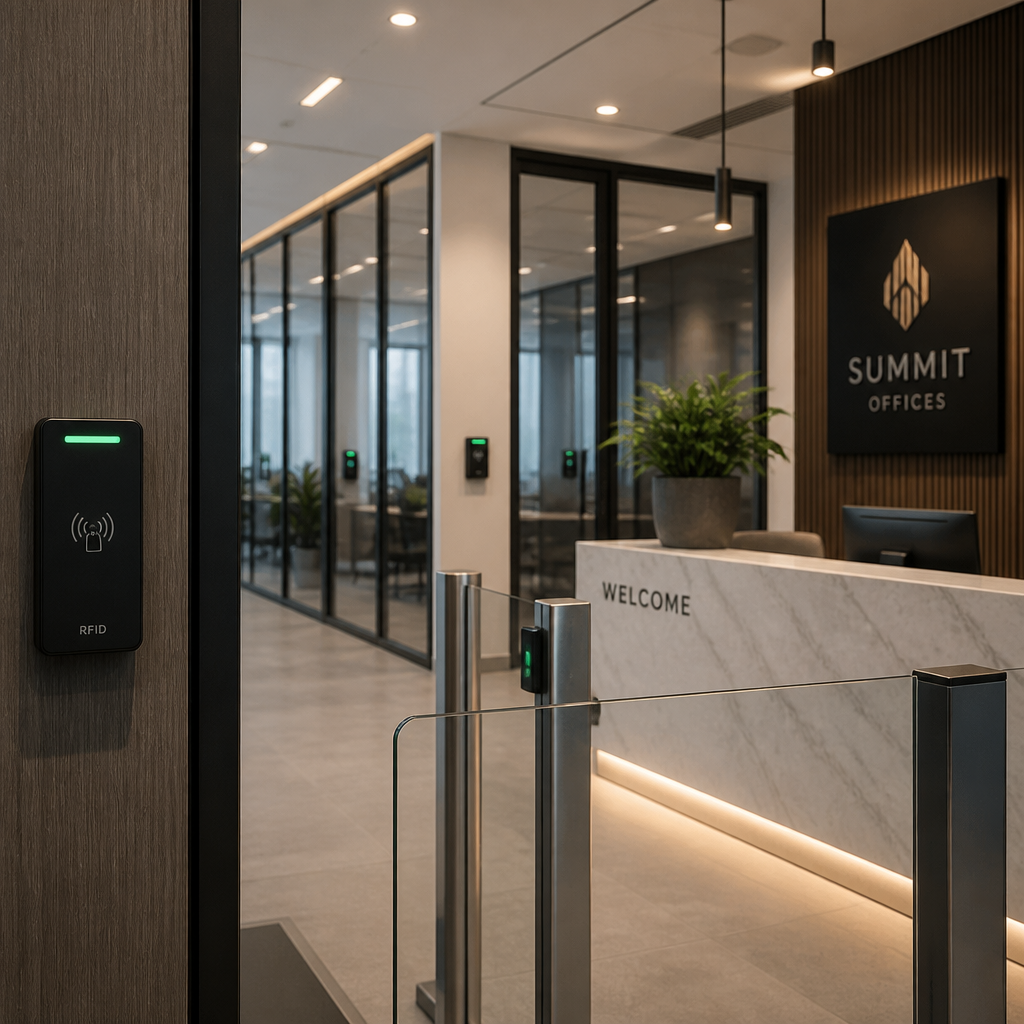
The case for RFID in commercial offices is just as strong, but the pain point is different. In a hotel, the problem is high-volume guest turnover. In an office, the problem is employee lifecycle management. When someone joins, they need access immediately. When someone leaves – voluntarily or not – that access must be revoked just as fast.
With a traditional key system, a departing employee can retain building access indefinitely unless keys are physically collected and locks are re-keyed. With an RFID card operated door lock system, deactivating a card takes seconds from a computer. The card becomes useless before the person reaches the parking lot. That is not a minor convenience. It is a meaningful reduction in insider-threat exposure and a significant saving compared to the cost of re-keying multiple locks every time staff turns over.
Zone-Based Access for Multi-Floor or Multi-Tenant Buildings
Commercial buildings with multiple tenants or departments benefit from RFID’s ability to enforce zone separation without installing separate physical lock systems for each area. A single card reader infrastructure can restrict finance staff to their floor, give IT staff server room access, and allow facilities teams into utility areas – all managed from a central access control dashboard. Adding a new employee or adjusting access permissions as roles change requires no physical hardware changes whatsoever.
Audit Trails and Compliance
Every card read generates a time-stamped log entry. For businesses operating under compliance frameworks that require demonstrable access controls – healthcare facilities, financial offices, data centers – this audit trail is not optional. RFID access logs provide the timestamped evidence that a specific credential was presented at a specific door at a specific time. Physical keys provide none of that.
The ability to instantly deactivate a lost or stolen credential, without touching a single piece of hardware, is the operational argument that consistently closes the case for RFID over traditional key systems in any building with more than a handful of access points.
RFID Cards vs. Key Fobs vs. Mobile Credentials: Honest Comparison
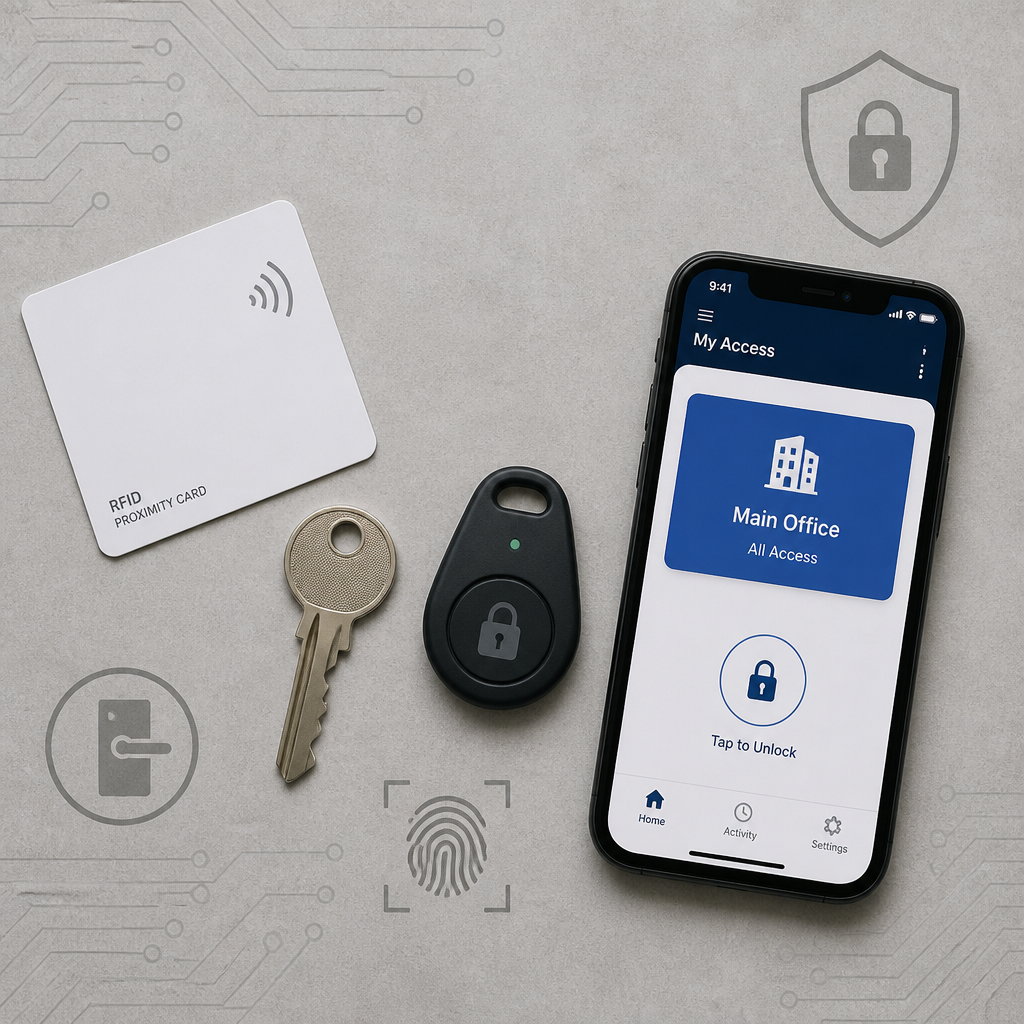
RFID access control is not a single product – it is a technology that runs across different form factors. Cards, key fobs, and mobile credentials all use radio frequency identification at the core, but they serve different use cases and have different failure modes. Here is a direct comparison for property managers choosing between them.
| Factor | RFID Card | RFID Key Fob | Mobile Credential (NFC/BLE) |
|---|---|---|---|
| Best environment | Hotels, offices, structured check-in environments | Gyms, residential complexes, parking, storage areas | Tech-forward offices, co-working spaces, multifamily |
| Durability | Moderate – bends, magnetic field damage | High – compact, hard-wearing | Dependent on user’s phone battery and software |
| Issue and revocation speed | Seconds with an encoder | Seconds with an encoder | Near-instant via app or cloud portal |
| User acceptance | Universal – no app or phone required | High – familiar, keychain-friendly | Mixed – requires smartphone and app setup |
| Clone vulnerability | Low to high – depends entirely on chip type | Low to high – same chip dependency | Generally lower – cryptographic protocols |
| Infrastructure cost | Low per-credential cost | Slightly higher per-credential cost | Lower credential cost, higher software/platform cost |
| Guest/visitor suitability | Excellent – no setup required from user | Good | Poor – requires app download and onboarding |
The verdict for hotels is clear: RFID cards win for guest-facing access because they require zero effort from the user. Key fobs are a better fit for long-term users in residential or gym environments. Mobile credentials are promising for tech-savvy staff but remain a poor choice for any access point that serves the general public or short-stay guests.
The Real Security Risks of RFID Cards and How to Address Them
RFID access control has genuine weaknesses and responsible buyers should understand them before specifying a system. The two most significant are card cloning and outdated chip standards, and both are avoidable with the right hardware choices.
The 125 kHz Legacy Problem
A large number of installed RFID systems still run on 125 kHz proximity cards, a format that carries no meaningful encryption. These cards transmit a fixed ID number to any reader that asks – including an attacker’s portable reader disguised as a notebook or clipboard. Cloning a 125 kHz card requires inexpensive, widely available hardware and a few seconds of proximity to the target card. Any building still running 125 kHz cards as its primary access credential is operating with a known, unpatched vulnerability.
MIFARE Classic Vulnerabilities
Even within the more modern 13.56 MHz category, not all chips are equal. The MIFARE Classic chip series – originally launched in 1994 and still widely deployed – has been the subject of multiple documented attacks over the years. Security researchers have demonstrated techniques that allow cloning of MIFARE Classic cards, and published reports have exposed backdoors in some implementations of these chips that enable fast credential duplication. The cards affected are used in hotel rooms and office buildings across multiple continents.
The mitigation is concrete: specify MIFARE DESFire EV2 or EV3 chips for any new installation. DESFire cards use AES-128 encryption and mutual authentication, meaning both the card and the reader verify each other’s identity before any credential data is exchanged. Cloning a properly configured DESFire card with off-the-shelf hardware is not currently a practical attack. The per-card cost is modestly higher than MIFARE Classic, but the security gap justifies it for any property handling sensitive access.
Physical and Procedural Risks
The technology is only part of the security equation. Lost cards that are not promptly deactivated, shared credentials between employees, and generic master cards with no expiry date are procedural failures that no chip upgrade will fix. A common mistake is deploying a capable RFID system and then managing credentials informally – issuing cards without logging them, never auditing who has access to what, and failing to deactivate cards when staff leave. The access control system is as strong as the discipline applied to managing it.
Pro tip: Schedule a quarterly credential audit regardless of how tight your onboarding and offboarding procedures are. In practice, there are almost always cards in the field assigned to roles that no longer exist, contractors whose projects ended, or temporary staff whose access was never revoked. A fifteen-minute audit every three months closes gaps that day-to-day operations miss.
Choosing the Right Card Operated Door Lock System
The market for card operated door lock hardware ranges from inexpensive standalone units to full networked systems with cloud dashboards, visitor management, and integration APIs. The right choice depends on the property type, the number of access points, and the level of administrative control you actually need day to day.
Standalone vs. Networked RFID Locks
Standalone RFID locks store their authorized credential list locally within the lock itself. Adding or removing cards requires either physically presenting a master card to the lock or using a dedicated programmer device. These are cost-effective for small installations – a single office suite, a small retail stockroom, or a residential property with a handful of doors.
Networked systems connect all readers to a central controller, enabling real-time management from a single interface. Adding a new employee, restricting access to a specific floor, or pulling a complete access log for an incident investigation all happen from one dashboard. For any property with more than ten to fifteen access points, or any building requiring compliance-grade audit trails, a networked system is the only practical choice.
What to Confirm Before Purchasing
Beyond the basic hardware, several integration and operational questions determine whether a system will actually serve the property well. Confirm PMS compatibility if the installation is hospitality-focused – ask specifically about the integration setup cost, which vendors often quote separately from the hardware price. Verify that the system supports the card chip type you intend to use long-term. Check whether credential management is cloud-based, server-based, or requires on-site software, since cloud systems are generally easier to maintain but add a recurring subscription cost. And confirm what happens when the network goes down – good RFID systems continue operating offline and sync logs when connectivity is restored.
For property managers and facility operators evaluating full-building access control solutions, UnikCCTV offers a range of RFID-compatible access control hardware including door access controllers, smart locks, and intercom systems that integrate with card-based and biometric credential formats. Systems can be matched to single-site or multi-building deployments without requiring a full rip-and-replace of existing door hardware in most cases.
Frequently Asked Questions
What is the difference between a magnetic stripe hotel key card and an RFID card?
A magnetic stripe card stores data on a physical magnetic band that must make contact with a reader – similar to a credit card swipe. An RFID card communicates wirelessly via radio frequency and requires only proximity, not physical contact, with the reader. RFID cards are generally more durable since there is no exposed magnetic stripe to degrade, and they support more sophisticated encryption. Most hotels built or renovated in the past decade use RFID rather than magnetic stripe.
Can RFID hotel key cards be cloned or hacked?
Yes, but the risk varies significantly by chip type. Older 125 kHz proximity cards and some MIFARE Classic 13.56 MHz cards have documented vulnerabilities that make cloning feasible with available hardware. MIFARE DESFire EV2 and EV3 cards use AES-128 encryption and mutual authentication, making cloning with consumer hardware practically infeasible. Choosing the right chip standard at procurement is the primary defence.
How do I deactivate a lost RFID card in an office building?
In a networked access control system, deactivating a lost card takes seconds: locate the credential in the management software and mark it as inactive or deleted. The change propagates to all connected readers immediately. In a standalone lock system, deactivation typically requires presenting a master card to each lock individually, which is why standalone systems are unsuitable for any building with many access points or a frequent need to change credentials.
Is an RFID card operated door lock system suitable for a small business or home office?
Absolutely, and it is often a better investment than it appears. Even a single-door standalone RFID lock eliminates the risk of copied keys, allows instant deactivation if a card is lost, and removes the need to re-key locks when staff changes. The initial hardware cost is the main consideration, but it is typically offset quickly by the elimination of locksmith call-outs and lock replacement costs. For a growing business, a standalone RFID lock that can be upgraded to a networked system later is a practical starting point.
What should I look for in an RFID access control system for a multi-tenant office building?
Prioritise these four things: a networked architecture that allows centralised credential management across all doors from one interface; support for zone-based access restrictions so tenants or departments can be limited to their own areas; a full timestamped access log for compliance and incident investigation; and MIFARE DESFire or equivalent encrypted card technology. Avoid systems that lock you into proprietary card formats that cannot be sourced from multiple suppliers, as this creates long-term vendor dependency.
How long do batteries last in battery-powered RFID door locks?
Battery life in standalone RFID locks varies by manufacturer and door traffic volume, but most commercial-grade units are designed to last between one and two years under normal use conditions. Most systems include a low-battery warning indicator visible on the lock or transmitted to the management system, giving staff time to replace batteries before a guest or employee is locked out. High-traffic doors – main building entrances, busy floor lobbies – benefit from wired power solutions rather than battery operation.
What has been your experience managing RFID access systems in your building – have you run into issues with legacy card formats or integration problems worth sharing?
References
- Guide to electronic and smart hotel door lock system types and how they work
- How RFID hotel door locks integrate with property management systems
- RFID security risks in door access control systems and how to mitigate them
- Security report on RFID smart card backdoor vulnerabilities enabling instant cloning
- Benefits of key card access control systems for office buildings


 No products in the cart.