
Most property managers do not realize they have a lock problem until a door is propped open, a key card is cloned, or a former employee walks back into a restricted area. Traditional deadbolts cannot log who entered or deny access to a lost key. Magnetic door locks solve all three of those problems at once, but they introduce a different set of trade-offs that most buyers underestimate. This guide covers how electromagnetic locks actually work, where they belong in a real access control setup, where they do not belong, and how to spec them correctly the first time so you are not ripping hardware off door frames six months later.
Table of Contents
- Quick Takeaways
- How Magnetic Door Locks Work
- Types of Magnetic Locks
- Where to Use Magnetic Door Locks
- Electromagnetic Lock Guide to Installation
- Access Control Door Hardware Integration
- Magnetic Locks vs. Electric Strikes vs. Deadbolts
- Common Mistakes to Avoid
- Frequently Asked Questions
- References
Quick Takeaways
| Key Insight | Explanation |
|---|---|
| Maglocks are fail-safe, not fail-secure | When power is cut, the door unlocks. This meets fire code in most jurisdictions but means a power outage also means an open door. |
| Holding force is not the same as security rating | A 1,200 lb holding force sounds impressive, but the weak point is almost always the door frame, not the maglock itself. |
| No moving parts means very low maintenance | Unlike deadbolts or electric strikes, maglocks have nothing to jam, strip, or wear down mechanically over time. |
| Maglocks require continuous power to stay locked | They draw constant current to maintain the magnetic field, so your access control panel and power supply must be sized correctly. |
| Integration is the real selling point | Maglocks connect cleanly with keypads, biometric readers, intercoms, and time-attendance systems for a unified access control setup. |
| Not suitable for every door type | Glass doors, outswing doors, and hollow-core frames often need specific bracket configurations or are poor candidates altogether. |
| Fire code compliance is non-negotiable | On any egress path, the maglock must release on fire alarm activation. Ignoring this creates both a legal and a life-safety liability. |
How Magnetic Door Locks Work
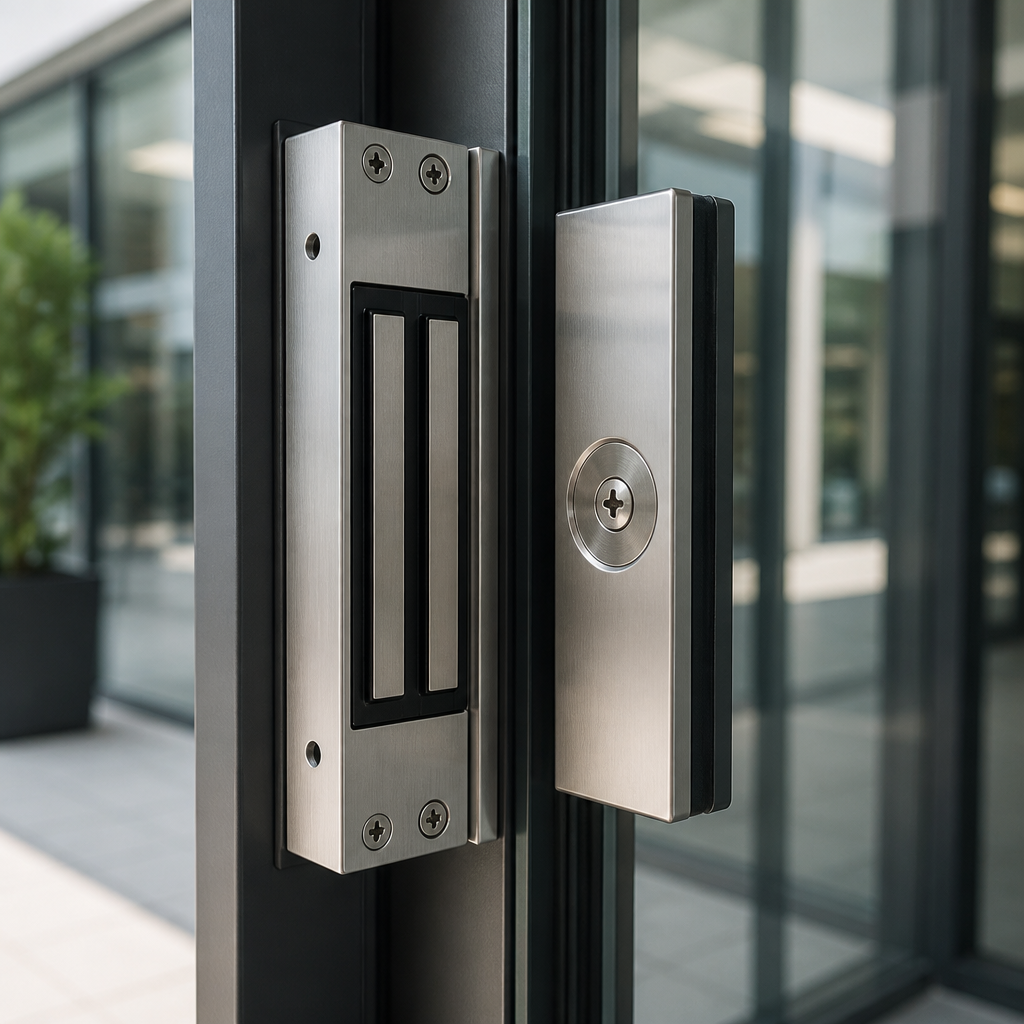
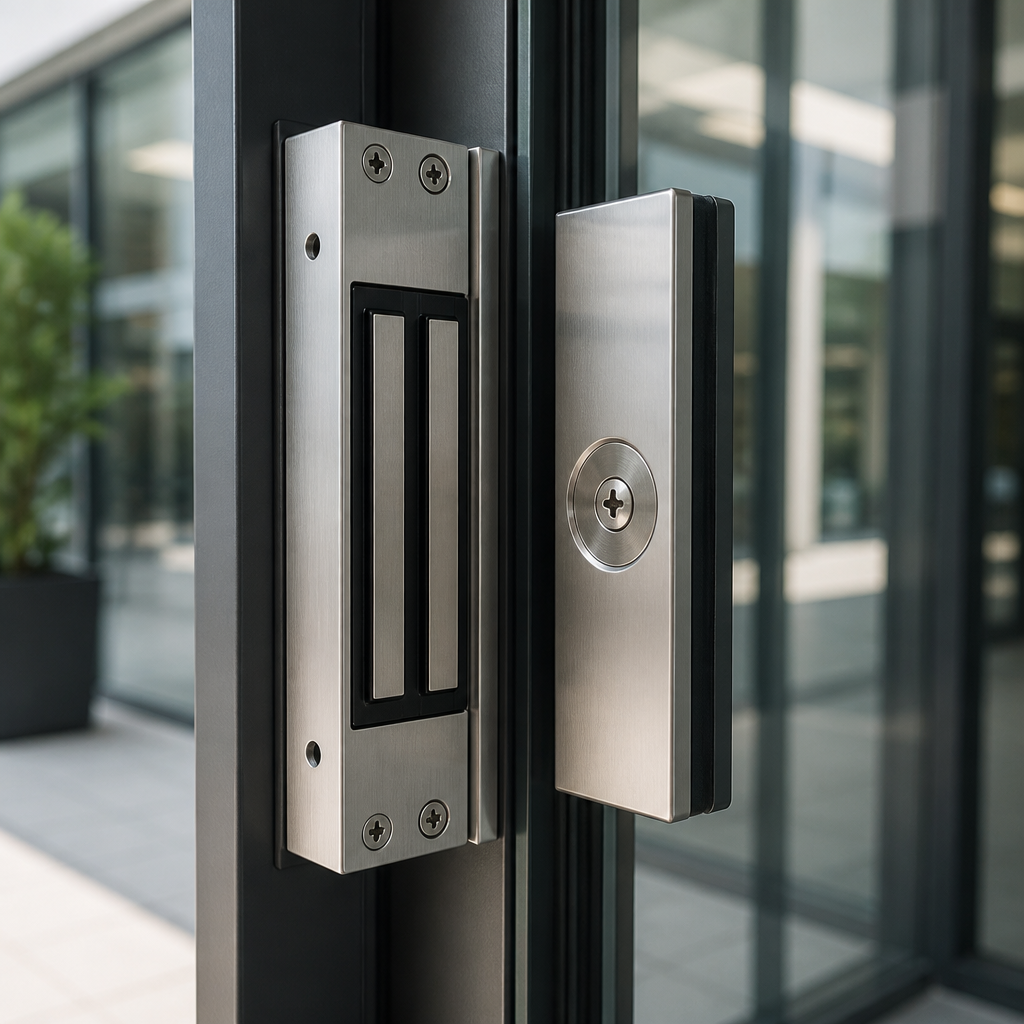
A magnetic door lock, commonly called a maglock, consists of two components: an electromagnet mounted to the door frame and a ferromagnetic armature plate mounted to the door itself. When electrical current flows through the coil inside the electromagnet, it generates a magnetic field that pulls the armature plate flush against it, holding the door shut with significant force.
Cut the current, and the magnetic field collapses instantly. The door is free to open. This is the defining characteristic of a maglock and also its most misunderstood trait. The lock does not bolt, latch, or grip in any mechanical sense. It holds through electromagnetic attraction only.
Most commercial maglocks operate on 12VDC or 24VDC and draw between 250mA and 500mA depending on the holding force rating. Standard residential-grade units are typically rated at 600 lbs of holding force. Commercial-grade units are more commonly rated at 1,200 lbs. In practice, the frame and door construction are usually the limiting factor long before the magnet’s rated force becomes relevant.

The lock is energized when the door should be closed and de-energized when a valid credential is presented at the reader. A momentary relay signal from the access control panel interrupts power to the magnet, which releases the door for a configurable hold-open time, typically between three and ten seconds, before re-locking automatically.
Pro tip: Always install a door position sensor alongside the maglock. If someone props the door open after the relay releases, the sensor triggers an alert rather than letting the lock silently re-energize against a wedged-open door.
Types of Magnetic Locks
Not every maglock is the same form factor, and picking the wrong type for a door configuration is one of the most common spec errors. Understanding the physical variants before purchasing saves costly rework.
Single Door Maglocks
The standard single-door maglock is a rectangular unit, typically around 10 to 12 inches long, designed for single-leaf doors that swing inward. The electromagnet mounts to the door stop side of the frame header. This is the most common configuration for office entry doors, server room doors, and stairwell access points.
Double Door Maglocks
Double-door or dual-maglock setups use two magnets on a shared power circuit to hold both leaves of a double-door entry. These are standard for main lobby entrances and loading dock access points in commercial buildings. Coordinating the release timing on both leaves requires attention during programming.
Shear Locks
A shear lock mounts differently from a standard maglock. Instead of the armature being pulled face-to-face with the magnet, the armature slides into a recess and the force is applied laterally. Shear locks are used on sliding doors, overhead doors, and applications where the standard face-to-face configuration is geometrically impossible. They tend to be more expensive and require more precise installation alignment.
Bracket Configurations
Standard L-brackets, Z-brackets, and outswing brackets allow maglocks to be adapted to doors that swing outward, glass-framed doors, and doors without adequate frame header clearance. Bracket selection is not cosmetic. The wrong bracket creates misalignment between the magnet face and the armature plate, which drops holding force dramatically and causes premature wear on the armature surface.
Where to Use Magnetic Door Locks
Maglocks are not a universal replacement for every lock on a property. They work extremely well in specific situations and poorly in others. Knowing the difference before spec day is what separates a clean installation from a callback-heavy mess.
Ideal Applications
Office and commercial building interiors are the natural home for maglocks. Controlled-access zones like server rooms, executive suites, records rooms, and pharmacy areas benefit from the seamless credential-based release without any physical manipulation of the door itself. Employees badge in, the magnet releases, the door swings open. No fumbling with keys in both hands.
Apartment building common areas, including lobby doors, mail room entries, and gym or amenity room access, are strong maglock use cases. The fail-safe behavior is an advantage here: in any emergency, residents exit without needing to operate a lock at all.
Gate access control for pedestrian gates adjacent to vehicle entry points is another solid fit. A maglock on a pedestrian gate, paired with a wireless intercom at the gate post and a gate access controller at the main panel, gives property managers remote release capability without running to the gate physically.
Healthcare facilities and schools use maglocks extensively on interior controlled zones where rapid egress is legally required. The automatic fail-safe release on alarm activation is what makes them compliant in these environments.
Where Maglocks Do Not Belong
Exterior perimeter doors that are the last line of defense are a poor fit if the building is in an area with frequent or prolonged power outages. A backup power supply or battery backup unit is not optional in those scenarios. It is a required part of the spec.
Doors that see heavy wind pressure on the armature side can experience the magnet partially releasing due to flex in the door. Hollow-core doors and lightweight aluminum-framed doors require reinforcement before a maglock installation will hold reliably under real conditions.
Pro tip: For any door on a fire egress path, confirm with your local authority having jurisdiction whether a request-to-exit (REX) sensor alone is sufficient, or whether the maglock must also be wired directly into the fire alarm panel. Requirements vary by jurisdiction and building occupancy classification.
Electromagnetic Lock Guide to Installation
A maglock installation involves more than bolting hardware to a door frame. The electrical, mechanical, and code compliance elements all need to be addressed together. Skipping any one of them creates problems that surface at the worst possible time.
Power Supply Sizing
Each maglock draws continuous current to stay locked. A single 1,200 lb maglock typically draws around 500mA at 12VDC, meaning a standard 1A power supply has essentially no headroom for anything else on that circuit. Most professional installations use a dedicated access control power supply with enough capacity to run the lock, the reader, and the door position sensor simultaneously, plus a battery backup that can sustain the system for at least four hours during a power failure.
Wiring and Relay Control
The access control panel releases the maglock by interrupting power through a relay. Wiring runs from the power supply to the maglock through a normally-closed relay output on the panel. When the panel triggers the relay, power to the maglock is cut, the field collapses, and the door opens. This is a simple circuit but must be wired correctly. Reversing the relay logic converts a fail-safe lock into a fail-secure one unintentionally, which is both a code violation on egress paths and a safety hazard.
Request-to-Exit Device
Any door secured by a maglock must have a means of egress from the secure side that does not require a credential. The standard solution is a request-to-exit (REX) sensor, either a passive infrared motion sensor positioned above the door on the secured side, or a push-button override. The REX sends a momentary signal to the access control panel to release the lock, allowing exit without badging out.
Fire Alarm Integration
On any egress-rated door, the maglock must be connected to the building’s fire alarm system so that it releases immediately on alarm activation. This is achieved through a dedicated relay output on the fire alarm panel wired to cut power to the maglock. This wiring runs independently of the access control system so that a failure in the access control panel cannot prevent fire-triggered release.
Access Control Door Hardware Integration
A maglock by itself is just a lock. The value of a maglock system comes from how it integrates with the broader access control door hardware ecosystem. Property managers and facility operators who think of a maglock as a standalone product tend to underspec the rest of the system and end up with a lock that works but a building that is not actually controlled.
The credential reader is the front end of the system. For a single office door, a proximity card reader or PIN keypad is often sufficient. For a building lobby with multiple tenants or high visitor volume, a video intercom system that allows staff to visually verify and remotely release the maglock is far more practical. The maglock becomes the actuator for the intercom’s door release output.
For facilities managing shift workers, maglocks integrated with time attendance systems add a layer of schedule-based access. A door secured by a maglock can be programmed to allow access only during business hours for certain credential holders, and to stay permanently locked outside those windows without any staff intervention.
The most secure door hardware configuration is the one that staff will actually use correctly every day. A system that is too complicated to operate gets propped open, bypassed, or ignored. Simplicity of daily use is a legitimate security requirement, not a compromise.
Smart lock and biometric reader combinations paired with maglocks work particularly well for server rooms, medical record storage, and financial processing areas where a high-security audit trail is required. The biometric reader generates the credential event log, and the maglock provides the physical control.
Wireless intercoms at gate entry points, with the gate maglock wired back to the intercom’s door release relay, give remote monitoring capability without needing a guard physically at every access point. This is a practical and cost-effective configuration for apartment complexes and light commercial properties.
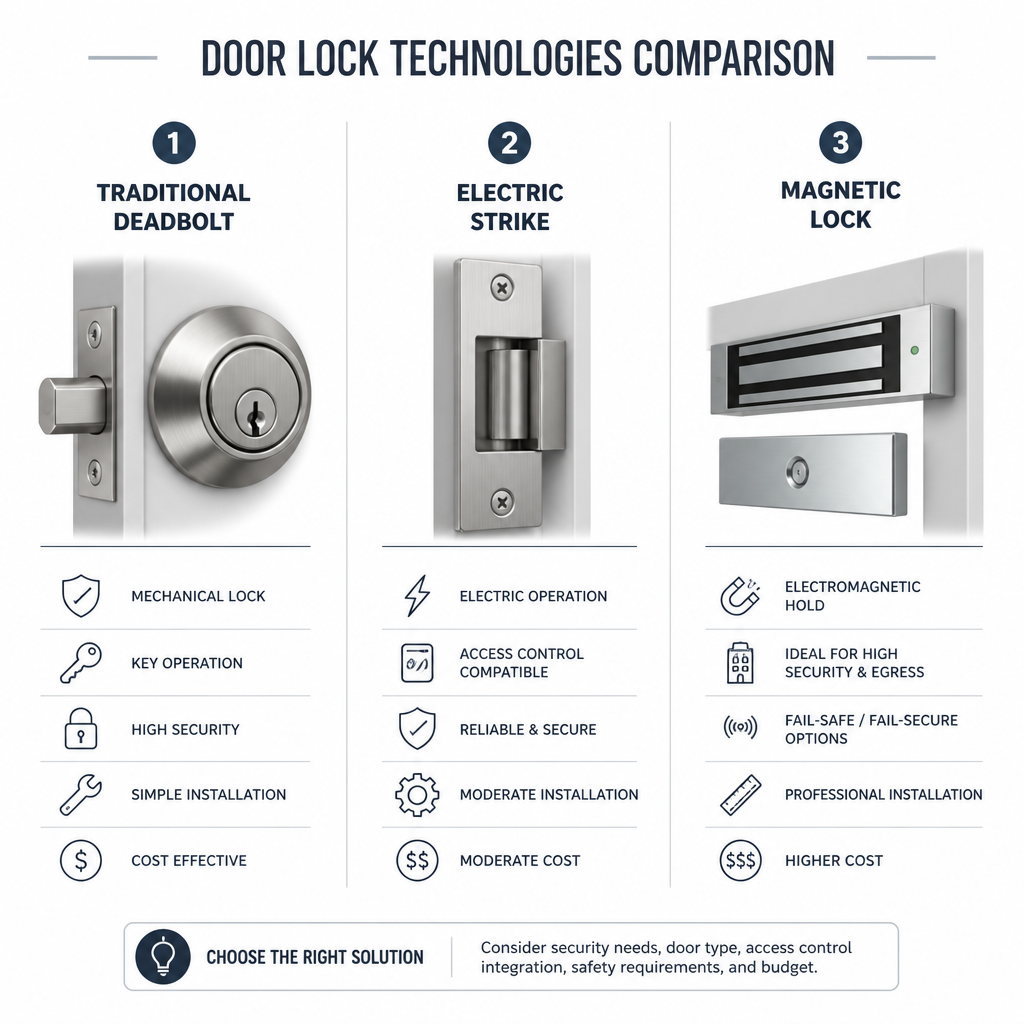
Magnetic Locks vs. Electric Strikes vs. Deadbolts
Choosing between these three technologies is a decision that shapes installation cost, maintenance burden, and how well the hardware matches the door’s daily use pattern. Each has a place. None is categorically superior for every situation.
| Feature | Magnetic Lock (Maglock) | Electric Strike | Traditional Deadbolt |
|---|---|---|---|
| Fail-safe vs. fail-secure | Fail-safe (unlocks on power loss) | Available in both configurations | Fail-secure (stays locked without power) |
| Moving parts | None | Yes (strike plate moves) | Yes (bolt, cylinder, springs) |
| Access control integration | Excellent, clean integration | Good, requires latch hardware | Limited to key or mechanical override |
| Key management | Not required | Not required | Required, can be a liability at scale |
| Maintenance | Very low, no mechanical wear | Moderate, strike components wear | Low to moderate, cylinders need rekeying |
| Best use case | Interior commercial doors, egress paths | Doors needing fail-secure or with existing latches | Residential exterior, standalone security |
| Power dependency | Continuous power required | Momentary power to release | No power required |
Electric strikes are often the better choice when the door already has a mechanical latch and the installation needs to work in a fail-secure mode, for example on a server room exterior door where power outage should mean the door stays locked, not open. Maglocks are the better choice when the door has no existing latch hardware, when the door is on an egress path, or when the installation prioritizes low maintenance over fail-secure behavior.
Traditional deadbolts remain appropriate for residential exterior doors and any application where there is no access control infrastructure in place and none is planned. Attempting to retrofit deadbolts with smart lock cylinders is a reasonable intermediate step, but it does not scale to multi-door commercial environments.
Common Mistakes to Avoid
Most maglock failures in the field are not product failures. They are installation or specification errors that were avoidable. After seeing enough of these setups, a pattern of recurring mistakes becomes very clear.
Undersized Power Supply
Running a maglock from a shared power supply that also powers readers, panels, and other devices is a common shortcut that causes intermittent lock failures. When the panel draws a surge during boot or event logging, voltage drops briefly, and the maglock can pulse open for a fraction of a second. Use a dedicated, appropriately rated power supply for the lock circuit.
Missing Door Position Sensor
Installing a maglock without a door position sensor means you have no way to know if the door is actually closed and the magnet is fully engaged. A door that does not close completely will not achieve full holding force. The access control system will show the door as “secure” while the magnet is holding against a partially open door with a fraction of its rated force.
Ignoring Armature Plate Alignment
The armature plate must contact the magnet face squarely and completely. Any gap, tilt, or offset reduces holding force significantly. Many installers set the bracket position by eye and discover later that the door’s natural resting position leaves the armature slightly cocked. Use a feeler gauge or the magnet’s own pull to confirm full-surface contact before finalizing mounting.
Not Wiring REX Before Going Live
Energizing a maglock on an egress path without a functioning request-to-exit device is a fire code violation in most jurisdictions. It also creates an obvious scenario where someone is trapped on the secure side during a system malfunction. The REX device is not a finishing touch. It is part of the minimum viable installation.
A common mistake that property managers make when comparing maglock vendors is evaluating only the holding force rating. Two maglocks with the same rated holding force can perform very differently based on the quality of the magnet’s face flatness, the armature material, and the voltage regulation of the power supply. Cheaper units often have inconsistent face tolerances that result in real-world holding force well below the spec sheet number.
Frequently Asked Questions
Do magnetic door locks work during a power outage?
Standard maglocks are fail-safe devices, which means they release and the door unlocks when power is lost. If your application requires the door to stay locked during a power outage, you need either a fail-secure electric strike or a maglock system with a battery backup power supply that keeps the lock energized during outages. Specifying which behavior you need before purchasing is essential.
Can a magnetic door lock be forced open?
A properly installed maglock with a 1,200 lb holding force rating is extremely difficult to force open through direct pull. However, forced entry attacks rarely involve pulling against the magnet face directly. Attackers typically attack the door frame, hinge side, or use pry tools to create a gap between the armature and magnet. The door frame and surrounding hardware are usually the weak point, not the maglock itself.
Are magnetic door locks suitable for residential use?
Maglocks can be used in residential settings, particularly in high-security home offices, garage access points, or smart home setups integrated with video intercoms. However, for most standard residential exterior doors, the combination of power dependency and fail-safe behavior makes electric strikes or smart deadbolts a more practical choice. The installation complexity and ongoing power requirement of a maglock is easier to justify in a commercial or multi-unit residential context.
How do I reset or unlock a magnetic door lock manually?
The standard method is through the access control panel, which sends a momentary signal to cut power to the maglock. In a true emergency, cutting power to the lock directly at the power supply releases it immediately. Well-designed installations also include a key-switch override or a push-button REX on the secured side that allows manual release without affecting the access control system’s normal operation. Any installation without at least one manual override method is incomplete.
What is the difference between a 600 lb and a 1,200 lb magnetic lock?
The numbers refer to the magnet’s rated holding force under ideal conditions with full armature contact. A 600 lb maglock is generally sufficient for standard interior access control doors in low-to-medium traffic environments. A 1,200 lb unit is the professional standard for commercial applications, high-traffic doors, and anywhere the installation is subject to regular physical pressure on the door from wind, crowds, or operational use. The higher-rated unit also provides a larger tolerance buffer when installation conditions are not perfect.
Do maglocks require special door hardware or frames?
Maglocks require a solid, rigid mounting surface on both the door frame and the door itself. Wood frames, hollow metal frames, and aluminum storefront frames all work with the right bracket hardware, but each requires a different approach. Hollow-core doors are a problem because the armature plate needs a solid substrate to mount to. Glass doors can work with aluminum channel brackets designed specifically for frameless glass, but these installations require more care and are more expensive to do correctly.
Have you installed or spec’d a maglock system in your building? Share what worked, what surprised you, or what you wish someone had told you before the installation started.


 No products in the cart.