
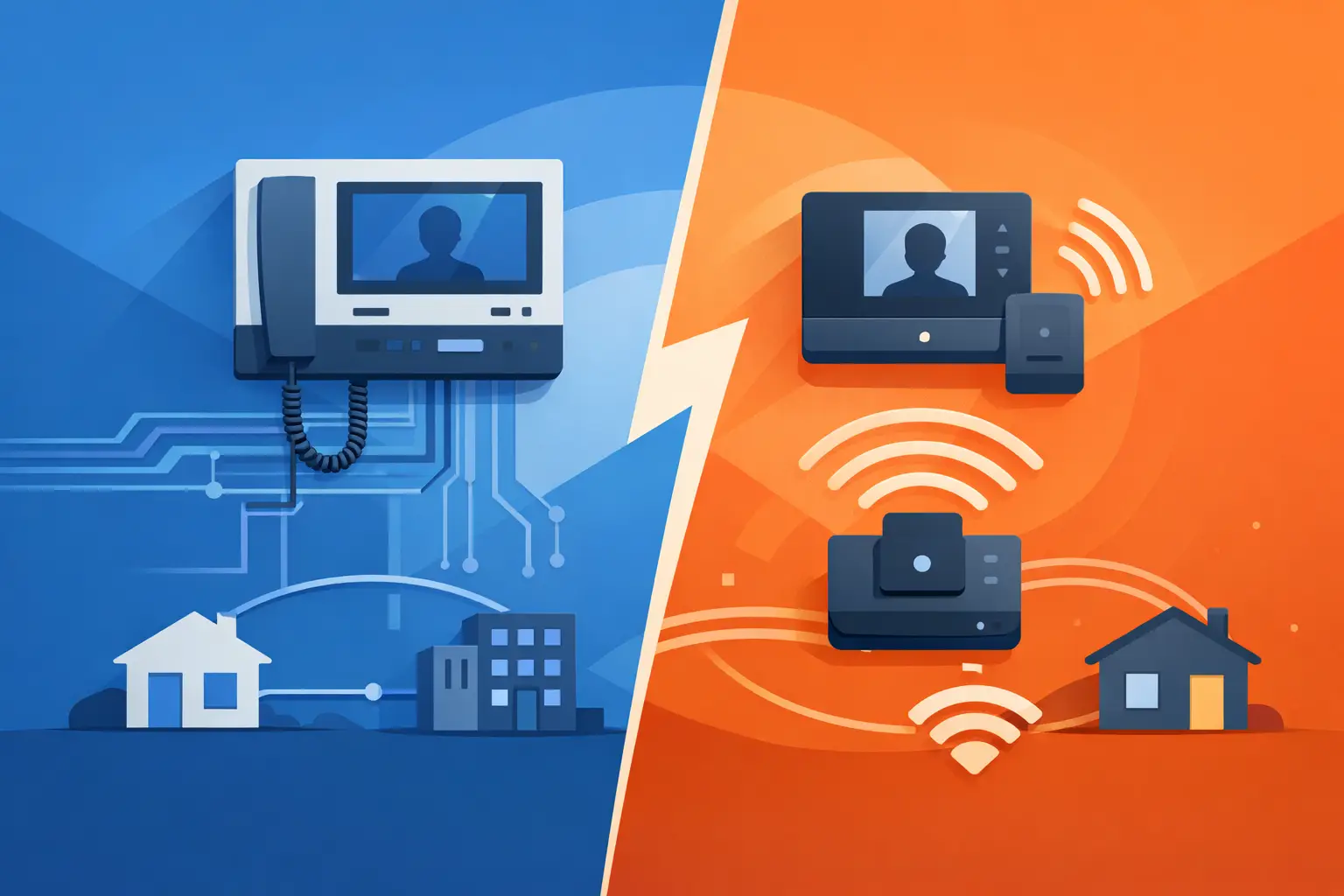
A front gate that misses calls, a tenant entry panel with poor audio, or a warehouse door that cannot release reliably is not a minor inconvenience. It is an operational security problem. The wired versus wireless intercom decision affects more than installation labor: it determines system uptime, expansion options, access-control compatibility, maintenance requirements, and the experience of everyone using the entrance.
For a new build or a major renovation, wiring is often the practical long-term choice. For a remote gate, a small office, or a property where opening walls is not realistic, wireless may be the better answer. The correct system depends on the site, the required functions, and what failure is least acceptable.
Wired versus wireless intercom reliability
A wired intercom uses physical cable to carry communication, power, control signals, or a combination of all three. Depending on the platform, that may involve traditional multi-conductor intercom cable, Cat5e/Cat6 network cable, two-wire bus cable, or separate wiring for an electric strike, magnetic lock, gate operator, and exit device.
The primary advantage is predictability. A properly specified cable run is not affected by Wi-Fi congestion, changing radio conditions, nearby metal structures, or a tenant replacing a router. Audio, video, and door-release commands travel over a defined path. For multi-unit buildings, schools, medical offices, commercial entrances, and industrial facilities, that consistency is usually worth the added installation effort.
Wireless intercom systems communicate through radio frequency, Wi-Fi, cellular service, DECT, or another wireless method. Their strongest advantage is installation flexibility. A wireless call station at a gate can avoid trenching hundreds of feet of conduit. A small business can add a reception intercom without disrupting finished walls. A property manager may be able to improve a difficult entry point without a large capital project.
Wireless reliability is not automatically poor, but it must be verified at the actual installation site. Distance alone does not tell the whole story. Masonry walls, metal siding, elevator shafts, vehicles, trees, terrain changes, and electrical interference can reduce signal quality. A gate station that works well during a bench test may perform differently after it is mounted on a steel pedestal at the edge of a large property.
For security-critical entrances, test the intended wireless path before finalizing equipment and mounting locations. Confirm audio quality, video response if applicable, relay operation, and performance during normal business activity. If the system depends on Wi-Fi or cellular service, define who controls that connection and what happens during an internet outage.
Installation cost is more than the equipment price
Wireless systems often cost less to deploy when cabling is difficult. Avoiding trenching, core drilling, ceiling access, drywall repair, and labor across multiple buildings can materially change the project budget. This is especially relevant at detached garages, parking gates, temporary offices, historic properties, and existing facilities where pathways are limited.
However, a lower initial labor cost does not always mean a lower lifetime cost. Wireless devices may need battery changes, antenna adjustments, network troubleshooting, firmware updates, or replacement when the radio environment changes. Wi-Fi-based intercoms also introduce network responsibilities that a simple hardwired audio system may not have.
Wired systems require more planning at the start. Installers need to identify cable routes, voltage drop, cable type, power supplies, door hardware connections, and fire or building-code considerations where applicable. Yet once the cable infrastructure is in place, service is generally easier to isolate. A technician can test a conductor, power source, relay, station, or network port without first questioning wireless coverage.
For a property with several entry points, the cable installed today may also support future expansion. A building owner who adds cameras, card readers, door contacts, request-to-exit devices, or additional master stations later may benefit from having planned pathways and power distribution from the beginning.
Power and door-release requirements matter
Intercom communication is only part of an entry system. Most professional applications also require a way to control a lock, electric strike, maglock, gate operator, or automatic door. That requirement tends to favor wired architecture, especially when the entrance must work consistently over long distances.
A door station can be wireless while the locking hardware still needs local power and proper control wiring. Electric strikes, maglocks, and gate operators have specific voltage and current demands. Long cable runs can create voltage drop, and locks may need separate power supplies, relays, suppression devices, or code-compliant interfaces. These details should be addressed before selecting the intercom, not after the station is mounted.
Battery-powered wireless intercoms can be useful where running power is impractical, but buyers should examine duty cycle closely. Frequent visitor traffic, cold weather, video use, illuminated keypads, and weak signal strength can shorten battery life. A battery maintenance schedule may be acceptable for a lightly used side gate. It is less attractive for a busy apartment entrance or delivery gate that needs daily operation.
Backup power also deserves attention. A wired intercom and access-control system can often be supported by a centrally located battery-backed power supply or UPS. Wireless devices may continue communicating during a local power loss if their batteries are charged, but any electric locking device, network equipment, or gate operator still needs a planned backup strategy.
Match the system to the property type
Apartment and multi-tenant properties usually benefit from wired or managed IP intercom systems, particularly when there are many indoor stations, directory functions, tenant calling, video verification, and controlled door release. These environments need clear rules for resident changes, credential management, repair access, and common-area equipment. A system that relies on each tenant’s personal Wi-Fi network can become difficult to support.
For offices and medical practices, the choice depends on the entrance layout. A wired video intercom at a main door can integrate cleanly with an electric strike and interior monitors. A wireless system may be appropriate for a secondary entrance, reception overflow, or leased suite where construction changes are unlikely to be approved.
Schools, factories, and larger commercial sites should place reliability and integration ahead of convenience. Entrances may require video identification, scheduled locking, multiple interior answer stations, emergency procedures, and coordination with access control. Wired systems are generally the stronger foundation where traffic is high and failure has operational consequences.
Remote gates are one of the clearest cases for wireless consideration. Trenching from a building to a gate can be expensive or disruptive, particularly across paved areas or long drives. Still, the system must be selected for the real distance and environment, with a clear plan for power at the gate, gate-operator interfacing, weather exposure, and backup operation.
Choosing the right wired or wireless intercom
Start with the entry workflow, not the product category. Determine who will call from the entrance, who must answer, how visitors are verified, and what device releases the door or gate. A single-family home, a six-unit building, a loading dock, and a school vestibule may all need an intercom, but they do not need the same system.
Then assess the site. Measure cable distances and wireless paths. Identify walls, underground routes, available power, existing network infrastructure, weather exposure, and the condition of current door hardware. If video is required, confirm whether the network can support it and whether image quality is usable in backlight, darkness, and bad weather.
Compatibility should be evaluated early. The selected intercom must work with the lock type, door controller, gate operator, request-to-exit device, and power supplies already in place or planned for the project. It should also support the number of stations, doors, tenants, and future expansion points the property is likely to need.
Finally, assign ownership for ongoing service. Someone must manage batteries, network credentials, tenant directories, mobile app permissions, and occasional testing. For many commercial and managed properties, a wired system reduces the number of variables that can create a service call. For other sites, the saved construction cost of wireless is enough to justify a defined maintenance plan.
A good intercom installation is not the one with the fewest wires or the most features. It is the one that gives the property dependable communication and controlled entry under normal use, after hours, and when the site needs it most.


 No products in the cart.