
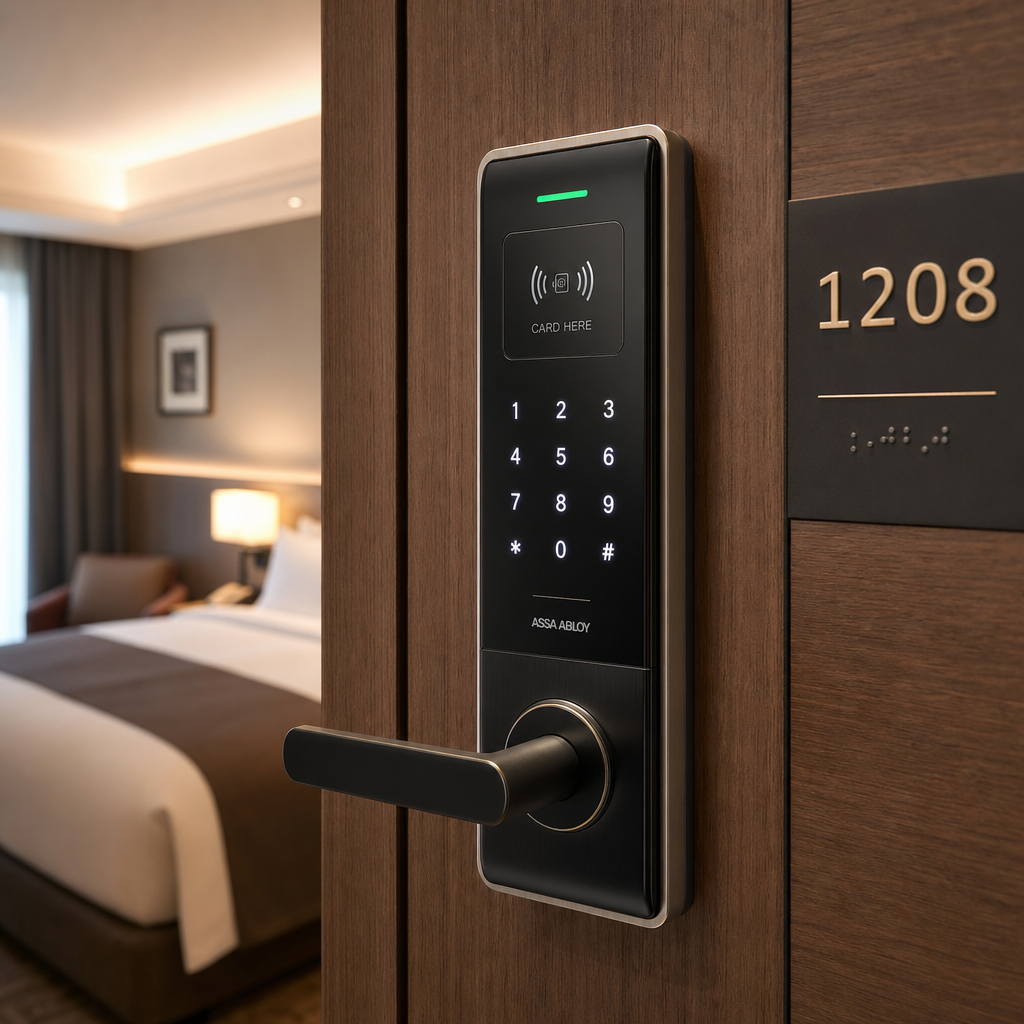
A stolen key card, a copied master key, or an unauthorized duplicate can expose your entire property overnight. Hotels and motels face a security challenge that most commercial buildings do not: hundreds of guests cycling through the same doors every week, each expecting both privacy and convenience. Hotel door locks are no longer a simple hardware decision. They are the front line of your liability management, your guest experience, and your operating cost structure. This guide covers what actually works, what fails in practice, and how to build an access control system that scales with your property.
Table of Contents
- Quick Takeaways
- Why Traditional Hotel Locks Fail Modern Properties
- Types of Hotel Smart Locks and When to Use Each
- Motel Smart Locks: Specific Challenges and Practical Fixes
- Building a Full Hospitality Access Control System
- Hotel Security System Integration: CCTV, Intercoms, and Gate Access
- Comparison of Hotel Lock System Approaches
- Biometric and Facial Recognition in Hospitality: Real Use Cases
- Common Mistakes in Hotel Access Control (And How to Avoid Them)
- Frequently Asked Questions
- References
Quick Takeaways
| Key Insight | Explanation |
|---|---|
| RFID cards are not enough on their own | Standard RFID key cards can be cloned with off-the-shelf readers. Properties relying solely on card access without audit logs or encryption are exposed. |
| Motel layouts require wireless lock solutions | Exterior-facing motel doors lack the wiring infrastructure of corridor hotels. Wireless smart locks eliminate costly retrofitting. |
| Mobile key access reduces front desk load by up to 30% | According to Statista hospitality data, mobile check-in adoption cuts front desk transaction volume significantly, freeing staff for higher-value tasks. |
| Gate access control is the most overlooked vulnerability | Properties that upgrade room locks but leave parking gates and utility entrances uncontrolled create an obvious weak point for unauthorized access. |
| Audit trails are a legal asset, not just a security feature | Timestamped entry logs from smart locks have been used in liability cases to prove or disprove guest access claims. This data has real legal value. |
| Intercom systems reduce false alarm call-outs at night | A two-way intercom at entry points lets staff verify visitors before unlocking doors, cutting unnecessary security responses dramatically. |
| Biometric systems work best for staff-only zones | Guest-facing biometric locks create friction for first-time users. Biometrics shine in back-of-house, server rooms, and management offices. |
Why Traditional Hotel Locks Fail Modern Properties
Mechanical key systems in hotels were never designed for the volume of use a busy property puts them through. A 60-room motel with 80% occupancy sees roughly 35,000 lock interactions per year. That is mechanical wear, lost keys, re-keying costs, and zero record of who entered which room at what time.
The shift to magnetic stripe cards improved things marginally, but magnetic stripe technology dates to the 1960s. These cards demagnetize easily from contact with phones or wallets, and they provide no encryption. A common mistake is treating the magnetic stripe card system as a permanent solution rather than a transitional one.
The core problem with legacy hotel door locks is accountability. When something goes wrong, whether a theft, a safety incident, or a guest complaint, a mechanical lock gives you nothing. A properly configured smart lock system gives you a timestamped log of every access event, remotely accessible from a management dashboard.
“The hospitality industry loses an estimated $100 million annually to room theft, with inadequate access control cited as a primary contributing factor.” — American Hotel and Lodging Association security research overview.
The data consistently shows that properties upgrading from mechanical or basic magnetic stripe systems to encrypted smart locks see a measurable reduction in room-related incidents within the first 12 months. The upfront cost is real, but the liability reduction and operational savings justify it at almost any property size above 20 rooms.
Types of Hotel Smart Locks and When to Use Each
Not every smart lock type fits every hospitality context. Choosing the wrong technology for your property layout or guest demographic is one of the fastest ways to generate negative reviews and staff headaches simultaneously.
RFID and NFC Smart Locks
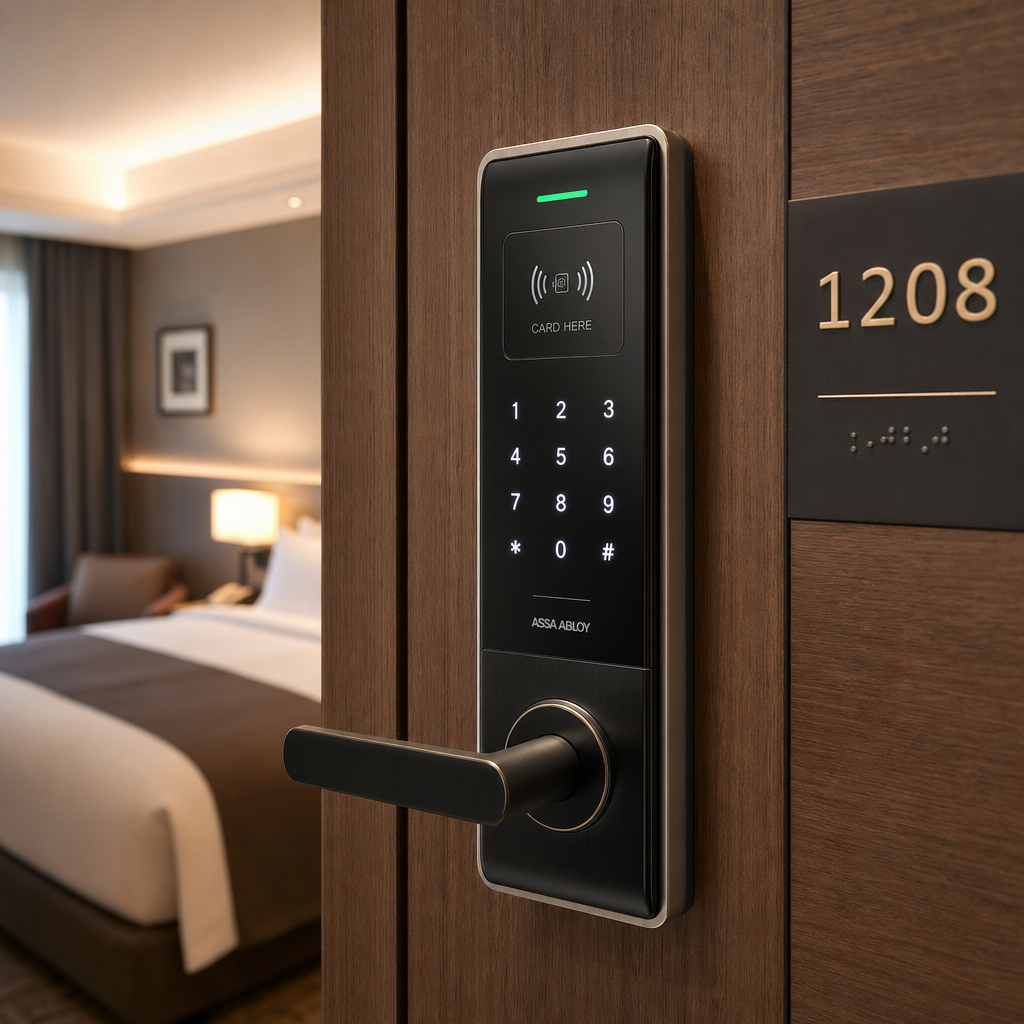
RFID smart locks with 13.56 MHz Mifare encryption are the current industry standard for mid-scale and upscale hotels. Unlike older 125 kHz cards, modern RFID credentials are significantly harder to clone. NFC locks extend this by allowing mobile wallet credentials, which means a guest’s smartphone functions as their room key. In practice, NFC-enabled locks reduce physical card issuance costs by 15 to 25 percent annually at high-turnover properties.
Best use case: Full-service hotels with a staffed front desk and PMS (Property Management System) integration. These locks sync directly with your reservation software to auto-expire credentials at checkout.
PIN Code and Keypad Locks
Keypad locks are the strongest choice for extended-stay properties, vacation rentals, and budget motels where guests may arrive after hours without staff present. A unique PIN per guest, generated automatically and sent via SMS, eliminates the need for a physical key handoff entirely.
The limitation is audit granularity. While good keypad systems log PIN usage, they cannot distinguish between a guest and someone the guest shared their PIN with. For properties where this distinction matters, combining a PIN lock with a camera at the door entry point closes that gap.
Bluetooth and App-Based Smart Locks
Bluetooth locks connect directly to a guest’s smartphone app without requiring the phone to be online at the moment of unlock. This matters for properties with inconsistent Wi-Fi coverage. The app stores an encrypted credential locally, which it presents to the lock via Bluetooth at close range.
The guest experience friction is the main drawback. Guests unfamiliar with the app process can struggle at the door, particularly older demographics. Properties that have succeeded with this approach tend to offer a physical card backup without requiring guests to ask for it.
Pro tip: Always specify Bluetooth Low Energy (BLE) locks rather than classic Bluetooth. BLE consumes significantly less battery power on the lock hardware itself, extending battery life from roughly 6 months to 18 months between replacements.
Motel Smart Locks: Specific Challenges and Practical Fixes
Motels present a distinct set of physical and operational challenges that corridor hotels simply do not face. Exterior-access rooms, inconsistent power infrastructure, varied door frame conditions, and often limited maintenance staff create a very different installation environment.
Exterior Door Weather Resistance
Motel smart locks must be rated for outdoor exposure. An IP65 weather resistance rating is the minimum acceptable standard for any lock installed on an exterior-facing door in a temperate climate. In coastal or high-humidity environments, IP66 or above is the correct specification. In practice, properties that cut costs by installing indoor-rated locks on exterior motel doors see hardware failures within 18 months, often voiding warranties.
Wireless Installation Without Rewiring
Most motel buildings were constructed without the conduit runs that corridor hotels use for electronic locks. Wireless smart locks solve this directly. A wireless lock communicates its status and receives configuration updates over a secured Z-Wave, Zigbee, or proprietary RF network, with no data cabling required at the door itself.
The lock runs on batteries, and the management hub connects to your existing internet router. For a 30-room motel, this means a complete smart lock retrofit can be completed in two to three days without structural work, compared to weeks of electrical work for a wired system.
Pro tip: When evaluating wireless transmitters for motel lock networks, confirm the operating frequency and whether it conflicts with your existing Wi-Fi channels. Poorly planned wireless deployments create interference that degrades both your guest Wi-Fi and your lock communication reliability simultaneously.
After-Hours Access Management
Many motels operate with reduced or no overnight staffing. Smart locks with automated credential delivery, where a guest books online, pays, and receives a PIN or mobile key via SMS before arrival, eliminate the dependency on a physical front desk interaction. This model works reliably at properties that invest in a connected lock management platform from the start.
Building a Full Hospitality Access Control System
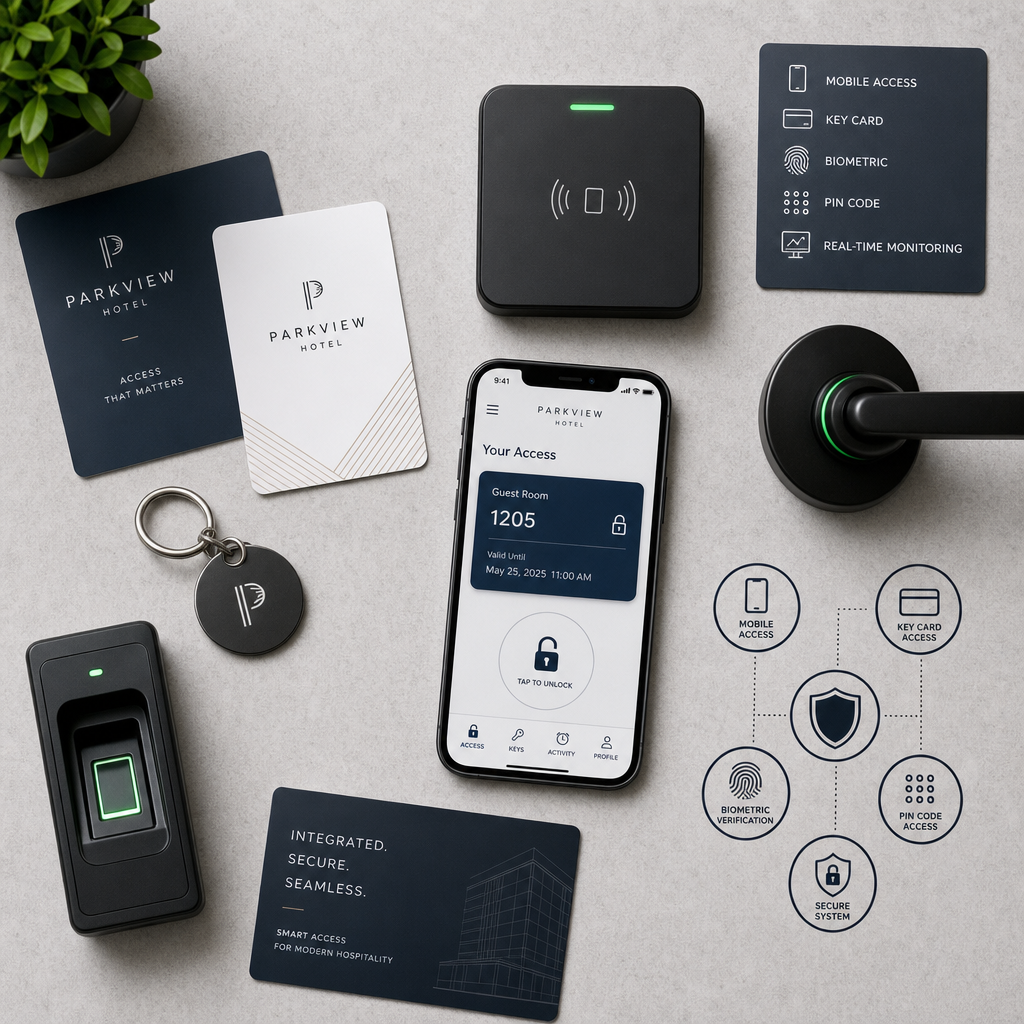
A room lock is one component. A complete hospitality access control system covers every controlled entry point on your property: guest room doors, stairwells, elevators, pool areas, fitness centers, parking gates, service entrances, and back-of-house areas. Each zone has a different access population, a different risk profile, and a different credential requirement.
Zoning Your Property for Access Control
The standard approach is to define three zones: guest zones (rooms, amenity areas with guest access), shared zones (lobbies, corridors, laundry rooms), and staff-only zones (housekeeping storage, server rooms, management offices). Each zone requires a different access profile.
Guest credentials should automatically grant access to their room, their floor’s stairwell exits, and any amenities included in their booking, nothing more. Staff credentials should be role-based: a housekeeper’s card opens housekeeping closets and assigned rooms during their shift window, not the GM’s office. This principle of least privilege is the single most effective administrative control in any access system.
Elevator and Floor Access Control
Floor-restricted elevator access is a feature that significantly improves both security and guest comfort perception. When a guest’s key card only activates the button for their floor, unauthorized individuals cannot simply ride the elevator to any floor and try doors. The technology to implement this exists at a reasonable cost and integrates with the same credential system used for room locks.
Property Management System Integration
The practical value of a hospitality access control system multiplies when it is connected to your PMS. Checkout triggers automatic credential expiration. Early check-in is handled by staff with a software action, not a physical key handoff. Audit logs sync with guest records for incident management. Properties using PMS-integrated access control consistently report fewer post-checkout security calls because credential deactivation is no longer a manual step that staff can forget.
Hotel Security System Integration: CCTV, Intercoms, and Gate Access
Smart locks are most effective when they are part of a broader hotel security system, not a standalone hardware upgrade. The combination of CCTV surveillance, intercom systems, gate access control, and smart locks creates overlapping layers of protection where each element supports the others.
CCTV Placement Strategy for Hotels
The minimum effective CCTV deployment for a hotel covers: all exterior entries, the main lobby and front desk, elevator banks and stairwell landings, parking areas, and pool or recreation zones. Corridors with room doors are a more sensitive placement decision and vary by jurisdiction regarding guest privacy laws. Check local regulations before installing corridor cameras.
Resolution matters more than camera count. Two 4K cameras with good coverage angles outperform eight 720p cameras with poor placement. In practice, the footage quality difference becomes critical the moment you need to identify a face or read a plate number.
Intercom Systems at Entry Points
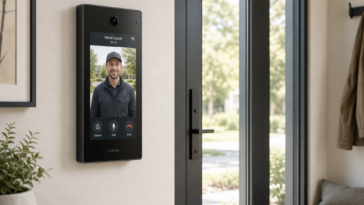
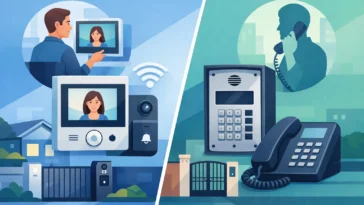
A two-way video intercom at your main vehicle gate, pedestrian entrance, and service delivery entry is one of the highest-value security investments per dollar for any hotel or motel. It allows staff to visually verify a visitor before granting access, without leaving the front desk.
Modern wireless intercom systems eliminate the need for extensive wiring between the entry point and the staff station. For properties where the front desk is far from the main vehicle gate, a wireless intercom with mobile app notification means the same staff member can manage the desk and the gate simultaneously.
Gate Access Control for Parking and Service Areas
Uncontrolled parking areas are a consistent vulnerability at motels and budget hotels. A gate access system using proximity cards, license plate recognition, or PIN entry limits your parking area to registered guests and authorized vehicles. This reduces trespassing, vehicle-related incidents, and the liability exposure that comes with them.
The gate system should use the same credential infrastructure as your room locks wherever possible. A guest who checks in receives a credential that works at both their room door and the parking gate. This unified approach reduces the administrative overhead of managing separate access populations for different entry points.
Comparison of Hotel Lock System Approaches
| System Type | Best Fit Property | Key Strengths and Limitations |
|---|---|---|
| Encrypted RFID with PMS Integration | Mid-scale to upscale hotels, 40+ rooms, staffed front desk | Strongest audit trail, seamless checkout expiration, PMS sync. Requires wired infrastructure and professional installation. Higher upfront cost. |
| Wireless PIN Keypad Smart Locks | Budget motels, extended-stay properties, limited overnight staffing | No wiring required, easy retrofit, supports automated SMS credential delivery. Less granular audit data than RFID. Guest PIN sharing is an inherent limitation. |
| Bluetooth/NFC Mobile Key Locks | Boutique hotels targeting tech-forward guests, vacation rental portfolios | Eliminates physical card costs, supports remote access management. Requires consistent guest smartphone usage. App onboarding adds a check-in friction point for non-tech-savvy guests. |
Biometric and Facial Recognition in Hospitality: Real Use Cases
Biometric access is the most precise form of credential verification available, because the credential is physically inseparable from the authorized person. A key card can be lost or stolen. A PIN can be shared. A fingerprint or facial geometry cannot be transferred.
Where Biometrics Actually Deliver Value in Hotels
In practice, guest-facing biometric room locks introduce more problems than they solve at most properties. First-time enrollment at check-in adds time. Guests with certain skin conditions or injuries may have enrollment failures. And data privacy regulations around biometric data collection vary significantly by country and state, creating compliance complexity that most hotel operators are not equipped to manage.
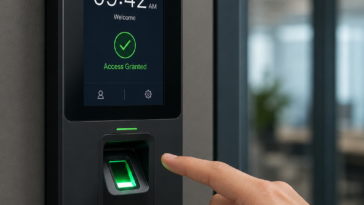
The use cases where biometric access genuinely delivers reliable ROI in hospitality are staff-only zones. A facial recognition lock on a server room, a management office, or a cash handling area eliminates the risk of shared PINs and lost key cards among staff. Time attendance systems with biometric verification also eliminate buddy punching, a documented labor cost problem in shift-based hospitality operations.
Facial Recognition for Time and Attendance
Biometric time attendance clocks using facial recognition are a practical and well-accepted implementation in hospitality back-of-house environments. They record shift start and end times with identity verification, provide payroll-ready exports, and integrate with common HR platforms. For a property with 30 or more hourly staff, the labor cost accuracy improvement alone typically covers the system cost within one year.
Pro tip: If you are implementing biometric systems for staff, consult your legal counsel about biometric data storage requirements in your jurisdiction before deployment. Several U.S. states and many international markets have specific consent and retention rules for biometric data that carry significant penalties for non-compliance.
Common Mistakes in Hotel Access Control (And How to Avoid Them)
After seeing how properties of different sizes approach security upgrades, certain failure patterns appear repeatedly. These are not edge cases. They are the standard ways that otherwise reasonable investment decisions produce disappointing results.
Upgrading Room Locks Without Addressing Other Entry Points
This is the most common and most costly mistake. A property installs high-quality encrypted smart locks on every guest room, then leaves the pool gate propped open with a brick, the laundry room door unlocked around the clock, and the parking area accessible to anyone. The guest room upgrade provides a false sense of comprehensive security. Access control is only as strong as its weakest physical point.
Choosing Systems That Cannot Talk to Each Other
Proprietary lock systems from different manufacturers often cannot share credential databases or audit logs. A property that buys its room locks from one vendor, its parking gate system from another, and its intercom from a third ends up managing three separate platforms with no cross-system visibility. The operational cost of this fragmentation compounds over time.
The solution is to evaluate total system compatibility before purchasing any single component. Work with a supplier that can provide or integrate across locks, intercoms, gate access, and CCTV under a unified management framework.
Ignoring Battery Management on Wireless Locks
A smart lock with a dead battery is worse than no lock at all, because it creates an emergency situation at the guest’s door that your maintenance staff has to resolve at any hour. A common mistake is deploying wireless locks without a battery monitoring policy. Every serious wireless lock system includes a low-battery alert function. Ignoring those alerts until failure is a choice, and it is the wrong one. Set a property-wide battery replacement schedule and stick to it.
Neglecting Staff Training on Access Control Management
The hardware is only part of the system. If front desk staff do not know how to deactivate a credential when a guest reports a lost card, how to pull an audit log when an incident occurs, or how to issue a temporary access override for maintenance, the system’s capabilities go unused. Budget for staff training as a non-optional line item in any access control deployment.
Frequently Asked Questions
What is the best type of hotel door lock for a small motel with no front desk staff overnight?
A wireless PIN keypad smart lock with automated SMS credential delivery is the most practical choice for unstaffed overnight operations. Guests receive a unique PIN before arrival, bypass any front desk interaction, and enter their room independently. Pair it with a video intercom at the main entry and a connected CCTV camera covering the exterior for full coverage without requiring physical staff presence.
How much does it cost to install a complete hotel smart lock system?
Costs vary significantly based on property size, lock type, and whether existing wiring infrastructure is in place. A ballpark range for a 30-room motel upgrading to wireless keypad smart locks is between $4,000 and $12,000 for hardware, depending on specification level. Adding a gate access system and entry intercom typically adds $1,500 to $5,000. RFID systems with PMS integration for a 60-room corridor hotel can run $15,000 to $40,000 fully installed. Always get itemized quotes that separate hardware, software licensing, and installation labor.
Can hotel smart locks be integrated with existing property management software?
Most mid-to-upper-tier smart lock systems designed for hospitality include API integration with major PMS platforms including Opera, Mews, Cloudbeds, and others. The integration depth varies: some systems support only credential creation and expiration, while others sync in real time with reservation data for automated early check-in and checkout handling. Verify PMS compatibility before committing to a lock system, and ask specifically about the integration setup cost, which is often quoted separately from the hardware.
How do I handle access control for amenity areas like pools, gyms, and conference rooms?
The cleanest approach is to issue a single credential at check-in that controls access to all areas the guest is authorized for based on their booking type. RFID cards and mobile key apps both support this multi-zone access model well. For amenity areas with time-restricted access, such as a pool that closes at 10 PM, schedule-based access rules can be configured in the lock management software so the credential simply stops working outside authorized hours without any staff action required.
What should I look for in a hotel security camera system to pair with smart locks?
Prioritize cameras with at least 1080p resolution, ideally 4K for entry points where facial identification may be needed. Look for systems with local storage plus cloud backup, night vision or IR capability for low-light coverage, and weather resistance ratings of IP66 or higher for exterior placement. The camera system should record continuously, not only on motion trigger, for entry point cameras. Motion-triggered recording is acceptable for secondary areas like corridors but unreliable for primary access points where you need complete timestamp-accurate footage.
Are biometric locks suitable for hotel guest rooms?
In most cases, no, not as the primary credential for guest rooms. The enrollment friction at check-in, the potential for failure with guests who have temporary or permanent fingerprint recognition issues, and the data privacy compliance requirements make biometric guest room locks impractical at the majority of properties. Biometric access delivers clear value in staff-only areas and for time attendance tracking. For guest rooms, encrypted RFID or mobile key access provides better user experience with equivalent or better security.
Have you recently upgraded your property’s access control system, or are you still evaluating options? Share what has worked or where you have run into problems, because real-world property feedback helps everyone in this space make better decisions.
References
- Statista hospitality industry data on mobile check-in adoption and hotel security trends
- Forbes coverage of smart building technology and hospitality security investment
- NIST guidelines on physical access control systems and credential security standards
- American Hotel and Lodging Association resources on property security and risk management
- McKinsey analysis of technology adoption in the hospitality sector and operational efficiency gains
 No products in the cart.