
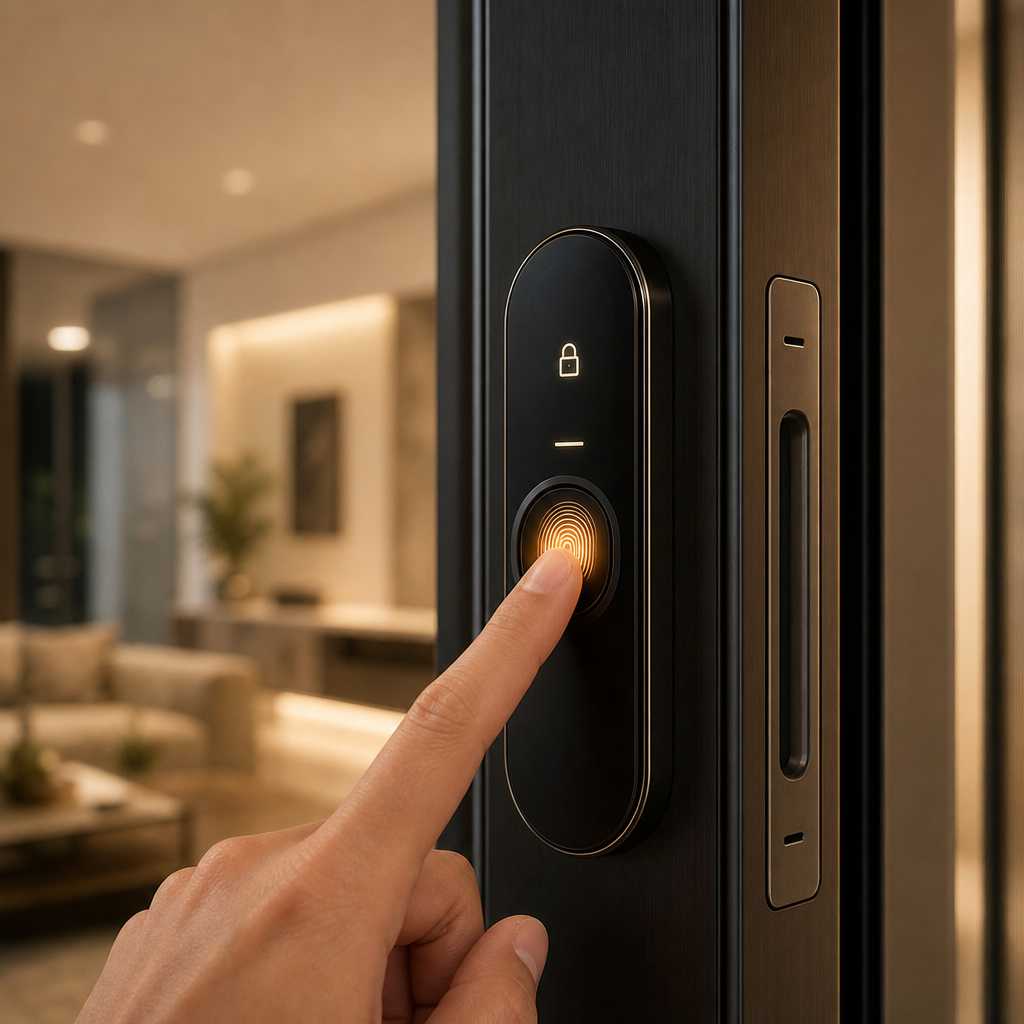
Sliding doors are one of the most common security weak points in residential and commercial properties. A standard sliding door lock can be defeated with a flathead screwdriver in under 30 seconds, yet most property owners treat this as an afterthought. If you are managing an apartment building, running a business, or protecting a home with a patio or balcony sliding door, upgrading to a fingerprint sliding door lock is not a luxury. It is the most practical security decision you can make right now.
Table of Contents
- Why Sliding Doors Are a Security Liability
- Quick Takeaways
- What Makes a Fingerprint Sliding Door Lock Different
- Sliding Door Smart Lock Options Compared
- Installation and Compatibility: What You Need to Know
- Smart Lock Upgrade for Property Managers and Facilities
- Frequently Asked Questions
- References
Why Sliding Doors Are a Security Liability
According to the FBI’s Uniform Crime Reporting data, roughly 34 percent of burglars enter through a front door, but sliding glass and patio doors rank consistently among the top five entry points exploited in residential break-ins. The reason is mechanical. Most factory-installed sliding door locks use a simple latch hook that engages a thin metal strike plate. That design has not meaningfully changed since the 1970s.
The vulnerability is not just physical. Traditional key locks on sliding doors create access management problems for property managers who need to rotate access credentials when a tenant leaves. Rekeying a sliding door lock is rarely prioritized, which means former occupants often retain silent access for months or years.
A sliding door smart lock solves both problems simultaneously: it eliminates the mechanical weakness of latch-hook designs and replaces shared keys with individually registered biometric profiles that can be added or revoked in seconds.
Quick Takeaways
| Key Insight | Explanation |
|---|---|
| Standard sliding locks fail fast | Most factory latches can be bypassed in under 30 seconds using basic tools. This is not a theoretical risk. |
| Fingerprint authentication eliminates key duplication | Biometric credentials cannot be copied at a hardware store, removing one of the most common access control failures. |
| Access revocation is instant | Property managers can delete a fingerprint profile the moment a tenant vacates, with no locksmith required. |
| Multi-modal locks outperform single-method locks | Locks offering fingerprint plus PIN plus app access reduce lockout incidents by giving users backup entry methods. |
| Retrofit installation is possible on most tracks | Many fingerprint sliding door locks are designed to fit standard track widths without structural modification. |
| Smart lock upgrade ROI is measurable for B2B | Facilities that switch to biometric access report reduced locksmith callout costs and faster tenant turnover processing. |
| Battery life is a real operational concern | Quality fingerprint smart locks deliver 6 to 12 months per charge cycle. Budget options often fall below 3 months. |
What Makes a Fingerprint Sliding Door Lock Different
Most discussions about smart locks focus on front door deadbolts. Sliding doors operate on a completely different mechanical axis, meaning horizontal force resistance and track engagement are the critical specs, not bolt throw depth. A fingerprint sliding door lock must address both the biometric authentication layer and the physical reinforcement of a door that moves laterally rather than swinging on a hinge.
How Biometric Authentication Works in Practice
In practice, fingerprint sensors on quality sliding door locks use capacitive or optical scanning to map ridge patterns against stored templates. Capacitive sensors, the same technology in flagship smartphones, perform more reliably in varying humidity and temperature conditions. This matters specifically for patio and balcony doors that are exposed to outdoor air.
A common mistake is assuming all fingerprint scanners are equally reliable. Entry-level optical sensors can be fooled by a high-resolution photograph of a fingerprint. Capacitive sensors require the actual electrical properties of a living fingertip, making spoofing significantly harder.
Physical Security Reinforcement Beyond the Lock Itself
The best fingerprint sliding door lock on the market will underperform if the door frame and track are not reinforced. In practice, the weakest link is usually the upper track, which can be lifted to disengage even a locked latch. Anti-lift brackets and steel track inserts are inexpensive additions that turn a smart lock upgrade into a genuinely hardened entry point.


Pro tip: When sourcing a fingerprint sliding door lock from a specialist like UnikCCTV, ask specifically whether the unit includes integrated anti-lift hardware or whether that needs to be purchased separately. The answer tells you a lot about whether you are buying a complete security solution or just a lock.
Sliding Door Smart Lock Options Compared
Not every sliding door smart lock is built to the same standard. The market broadly separates into three categories: basic biometric retrofit locks, integrated smart home system locks, and commercial-grade access control locks. Understanding the differences saves significant money and prevents underbuying for a property’s actual security requirements.
| Lock Type | Best For | Key Limitation |
|---|---|---|
| Basic Fingerprint Retrofit Lock | Single-family homeowners upgrading a patio door with a limited budget. Fits most standard track widths. | No remote access management. Access profiles must be added physically at the device. |
| Integrated Sliding Door Smart Lock with App Control | Homeowners and small businesses that want remote locking, access logs, and smart home integration via Wi-Fi or Bluetooth. | Dependent on network connectivity. Cloud service outages can interrupt remote functions. |
| Commercial-Grade Biometric Sliding Lock | Property managers, facility operators, and businesses needing multi-user profile management, audit trails, and high-cycle durability. | Higher upfront cost. May require professional installation to integrate with existing access control panels. |
UnikCCTV stocks options across all three categories, which is a meaningful differentiator from general home improvement retailers like Home Depot where sliding door security is treated as a one-size solution. For property managers overseeing multiple units, the commercial-grade category is the correct starting point, not a premium add-on.
“The global smart lock market was valued at approximately 2.47 billion USD in 2022 and is projected to grow at a compound annual growth rate of over 20 percent through 2030, driven primarily by demand for keyless biometric access in residential and commercial properties.” – Statista Market Insights, Smart Lock Segment Analysis
Installation and Compatibility: What You Need to Know
One of the most common mistakes property owners make during a smart lock upgrade is purchasing a lock without verifying compatibility with their existing door track profile. Sliding doors in North American residential construction typically follow one of three track width standards, but custom or older doors, particularly in commercial buildings, may fall outside those norms.
Track Width and Door Thickness Verification
Before purchasing any fingerprint sliding door lock, measure the track width and the door panel thickness. Most retrofit locks accommodate panels between 28mm and 45mm. Anything outside that range requires either a custom-fit solution or additional adapter hardware. UnikCCTV’s consultation service is particularly useful at this stage because getting the wrong unit means a return and a delay, not just a minor inconvenience.
Power Source and Battery Management
Fingerprint sliding door locks are almost universally battery-powered because sliding doors lack the fixed frame wiring channels that hardwired systems use. The data consistently shows that AA lithium batteries outperform alkaline in cold outdoor environments by a significant margin. For any patio or balcony door exposed to winter temperatures below 5 degrees Celsius, lithium is not optional.
Most quality units include a low-battery alert via app notification or LED indicator before the lock fails. Buying a lock without this feature creates a predictable operational failure that undermines the entire point of the upgrade.

Pro tip: Set a recurring calendar reminder to check battery levels every 90 days regardless of what the indicator shows. For high-traffic commercial sliding doors, check monthly. Biometric sensors consume more power than simple PIN locks because of the processing overhead involved in fingerprint matching.
Integration with Existing Security Systems
For facilities already running CCTV surveillance or intercom systems, the highest value comes from selecting a fingerprint sliding door lock that communicates with your existing access control panel. UnikCCTV specializes in exactly this kind of integrated setup, connecting smart locks with intercoms, gate access systems, and CCTV feeds into a single managed environment. That level of integration is simply not available through general retail channels.
Smart Lock Upgrade for Property Managers and Facilities
For property managers and facility operators, the argument for a smart lock upgrade on sliding doors is not primarily about technology. It is about operational efficiency and liability reduction. Every key-based sliding door lock in a managed property represents a latent cost: locksmith callouts, key duplication incidents, and the administrative gap between a tenant vacating and the lock being changed.
Audit Trails and Access Accountability
Commercial-grade fingerprint sliding door locks generate timestamped access logs for every entry event. For facilities that require compliance documentation, maintenance access records, or incident investigation capabilities, this is a non-negotiable feature. In practice, access logs have resolved tenant disputes about unauthorized entry in a fraction of the time that traditional investigation processes would require.
Scaling Access Management Across Multiple Units
The operational case for biometric locks strengthens significantly at scale. A property manager overseeing 20 units with sliding patio doors, each requiring individual key management, is carrying a disproportionate administrative burden. Centralizing that through a smart lock platform reduces the per-unit time cost and eliminates the key inventory problem entirely.
Companies like ButterflyMX offer intercom-centric access control solutions, and BEC Integrated focuses on broader building management ecosystems. UnikCCTV’s advantage is in offering the hardware itself, including fingerprint locks, intercoms, gate controls, and CCTV, at competitive pricing with direct access to configuration support. That matters when you are retrofitting 20 sliding doors and need a consistent solution across all of them.
Frequently Asked Questions
Can a fingerprint sliding door lock be installed on any existing sliding door?
Most retrofit fingerprint sliding door locks fit standard residential track widths between 28mm and 45mm door panel thickness. Older or custom commercial sliding doors may require adapter hardware or a professional assessment before installation. Always verify track width and panel thickness against the lock specifications before purchasing.
How many fingerprint profiles can a sliding door smart lock store?
Entry-level units typically store between 10 and 20 fingerprint profiles. Mid-range and commercial-grade locks store between 50 and 200 profiles. For property managers handling tenant turnover across multiple units, selecting a lock with a higher profile capacity and remote management capability is the correct choice even if the upfront cost is higher.
What happens if the fingerprint sensor fails or the battery dies?
Quality fingerprint sliding door locks include backup entry methods, typically a PIN keypad, a physical key override, or both. Battery failure is mitigated by low-battery alerts that provide several days of warning before the lock becomes inoperable. For critical access points, maintaining a physical key backup in a secure location is a sensible precaution regardless of the lock quality.
Is a fingerprint sliding door lock weather-resistant enough for outdoor patio doors?
This depends entirely on the unit’s IP rating. Look for a minimum of IP54 for covered patio environments and IP65 or higher for doors exposed to direct rain or humidity. Locks without an IP rating should not be used on any door with exterior exposure. UnikCCTV’s product specifications include IP rating details, which makes comparison straightforward before purchase.
How does a fingerprint sliding door lock compare to a keypad-only smart lock for security?
Fingerprint authentication is materially more secure than a PIN keypad alone because biometric credentials cannot be shared, written down, or shoulder-surfed. Keypad codes are frequently shared between users informally, which defeats access accountability. For any property where knowing exactly who entered and when is operationally important, fingerprint authentication is the correct choice. Multi-modal locks that offer both fingerprint and PIN provide the best balance of security and convenience.
What is the realistic lifespan of a fingerprint sliding door lock?
Commercial-grade units are typically rated for 100,000 or more access cycles and carry manufacturer warranties of 2 to 3 years on electronics. For a residential patio door used 4 to 6 times daily, that represents decades of use. The weakest component in practice is the fingerprint sensor, which degrades fastest in environments with extreme humidity or dust. Choosing a sealed, capacitive sensor unit extends practical lifespan significantly.
Have you installed a fingerprint sliding door lock on your property, or are you currently evaluating options? Share what factors matter most in your decision below.
References
- Statista smart lock and home security market size data and growth projections
- Forbes coverage of biometric access control technology and smart home security trends
- NIST guidelines on biometric system performance and fingerprint authentication standards
- U.S. Department of Energy resources on building security and physical access control for commercial facilities
- National Criminal Justice Reference Service research on residential burglary entry points and prevention

 No products in the cart.