
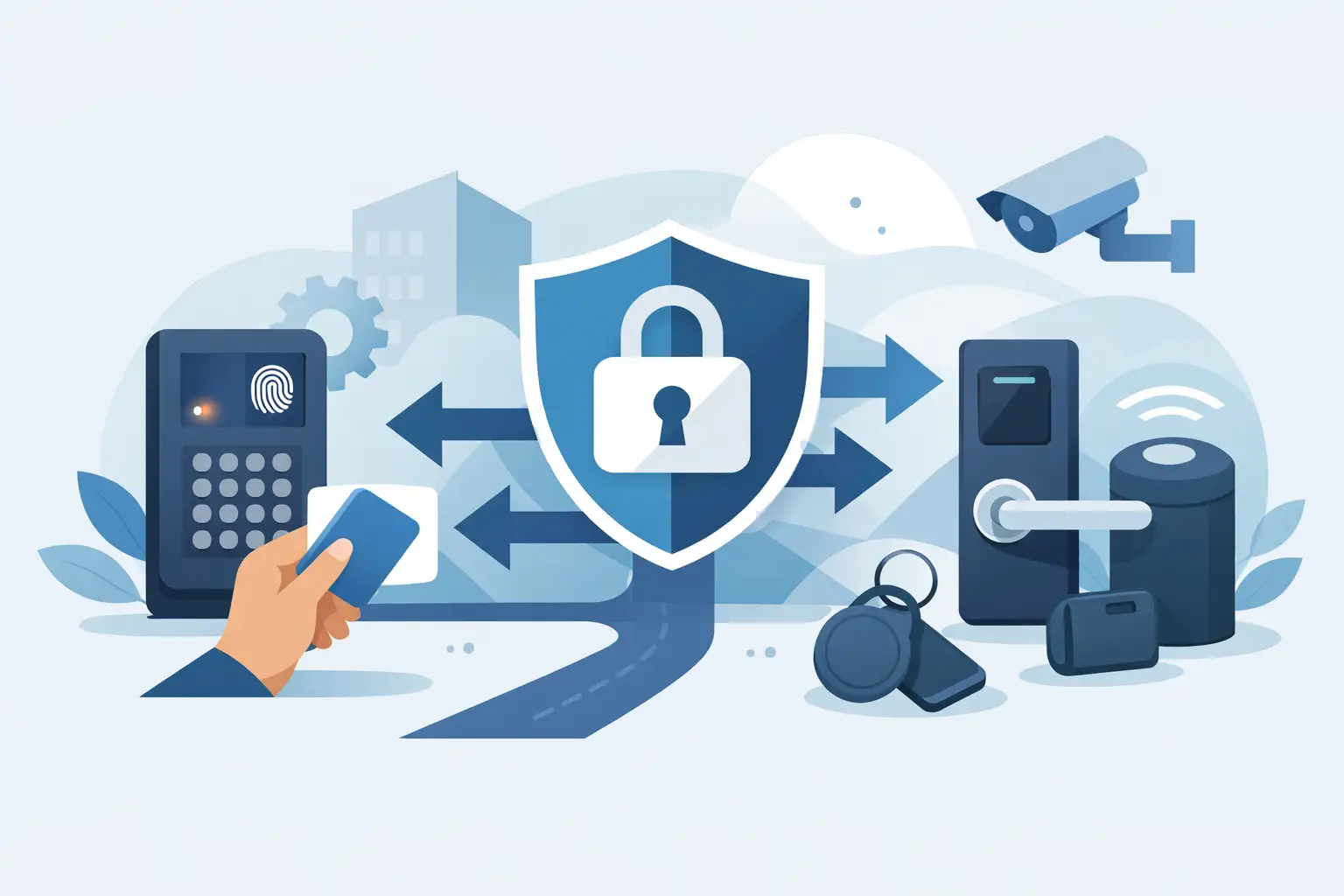
A door that looks simple on a floor plan can become the hardest part of a security project once hardware is involved. The opening may need to stay locked during business hours, release safely during an emergency, work with an intercom, handle heavy traffic, and fit an existing frame that was installed years ago. That is why access control hardware should be selected as part of the full opening, not as an isolated device.
For installers, property managers, and facility teams, the right hardware choice affects daily reliability more than almost any software setting. A reader can be programmed in minutes. Replacing the wrong electric lock on a misaligned aluminum storefront door is a different story. Good planning starts with understanding how the door functions, who uses it, what level of control is required, and what other components have to work with it.
What access control hardware actually includes
In practical terms, access control hardware is the physical layer that allows a system to grant, restrict, monitor, or release entry. That usually includes electric strikes, magnetic locks, electrified locksets, panic hardware, request-to-exit devices, door position contacts, power supplies, readers, keypads, credentials, exit buttons, and mounting accessories. Depending on the opening, it can also include intercom-related release hardware, gate hardware, or mechanical lock components that support the electronic side.
This matters because many buying mistakes happen when people think only about the credential side. Cards, fobs, and mobile credentials are visible to the user, but the opening lives or fails based on the lock type, door condition, cabling path, and code requirements. In commercial work especially, the hardware set has to match the actual use of the door, not just the preferred reader technology.
Start with the opening, not the reader
Before selecting a lock or controller, define the opening itself. A hollow metal door in a commercial corridor has different options than a glass storefront door, a wood office door, a gate, or a multi-tenant apartment entrance. Fire-rated openings, narrow stile aluminum doors, and doors with existing panic hardware all narrow the field quickly.
Traffic volume also changes the recommendation. A back office door with ten users per day can tolerate solutions that would not hold up at a school entry or apartment vestibule. Frequent cycling affects lock wear, power demand, and the need for durable request-to-exit and monitoring devices. High-abuse environments usually justify heavier-duty hardware from the start.
Door swing and frame condition matter as well. In-swing versus out-swing affects whether a maglock, strike, or electrified lock body is realistic. Existing misalignment can cause intermittent latch issues that get blamed on the access system even though the problem is mechanical. If the base door hardware is already failing, adding electronics will not fix the opening.
Electric strikes, maglocks, and electrified locks
Most projects land on one of three hardware approaches, and each has trade-offs.
Electric strikes are common when you want to keep a mechanical lockset or mortise lock at the door and release the latch from the frame side. They are often a practical retrofit choice, especially on commercial doors where preserving egress hardware makes sense. The benefit is that the door remains latched securely, and the opening can look clean from the outside. The downside is that strike compatibility can become very specific. Faceplate size, latch style, frame depth, and preload conditions all need attention.
Maglocks are often chosen for storefronts, glass doors, and difficult retrofit openings where modifying the frame for a strike is not ideal. They are straightforward in concept and can offer strong holding force, but they also require the correct life-safety accessories and code-compliant release logic. A maglock is not just a lock and a reader. It is a system that depends on request-to-exit devices, fire alarm release where required, and proper power planning. When those supporting parts are treated as optional, the installation becomes unreliable or noncompliant.
Electrified locksets and electrified panic hardware are usually the better long-term answer when the opening needs a cleaner integrated approach and the budget supports it. These options can provide better fit and finish for higher-end commercial applications, schools, and managed facilities. They also tend to demand more planning around door prep, hinge wiring, transfer devices, and handoff between locksmith, door hardware, and low-voltage trades.
Readers and credentials should match the use case
Once the locking side is defined, the credential method becomes easier to choose. Keypads work well for lower-user-count openings, temporary access control, or places where managing physical credentials is not practical. They are simple, but codes get shared. That may be acceptable at a stockroom or service entrance and less acceptable at a school or multi-tenant property.
Card and fob readers remain a standard choice because they are familiar, scalable, and easy to manage across multiple openings. They are a better fit when access rights change often or when audit history matters. In apartment, office, and light industrial settings, they balance cost and control well.
Mobile credentials can reduce physical credential handling, but they are not automatically the best option for every site. Some customers want them for convenience, while others prefer cards because they are easier to issue in volume, easier to replace on the spot, or better suited to users who do not want to rely on phones. The right answer depends on the user base, management process, and budget.
Power, egress, and monitoring are where projects go right or wrong
Hardware selection is not complete when the lock is chosen. Power supplies, relays, battery backup, and fire interface are critical parts of the opening. An underpowered lock circuit or poorly planned enclosure creates service calls that are avoidable from day one.
Fail-safe versus fail-secure is another decision that should be made carefully. A fail-safe device unlocks when power is lost. A fail-secure device stays locked when power is lost, while allowing free egress where the hardware is designed for it. Neither is universally better. The decision depends on life safety requirements, occupancy type, emergency planning, and the operational risk of a door unlocking during an outage.
Monitoring also deserves more attention than it often gets. Door position switches, request-to-exit devices, and latch or lock status outputs give the system real awareness of what the opening is doing. Without that feedback, the system may know a credential was presented but not whether the door was forced open, propped, or failed to secure. For managed properties and commercial sites, that visibility often matters as much as the lock itself.
Matching hardware to the building type
Different environments push buyers toward different hardware sets. Apartment entries often combine access control with intercom release, tenant management, and traffic from deliveries or visitors. The front entrance may need durable hardware and easy remote release, while side or utility doors may need simpler credentialed access.
Office buildings usually prioritize controlled employee access, visitor handling, and clean integration with existing door hardware. Schools place heavier emphasis on life safety, fast lockdown capability, durable exit hardware, and controlled public entry. Industrial sites may need weather-rated components, gate control, higher abuse resistance, and hardware that tolerates dust, vibration, or wider temperature swings.
This is why a generic hardware recommendation rarely works well. The opening has to be evaluated in context. Two exterior doors on the same property can require different hardware if one is a public entrance and the other is a staff delivery door.
Common buying mistakes to avoid
One common mistake is choosing hardware based on price before checking door compatibility. A less expensive strike or maglock can become the costlier option once modifications, callbacks, and replacement labor are counted. Another is assuming all readers and credentials will integrate easily with existing controllers. Protocols, credential formats, and power requirements still need verification.
It is also common to overlook accessories. Mounting brackets, housings, power transfer devices, request-to-exit sensors, surge protection, and weather protection are not afterthoughts. They are often what turns a parts order into an install-ready package.
Finally, many buyers underestimate support needs. Access hardware decisions affect locksmithing, low-voltage wiring, door function, and code compliance. Getting application guidance before ordering is usually faster than troubleshooting mismatched parts on site.
Why experienced sourcing matters for access control hardware
When a project includes mixed door types, retrofits, intercom release, or commercial-grade entry management, category depth matters. The goal is not just to buy a reader or a lock. It is to assemble hardware that works together, fits the opening, and can be supported later when changes or replacements are needed.
That is where a specialized distributor adds value. A supplier that works with installers, facilities teams, resellers, and property operators every day can help narrow options based on frame type, lock prep, traffic level, and system intent. For customers dealing with anything from apartment entrances to offices, schools, gates, or industrial doors, that practical guidance often prevents the delays that start with one wrong part number.
The best access control hardware choice is usually not the flashiest option. It is the one that fits the opening, meets the code path, holds up under actual use, and leaves you with a system that is serviceable a year from now. If you begin with the door and work outward, the rest of the system tends to make much more sense.


 No products in the cart.