
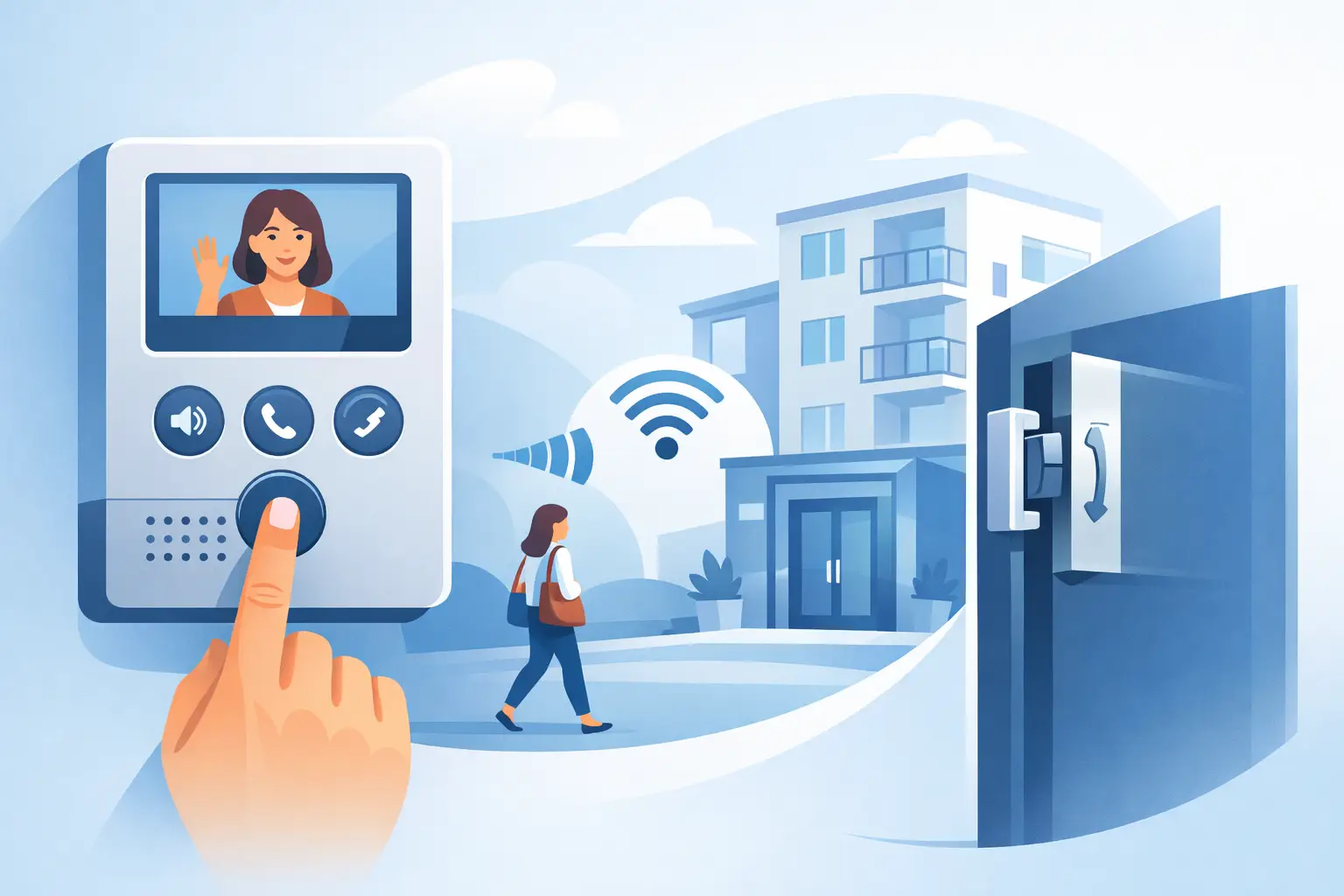
When a tenant is standing in the rain waiting for the front door to buzz open, nobody cares about marketing terms. They care that the call goes through, the resident can verify the visitor, and the door release works every time. That is the real standard for an apartment intercom system with door release, especially in multifamily buildings where reliability affects security, tenant satisfaction, and day-to-day management.
For property managers, installers, and building owners, the right system is not just an intercom at the door. It is a coordinated entry setup that connects communication, credentialing, power, locking hardware, and the physical realities of the building. A good fit reduces service calls. A poor fit creates recurring problems, from missed calls and stuck doors to tenant complaints and access control gaps.
What an apartment intercom system with door release actually does
At a basic level, the system lets a visitor call a resident or front desk, establish audio or video communication, and trigger a door to unlock remotely. In practice, the system can do much more depending on the application. It may support multiple tenant stations, mobile app answering, keypad or card access at the entrance, elevator control, directory functions, or integration with existing electric strikes and magnetic locks.
That is why these systems should be specified as part of the entire entry path, not as an isolated door station. The outdoor panel, tenant devices, power supply, lock hardware, exit devices, and wiring method all need to work together. If one part is mismatched, the intercom may function but the release cycle may be inconsistent or unsafe.
Start with the building, not the brochure
The biggest mistake in apartment intercom selection is choosing features before defining the building conditions. A small six-unit walk-up has different needs than a mid-rise with multiple entrances, package traffic, and after-hours access rules.
An older building may favor a system that can reuse existing wiring or replace a legacy audio intercom without opening every wall. A newer property may be better served by IP-based equipment with video, app-based call routing, and broader access-control options. Neither approach is automatically better. The right answer depends on distance, cabling pathways, tenant expectations, and how much change the property can absorb during installation.
Door count matters just as much as unit count. A single front entrance is straightforward. Multiple vestibules, side doors, parking entries, or gate access can push the job into a broader access-control design. At that point, the intercom is part of a managed entry system rather than a standalone call box.
Door release choices are where many projects go right or wrong
The phrase door release sounds simple, but there are several ways to accomplish it. The intercom may trigger an electric strike, a magnetic lock, or another electrified locking device. Each has different power and life-safety implications.
Electric strikes are common in apartment entry doors because they allow remote release while working with a mechanical lockset. They can be a practical option when the opening already has compatible hardware and frame conditions. But the installer still needs to confirm voltage, current draw, fail-safe versus fail-secure operation, and whether the existing latch and frame can support the strike properly.
Maglocks are common in some entry and vestibule applications, especially where door and frame conditions make strikes harder to install. They require proper egress hardware and attention to code requirements. A maglock can hold strongly, but it is not a drop-in answer for every apartment entrance. If the release hardware is selected without considering fire alarm interface, request-to-exit devices, or local code, the result can be expensive rework.
This is why buyers should treat the lock and release hardware as equal to the intercom itself. The outdoor panel gets attention because it is visible. The release side is what determines whether the system actually controls entry correctly.
Wired, IP, or hybrid: the decision depends on the site
For many apartment projects, the first technical fork in the road is system architecture. Traditional wired intercoms still make sense where stability, simpler functions, and predictable in-building performance matter most. They are often easier to support over the long term in basic residential applications.
IP intercoms offer more flexibility, especially when the property wants video, mobile answering, cloud-based management, or broader credential integration. They can also make sense in larger buildings where multiple entrances, management stations, and centralized administration are part of the plan. But IP systems require more network planning, device provisioning, and coordination with the building’s IT environment.
Hybrid approaches are often the practical middle ground. They can preserve parts of an existing infrastructure while adding modern entrance panels or updated resident communication options. For many retrofit jobs, that balance can save both labor and disruption.
Video is valuable, but it is not always the first priority
A video intercom gives residents and staff a better way to verify visitors. In buildings with package delivery volume, after-hours visitor traffic, or recurring security concerns, video can be worth the added cost. It can also improve confidence for tenants who do not want to open the main door based on audio alone.
Still, video does not fix weak fundamentals. If the camera view is poorly positioned, the network is unstable, or the release hardware is undersized, the system will still frustrate users. In many apartment applications, clear audio, dependable call routing, and a consistent release cycle matter more than adding advanced video features.
That is especially true in retrofit environments. If the budget forces a choice between a high-end video panel and properly matched locking hardware with adequate power, the hardware usually deserves the investment first.
The resident experience matters more than feature count
An apartment intercom system with door release only works well if tenants can use it without confusion. Residents should be able to answer quickly, identify who is calling, and release the door without guessing through a complicated menu.
For some properties, in-unit stations are still the best fit because they are simple and predictable. For others, mobile-based answering is more practical, especially where residents expect to manage access from their phones. The trade-off is that app-based access depends on user setup, phone availability, and network reliability. In-unit hardware is less flexible, but often more consistent.
Directories also deserve careful thought. A large directory with poor navigation slows down visitor entry and creates congestion at the front door. In a smaller building, a simpler layout is often better than a long list of functions nobody uses.
Installation planning affects long-term service costs
Many intercom issues that show up later are really installation planning issues from day one. Door station mounting height, weather exposure, cable routing, power supply location, surge protection, and lock alignment all shape long-term performance.
Retrofit buildings usually require the most discipline here. Existing wiring may be undocumented, damaged, or unsuitable for newer equipment. Entry doors may be out of alignment. Frames may not support the chosen strike cleanly. If those conditions are ignored during quoting, the finished system may technically operate but generate repeated callbacks.
This is where experienced product support makes a difference. A distributor with category depth can help match the intercom, power components, and release hardware to the actual application instead of forcing a generic kit into a building that needs a more specific approach. For buyers who need install-ready, professional-grade equipment, that guidance is often as important as the product itself.
What to confirm before you buy
Before selecting equipment, confirm the number of units, the number of controlled entrances, the type of door and frame at each opening, the lock hardware already in place, and whether the project is new construction or retrofit. Also confirm whether residents will use in-unit stations, phones, or both.
Then look at operating requirements. Does the property need audio only or audio and video? Is there a front office or concierge station? Will deliveries be handled through the main entrance? Does the owner want keypad, card, or fob access in addition to visitor calling? These answers shape the system more than brand names do.
It also helps to define who will maintain the system after installation. A simpler platform may be the better commercial choice if onsite staff need straightforward operation and replacement parts. A more advanced platform can be a strong fit when the property has the resources to support networked devices and user administration.
For buyers comparing options, the goal is not to find the most features. It is to find the most dependable fit for the building, the entry pattern, and the service expectations. That is the difference between a system that looks good in a catalog and one that performs at the front door year after year.
If you are planning an apartment entry upgrade, treat the intercom, release hardware, and building conditions as one system from the start. That approach usually saves more time and money than trying to correct mismatched components after tenants move in or complaints begin.
 No products in the cart.