
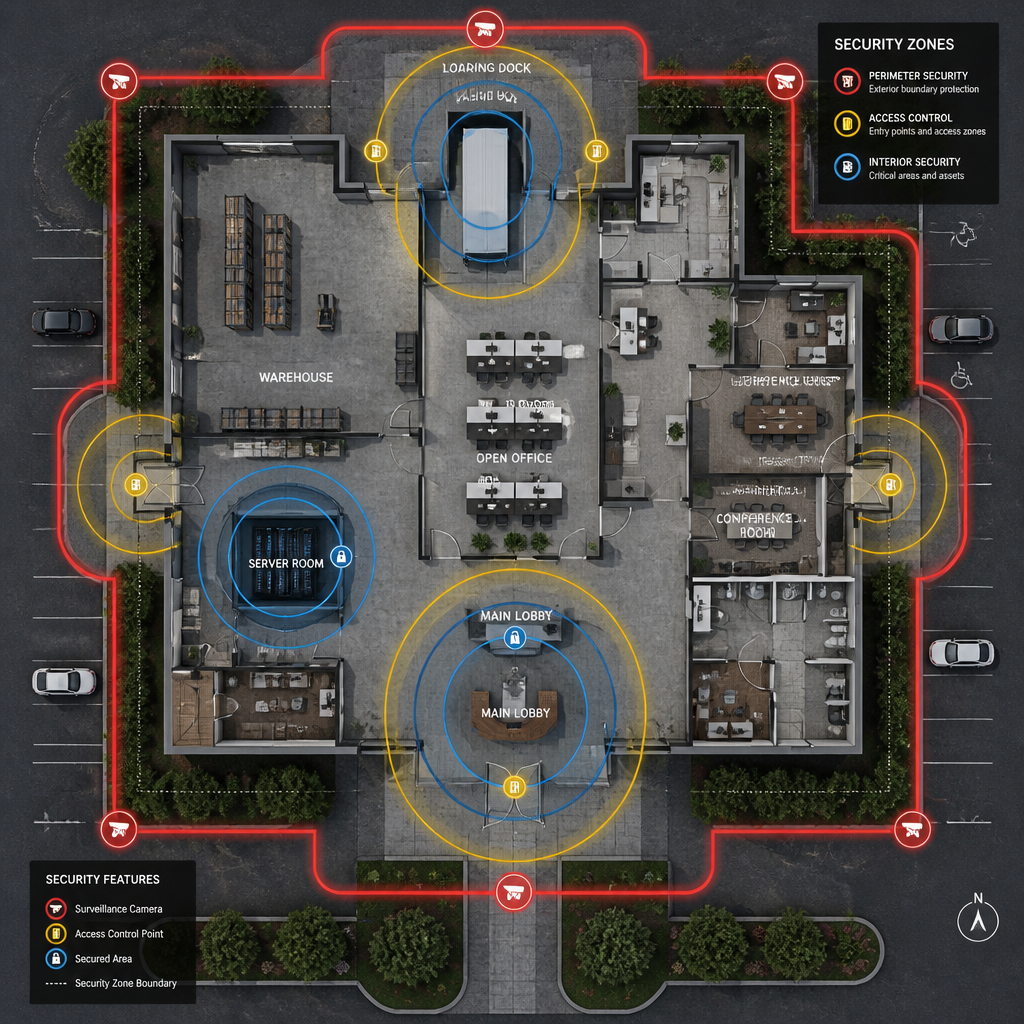
Most commercial security breaches do not happen at the front door. They happen at the loading dock, the propped-open server room door, or the side entrance that nobody checked because the main lobby camera looked fine. A single-perimeter strategy, where all the budget goes into one strong front line, is the most common and most costly mistake property managers make. A layered security system solves this by spreading protection across multiple independent rings, each one designed to catch what the previous layer missed. This guide walks through how to build that system for a commercial property, regardless of whether your budget is tight or generous.
Table of Contents
- Quick Takeaways
- Why Single-Layer Security Fails Commercial Properties
- The Three Rings of Defense: Perimeter, Entry Points, and Interior Zones
- Building Your Layers by Budget
- Access Control and CCTV Integration: Where the Real Value Is
- Comparison of Layered Security Approaches
- Common Mistakes to Avoid When Building a Layered System
- Frequently Asked Questions
- References
Quick Takeaways
| Key Insight | Explanation |
|---|---|
| Most breaches enter through secondary access points | Loading docks, service entrances, and unsecured interior doors are far more common breach points than the main lobby. Secure all entry points, not just the most visible one. |
| Three rings beat one strong wall | A layered system covers the outer perimeter, controlled entry points, and interior zones independently. If one layer is breached, the others still contain the threat. |
| Access control and CCTV must talk to each other | Integrating your access control system with your camera network links credential events to video footage, making investigations faster and deterrence stronger. |
| Budget-tier entry does not mean unsafe | Small commercial properties can build effective layered security using wireless intercoms, IP cameras, and smart locks without enterprise-level infrastructure costs. |
| Biometric and facial recognition add accountability | Biometric access systems eliminate credential sharing, a major gap in card- or fob-based systems, and create an audit trail that is hard to dispute. |
| Perimeter lighting is an underrated deterrent | Motion-activated lighting at perimeter zones and entry points reduces dwell time for potential intruders and improves camera image quality at night. |
| Gate access control is not optional for vehicular entries | Uncontrolled vehicle access is a serious vulnerability for warehouses, office parks, and multi-tenant commercial buildings. Gate access control with intercom or license plate recognition closes this gap. |
Why Single-Layer Security Fails Commercial Properties
The logic behind a single perimeter sounds reasonable: make the boundary strong enough and nothing gets through. In practice, it fails every time for the same reason. A commercial building is not a vault. It has dozens of entry points used by employees, contractors, delivery drivers, and visitors every single day. The moment one of those points is left unmonitored, or one credential is stolen or shared, your entire strategy collapses because there is nothing behind that first line to slow anyone down.
The most pervasive error in commercial property security is treating the front entrance as the whole security plan. A single exposed credential, one propped door, one unguarded service entrance, and the perimeter has already been breached. No single layer can compensate for the complexity of how people actually move through a commercial building.
A multi-layered defense strategy is what separates reactive security from genuinely resilient security. Each layer assumes the one before it can be breached, and responds accordingly.
The real-world implication for property managers is straightforward: your security plan must account for every physical zone inside the building, not just the threshold between inside and outside. Hybrid working patterns, shared building use, and the volume of outside contractors accessing commercial properties today make this more pressing than it was a decade ago.
The Three Rings of Defense: Perimeter, Entry Points, and Interior Zones
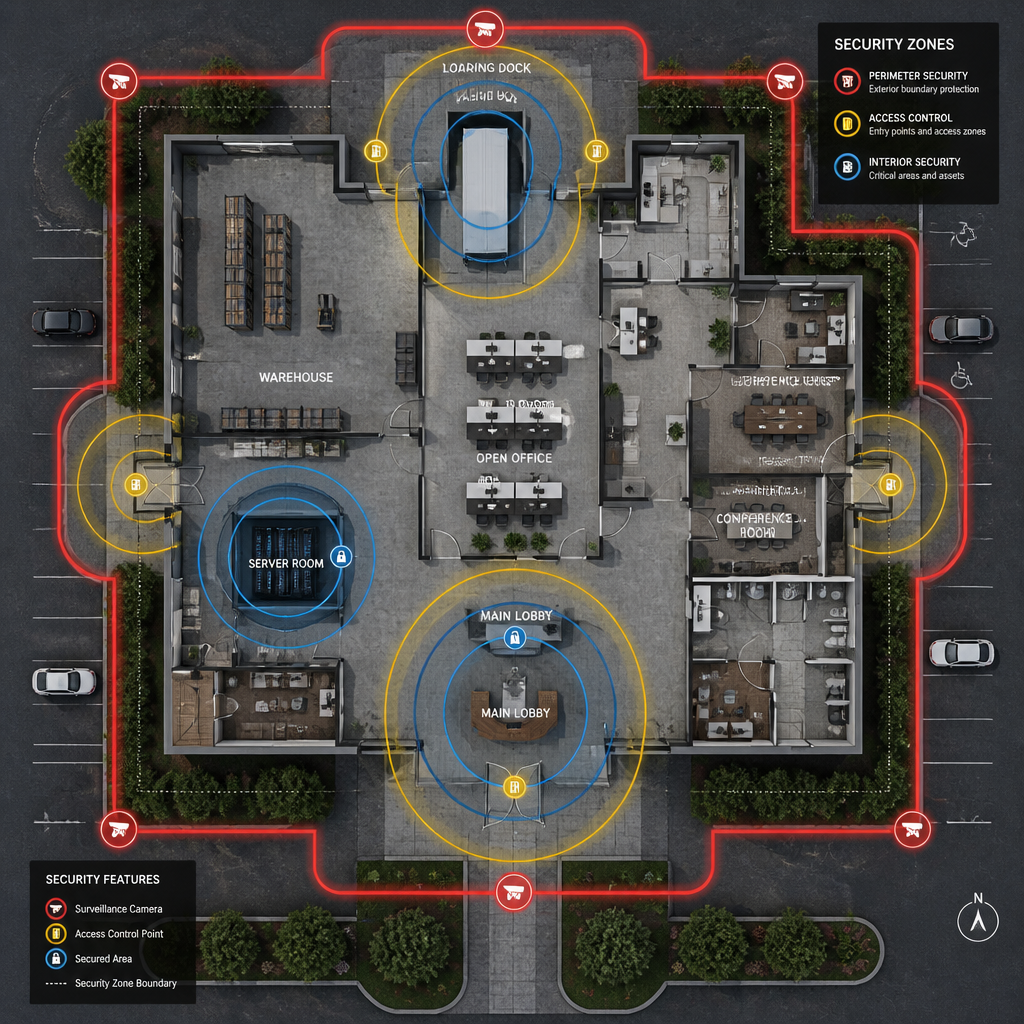
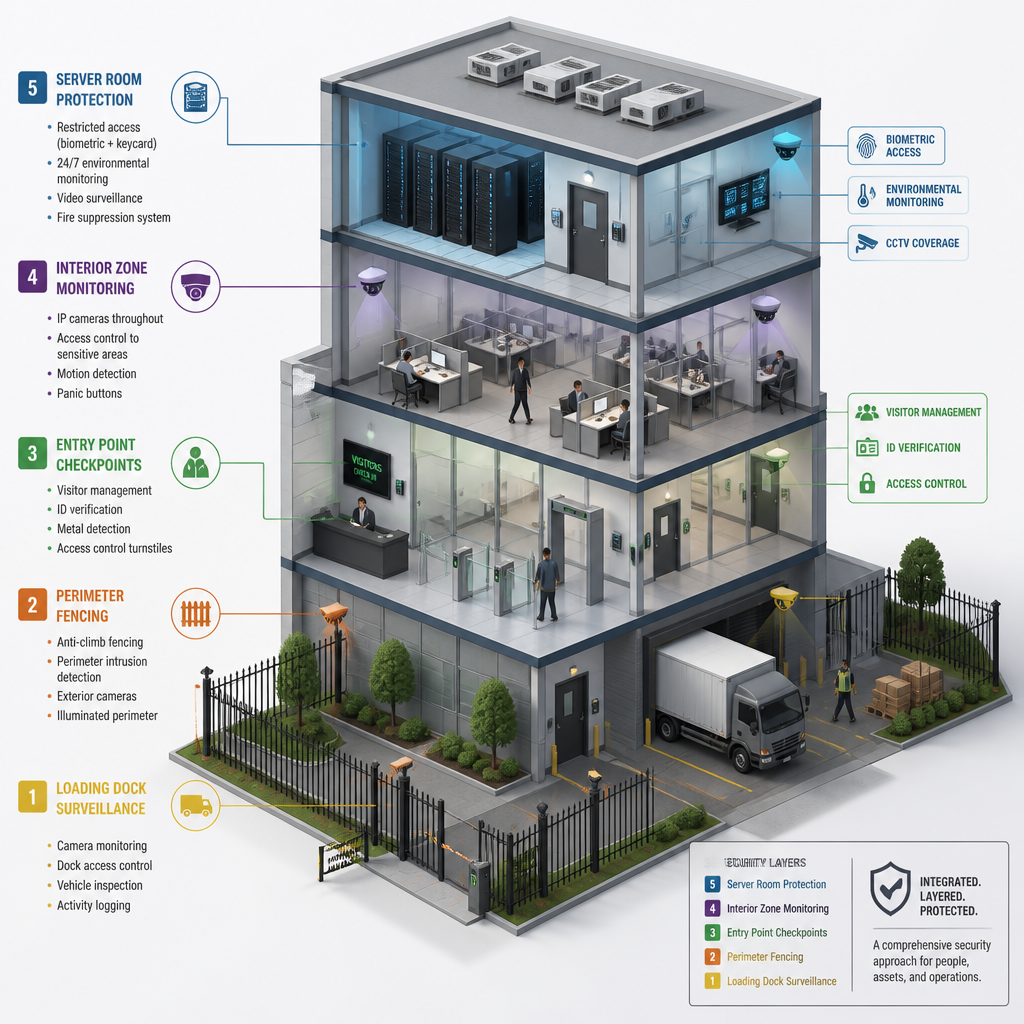
A layered security system for commercial property is built around three concentric rings of protection. Each ring operates independently and is designed to detect, delay, or deny threats that slip through the ring before it.
Ring 1: The Outer Perimeter
The outer perimeter is your first physical and psychological deterrent. For commercial properties, this includes fencing, gates, perimeter lighting, and CCTV cameras positioned to monitor boundary lines and vehicular entry points. The goal here is not to make breach impossible but to make it visible and slow it down enough for the next layer to respond.
Gate access control is a non-negotiable part of this ring for any property with vehicle traffic. A commercial gate fitted with an intercom system and credential reader, whether card, PIN, or video intercom, ensures that vehicle access is controlled and logged. High-definition cameras at gate entry points capture activity in real time and provide footage that supports incident response. Perimeter lighting, particularly motion-activated LED systems, supports the cameras and acts as a visible signal that the property is monitored.
Ring 2: Controlled Entry Points
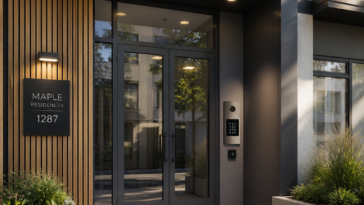
The second ring covers every door and opening that leads into the building itself. This is where access control systems do their most important work. The technology options here range from key card and fob readers to biometric systems and facial recognition locks, each with a different balance of cost, friction, and accountability.
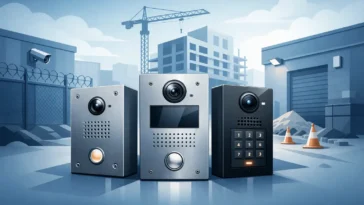
Wireless intercom systems add a critical layer at this ring for visitor management. A visitor who cannot be automatically credentialed requests entry through an intercom, where a staff member, or an automated system with video, can verify identity before granting access. This is especially important for secondary entrances such as loading docks and service corridors, which are statistically more likely to be exploited than the main reception entrance.
Pro tip: Fit every exterior door, including service and emergency exits, with an access control reader and alarm contact. Leaving even one door on a key-only system creates a credential gap that defeats the purpose of the rest of your access control investment.
Ring 3: Interior Zones
The interior zone layer protects the most sensitive areas inside the building: server rooms, finance offices, storage areas, executive floors, and any space containing high-value assets or data. Access to these areas should require a higher level of credential than the main building entry. Biometric access systems work particularly well here because they eliminate the risk of card sharing or forgotten PINs, and they create a timestamped audit trail of exactly who entered which room and when.
Interior cameras support this layer by providing coverage of corridors, stairwells, and common areas. When integrated with your access control system, a camera can be triggered to record automatically when a door credential event occurs, linking the visual record directly to the access event.
Building Your Layers by Budget
The layered approach is not reserved for enterprise-level facilities with large security budgets. The components scale effectively, and the priority order stays the same regardless of budget: perimeter first, then entry points, then interior zones. What changes is the sophistication and redundancy of each layer.
Smaller Budget: Wireless-First, Scalable Foundation
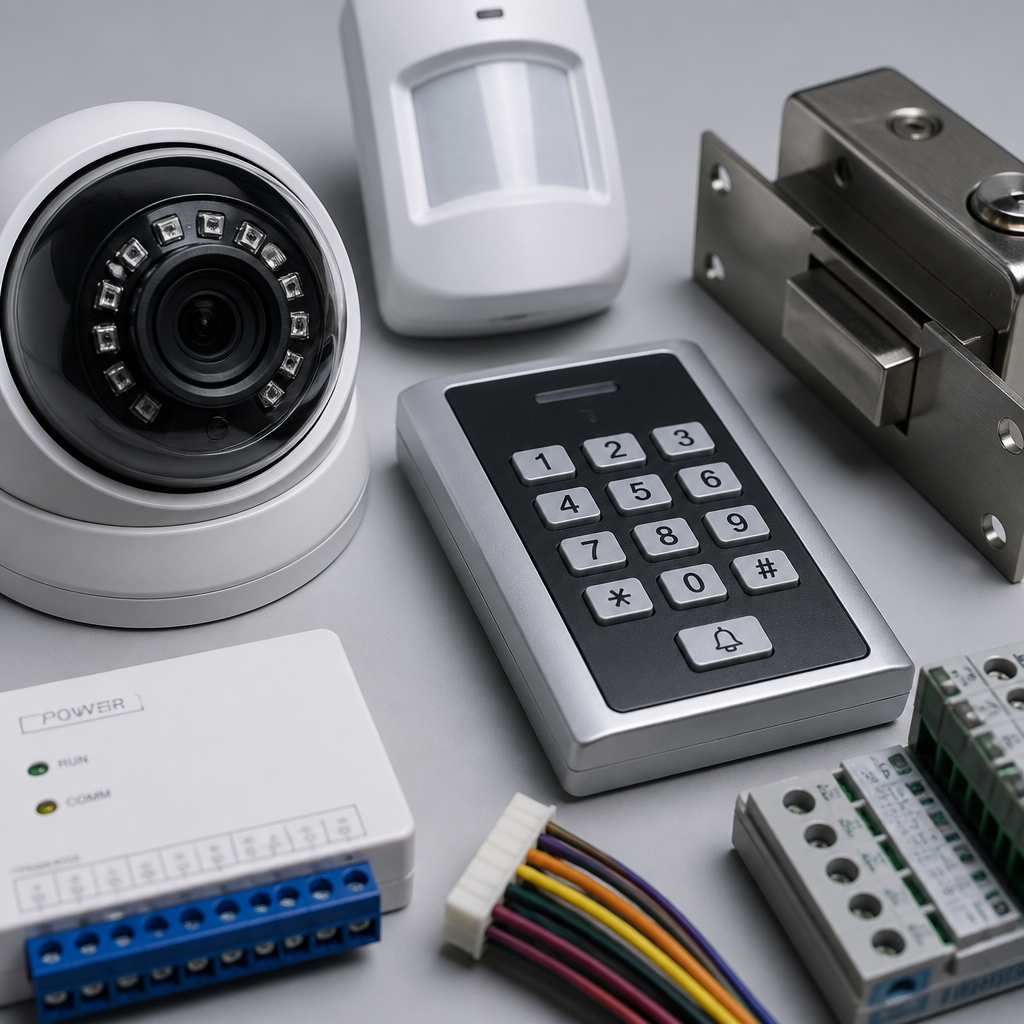
For smaller commercial properties, such as a single-tenant office, a small retail unit, or a light industrial space, the priority is establishing all three rings with cost-effective equipment that can be upgraded later. A wireless IP camera system covering the perimeter and main entry points, combined with a smart lock or keypad access control on the primary entrance and a wireless intercom for visitor management, gives you functional three-layer coverage without structured cabling costs.
Wireless transmitters and battery-operated sensors reduce installation costs significantly and allow for repositioning as your needs change. Start with cameras at the perimeter and main entry, add an intercom at the front door, and use a smart lock with access logging on any interior rooms holding sensitive assets.
Pro tip: Choose IP cameras and access control units that share a common integration platform from the start. Buying cheap, disconnected hardware that cannot communicate with each other forces you to replace everything when you scale up, not just add to it.
Mid-Range Budget: Integration and Redundancy
At the mid-range level, the goal shifts from basic coverage to system integration and redundancy. This is where access control and CCTV integration delivers its most visible return. A networked access control system linked to your camera network means that every credential event at a door automatically pulls the corresponding camera footage, creating a linked audit trail that makes incident investigation fast and accurate.
A mid-range commercial property setup would typically include a gate access control system with intercom and camera at the vehicle entry, card or fob readers on all exterior doors, video intercom at secondary entrances, an IP camera system covering all three rings, and biometric or facial recognition access on high-sensitivity interior zones. Time attendance clocks integrated with the access control system add an additional layer of occupancy accountability.
Larger Budget: Full Integration with Advanced Analytics
Larger commercial buildings, multi-tenant properties, and facilities with high compliance requirements benefit from a fully integrated system where CCTV, access control, intercoms, alarms, and visitor management all operate from a single management platform. Advanced camera systems with AI-driven motion detection and analytics reduce false alarms and improve real threat response times. License plate recognition at vehicle entries, biometric access throughout the facility, and centralized monitoring create a security posture that is proactive rather than reactive.
Access Control and CCTV Integration: Where the Real Value Is
Access control and CCTV integration is the single most impactful upgrade a commercial property can make to an existing security setup. Running these two systems independently is one of the most common and most wasteful security errors. When access control events and camera footage are siloed, an investigation that should take minutes takes hours, and patterns that should trigger alerts go unnoticed.
Integration works by linking credential events at a door reader or intercom with the nearest camera’s recording. When someone uses a key card at a door at 2 a.m., the integrated system automatically tags that footage with the credential event, so a security manager can search by door, time, or user rather than scrubbing through hours of generic recording. When a door is held open longer than expected, or when the same credential is used at two different locations within an impossible time window, the integrated system can flag the anomaly automatically.
For property managers and facility operators, this integration also simplifies compliance. Many data protection and industry-specific regulations require that access logs and video footage are maintained, secured, and linkable. An integrated system with encryption and audit trails handles this by design. Managing user access credentials centrally, rather than through a mix of physical keys and separate systems, also reduces the administrative burden of onboarding and offboarding staff and contractors.
From a practical installation standpoint, the best time to plan for integration is before you purchase either system. Look for access control platforms and camera systems from manufacturers that support open standards or documented API integrations. Proprietary-only systems that cannot communicate with other brands lock you into a single vendor and create expensive upgrade paths later. UnikCCTV’s range of intercom systems, IP cameras, and access control products is designed with this compatibility principle in mind, supporting both standalone use and full system integration.
Comparison of Layered Security Approaches
| Approach | Best Suited For | Key Strengths and Limitations |
|---|---|---|
| Wireless IP camera and smart lock system | Small commercial properties, single-tenant offices, retail units | Low installation cost, easy to reposition, scalable. Limited central management without a cloud platform. Works well as a starting layer but needs integration planning to avoid future replacement costs. |
| Networked access control with integrated CCTV | Mid-size offices, multi-floor commercial buildings, warehouses | Links credential events to footage automatically, supports audit trails, scales to hundreds of users. Requires structured cabling or strong Wi-Fi infrastructure. Setup is more involved but the operational return is significant. |
| Full integrated platform with biometrics, gate control, and AI analytics | Large commercial properties, multi-tenant buildings, high-compliance facilities | Highest level of accountability and threat detection. Eliminates credential sharing through biometrics. Centralized management reduces admin overhead. Highest upfront investment but lowest per-incident cost over time. |
Common Mistakes to Avoid When Building a Layered System
The three-ring model is straightforward in theory, but execution is where most commercial security projects go wrong. Knowing the common failure points saves money and prevents real security gaps.
Ignoring Secondary and Service Entrances
The loading dock, the back stairwell exit, and the service corridor are the most commonly under-secured access points in commercial buildings. These doors often run on a simple deadbolt or are propped open during business hours for convenience. Equip every exterior opening with at minimum an alarm contact and, where footfall justifies it, a card reader or intercom. The front lobby can have the most sophisticated access control on the market, but a propped service door makes it irrelevant.
Buying Disconnected Equipment
Purchasing a camera system from one vendor, an access control system from another, and an intercom from a third, without confirming they can integrate, is a budget mistake that compounds over time. You end up managing three separate platforms, three separate databases of users, and three separate alert systems. When an incident occurs, you are cross-referencing across all three manually. Buy with integration in mind, or at minimum confirm that API connections are available.
Setting and Forgetting
A layered security system requires periodic review. Access credentials for former employees should be revoked immediately. Camera fields of view should be checked after any physical changes to the building. Firmware on IP cameras and access control readers should be updated regularly to patch security vulnerabilities. A common mistake is treating the installation as the end of the project rather than the beginning of a maintenance cycle.
Underinvesting in Lighting
Lighting is one of the cheapest deterrents available and one of the most consistently overlooked. A perimeter camera that records well-lit footage is a far more effective evidence-gathering tool than one struggling with low-light conditions. Motion-activated LED lighting at all perimeter zones and entry points improves camera performance and acts as a visible deterrent for anyone considering a breach.
Skipping Visitor Management
Every visitor who enters the building uncredentialed is an audit gap. A wireless video intercom system at entry points allows staff to verify and log visitor identity before granting access. For higher-security facilities, temporary digital credentials issued through a visitor management integration create a complete record of who was in the building and when, without requiring staff to be physically present at every entry point.
Frequently Asked Questions
What does a layered security system mean for a commercial property?
A layered security system means protecting a commercial property through multiple independent rings of defense rather than relying on a single strong perimeter. Each layer, typically the outer perimeter, controlled entry points, and interior zones, is designed to detect and delay threats that breach the layer before it. This approach means that no single failure, whether a stolen key card, a propped door, or a camera blind spot, compromises the entire property’s security.
How much does it cost to build a layered security system for a small commercial property?
The cost varies widely depending on the size of the property, the number of entry points, and the technology choices made. A small commercial property can establish functional three-layer coverage using wireless IP cameras, a smart lock, a video intercom, and alarm contacts on exterior doors without enterprise-level costs. Scalable wireless systems reduce installation costs significantly compared to hardwired infrastructure. The key is to buy equipment that supports future integration rather than starting over when you need to expand.
Do I need biometric access control or will key cards work?
Key cards and fobs work well as the primary credential type for general building access, but they carry a real vulnerability: they can be shared, lost, or stolen without anyone knowing until after an incident. For interior zones protecting sensitive assets, server rooms, or high-value storage, biometric access systems or facial recognition locks eliminate this risk entirely because the credential cannot be passed from one person to another. A practical approach is to use card access for the general building entry layer and biometrics for the most sensitive interior zones.
How does access control and CCTV integration actually work in practice?
In an integrated system, every credential event at a door reader or intercom is linked to the nearest camera’s recording at that exact timestamp. Security managers can search footage by access event rather than scrubbing through hours of recording manually. The integration also enables automated alerts, for example when a door is held open beyond a set time, or when an access attempt fails repeatedly at a specific entry point. The practical result is faster incident response, cleaner audit trails for compliance, and fewer hours spent on manual investigation.
What is the most important layer to get right first?
Start with perimeter and main entry point coverage before worrying about interior zones. Cameras and access control at the outer perimeter and all exterior doors give you the widest coverage gain per dollar spent. Once that foundation is in place, adding interior zone protection, biometric readers in sensitive areas, and advanced integration is a straightforward incremental build. Trying to start with interior complexity before perimeter basics are covered is a common budget mistake that leaves obvious gaps.
Can a layered security system work for a multi-tenant commercial building?
Yes, and multi-tenant buildings particularly benefit from the layered approach because the building owner and individual tenants each have distinct security needs. A centrally managed access control system can control building-wide entry points while allowing individual tenants to manage their own floor or suite access separately. Shared perimeter cameras, a common gate access control system with intercom, and individual biometric or card readers for each tenancy create a coherent layered system where responsibilities are clearly separated.
What layer of your current commercial security setup do you feel is weakest, and what has worked well in addressing it? Share your experience below.
References
- Guide to building a layered physical security strategy for commercial properties, covering the three rings of defense and common perimeter mistakes
- Overview of the layered physical security approach for commercial and industrial facilities, including perimeter, access control, and surveillance layers
- Understanding access control and video surveillance integration in commercial real estate, including compliance considerations and audit trail management
- How integrated access control systems work with CCTV and other security components to strengthen commercial security posture
- Practical breakdown of layered perimeter security components for commercial sites, including gate access control, surveillance, and lighting
 No products in the cart.