
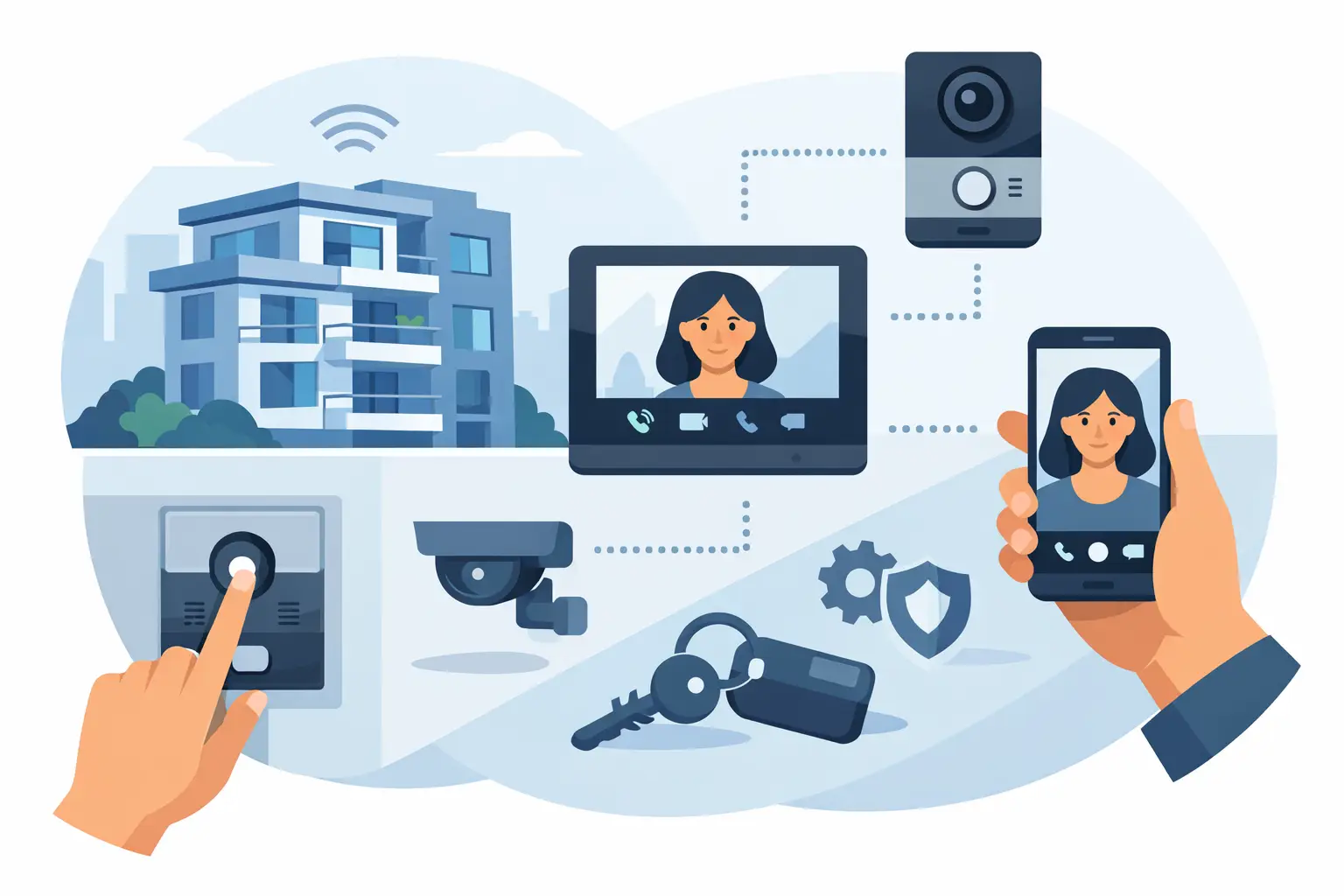
A video intercom can look straightforward at the front entrance: a visitor presses a button, a resident sees the caller, and the door opens. In an apartment building, however, that single interaction depends on tenant capacity, cable condition, door hardware, power planning, and a system that staff can support years after installation. This 6 apartment video intercom review focuses on the six areas that determine whether a system works reliably in the field.
For property managers, installers, and building owners, the right choice is rarely the system with the longest feature list. It is the system that fits the number of units, entrances, resident expectations, and existing infrastructure without creating unnecessary service calls.
1. Entry panel capacity and tenant directory
The entrance panel is the public-facing part of the system, so it must be easy for visitors to use and tough enough for the installation environment. For a six-unit walk-up, a dedicated button station can be faster and more intuitive than a large digital directory. Each tenant has a clearly labeled call button, and there is little menu navigation for a delivery driver or guest to figure out.
For larger properties, a directory-based panel generally makes more sense. Look for a directory that can accommodate turnover without requiring a complete panel replacement. Some systems use programmed names and unit numbers; others support tenant databases managed from software. The better option depends on who will administer the building and how often tenant information changes.
Camera placement matters as much as directory capacity. The camera needs enough vertical and horizontal coverage to capture a visitor standing naturally at the door, including taller visitors and people approaching with packages. A poorly positioned camera can leave residents looking at the top of a hat or a dark doorway instead of a recognizable face.
Outdoor conditions should also be part of the review. A recessed or sheltered entry may need less weather protection than an exposed gate station. In either case, the panel should be selected for commercial entry use, with durable call buttons, readable labels, and appropriate protection against moisture, temperature changes, and tampering.
2. Monitor choice and resident usability
Apartment video intercom monitors need to work for residents who may never have used an intercom system before. A clear image, dedicated door-release control, audible call tone, and straightforward answer button are more valuable than complicated menus in many residential installations.
Screen size should match the use case. A compact indoor station can be practical where wall space is limited, while a larger display may be preferred in higher-end units or buildings where residents want a clearer view of visitors. Touchscreen monitors can offer more functions, but physical buttons are often easier to use quickly and can be preferable for elderly residents or high-turnover properties.
Consider where each monitor will be installed. The location should be convenient enough that residents can answer a call before a visitor leaves, but not so exposed that it creates a wiring or damage concern. In renovated buildings, surface-mount stations may reduce wall work. In new construction, flush-mount or in-wall preparation can produce a cleaner finished appearance.
Mobile app calling deserves a careful review. It can be useful for residents who are away from the unit, especially in smaller buildings without on-site staff. But app-based access relies on stable internet service, resident account management, phone permissions, and ongoing support. It is usually best treated as an added convenience, not the only method for answering a visitor call.
3. Wiring method and the condition of the building
The wiring decision can control the labor cost of an apartment video intercom project. Before selecting equipment, inspect the cable pathways, risers, conduit capacity, existing station wiring, electrical room access, and distance from the entry panel to the farthest apartment.
Traditional multi-wire systems can be a practical choice when a building is already wired for that architecture or when the project is small enough that dedicated wiring remains economical. They are familiar to many installers and can provide dependable point-to-point operation. The trade-off is that adding units or expanding functionality later may require more cable work.
Two-wire systems are often well suited for retrofit projects because they can reduce the number of conductors required between components. Depending on the system design, existing low-voltage wiring may be usable, though cable condition and manufacturer requirements must be verified rather than assumed. A cable that worked for audio may not deliver reliable video or power at the required distance.
IP-based systems offer flexibility for larger or more complex properties. They can support multiple entrances, concierge positions, remote administration, and integration with networked access control. They also require disciplined network planning. Switch capacity, PoE budgets, segmentation, cybersecurity practices, and support responsibility should be established before equipment is installed. An IP intercom is not automatically the best option for every building simply because it has more features.
4. Lock release and door hardware compatibility
An intercom system only controls entry properly when it is matched to the opening. The lock, door frame, power supply, request-to-exit device, fire alarm interface, and egress hardware all need to be considered as one operating system.
Electric strikes are common for apartment entry doors and can work well with cylindrical latch hardware or certain mortise lock arrangements. They allow the mechanical latch to release electronically while maintaining normal free egress from inside. Magnetic locks may be appropriate in specific applications, but they require careful code-compliant planning because they are fail-safe devices and depend on continuous power to remain locked.
The relay output on the intercom must be compatible with the locking hardware and the required release timing. A common mistake is treating the door relay as the entire locking solution. In reality, current draw, voltage drop, lock power, suppression, and fire-life-safety requirements can all affect performance.
Review the desired entry workflow as well. Residents may need to release the door from their monitor, but staff may also need credential access, key access, keypad access, or scheduled unlock periods. A professional installation accounts for these overlapping access methods rather than adding them as afterthoughts.
5. Number of entrances and system expansion
A single-front-door building has very different requirements from a property with a front entrance, rear entrance, parking gate, package room, and elevator lobby. The intercom platform should support the actual number of entrances from the beginning, including locations likely to be added later.
When reviewing capacity, ask whether each apartment can receive calls from every entrance, whether residents can distinguish which entrance is calling, and whether doors can be released independently. These details matter when a resident needs to open the front entry for a guest but not release a gated parking entrance.
Expansion is not only about adding doors. It can include additional indoor stations, a master station for management, cameras at secondary entrances, or access credentials for residents. A system that reaches its maximum capacity as soon as the first phase is complete can create an expensive replacement decision later.
For mixed-use buildings, separate access rules may be necessary. Commercial tenants, residential tenants, maintenance staff, and delivery personnel often need different permissions and calling paths. This is where an intercom system should be evaluated alongside the access-control plan, not as a separate purchase.
6. Serviceability, replacement parts, and support
The final part of a 6 apartment video intercom review is often the most overlooked: what happens after turnover, a damaged entrance panel, a failed monitor, or a door-release issue? Apartment intercoms are long-term infrastructure. A low initial price has limited value if replacements are difficult to source or if no one can identify the proper compatible part.
Specify a system with available monitors, power supplies, entry panel components, mounting accessories, and documented programming procedures. Property staff should know how tenant names are updated, how a lost credential is removed, and who is responsible for resetting resident app access if mobile calling is included.
Installers should also leave clear documentation. At minimum, that means equipment model numbers, wiring notes, power supply locations, network details where applicable, lock wiring information, and programming credentials held according to the property owner’s policy. This documentation can save hours when service is needed months or years later.
For projects that involve multiple doors, existing wiring, or access-control integration, a pre-installation equipment review is usually worth the time. A knowledgeable distributor such as UnikCCTV can help match the entry station, tenant monitors, lock hardware, and supporting power components before the installer is standing at an open wall or a non-functioning door.
The best apartment video intercom is the one residents can operate without instruction, managers can maintain without guesswork, and installers can service without rebuilding the system. Start with the building’s doors, wiring, and daily traffic patterns, then specify the equipment around those real conditions.
 No products in the cart.