
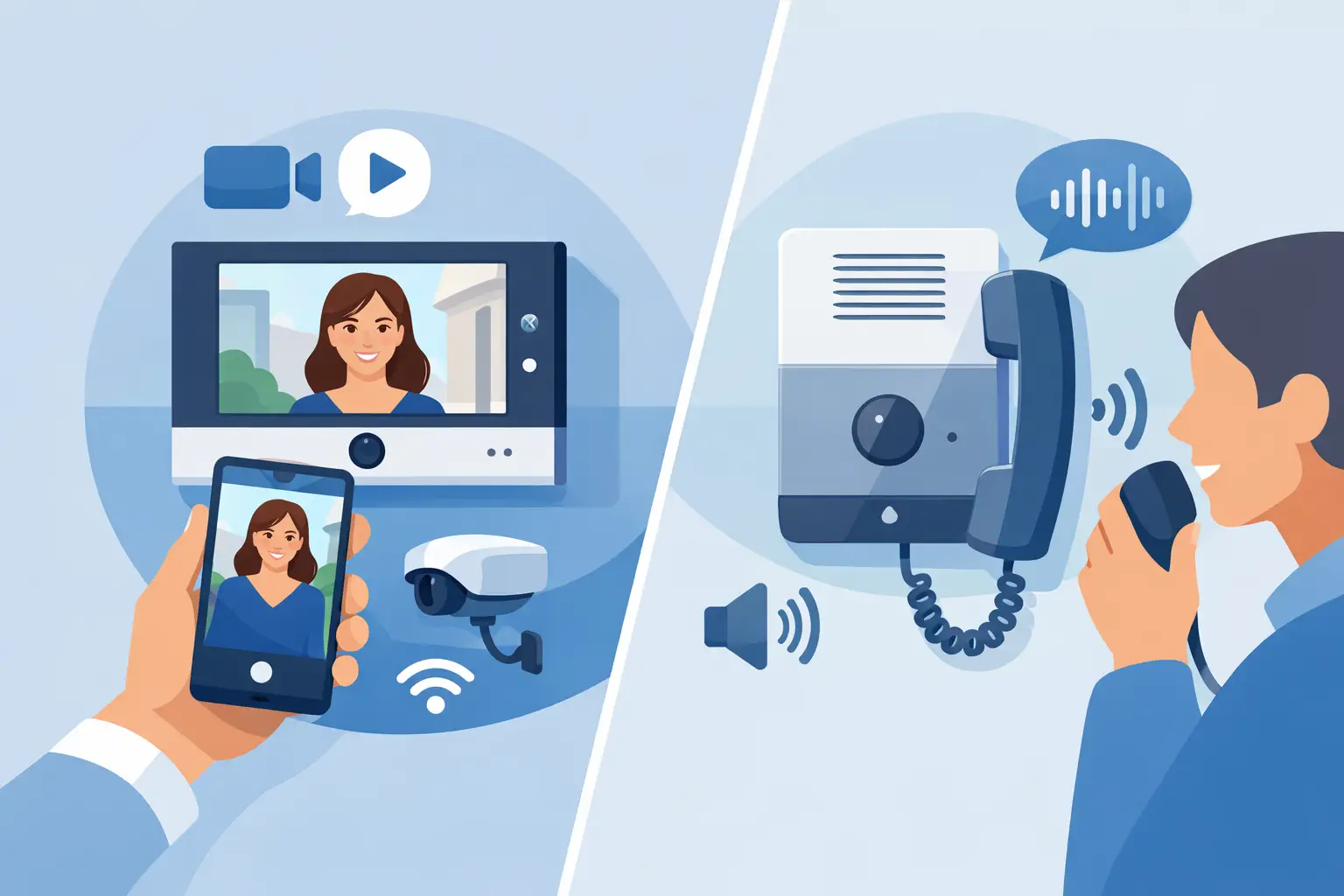
A front entry system usually gets judged on one question: can staff or residents identify the visitor fast enough to make the right decision at the door? That is where the choice between video intercom vs audio intercom becomes more than a feature comparison. It affects security, wiring, budget, user behavior, and how well the system fits the property.
For some sites, audio is exactly what is needed and anything more adds cost without adding much control. For others, not having video creates avoidable risk, especially when deliveries, unknown visitors, tailgating, or after-hours entry are part of daily operations. The better choice depends on the building, the traffic pattern, and what level of verification the operator actually needs.
Video intercom vs audio intercom: the real difference
At a basic level, both systems let someone at the entry point communicate with someone inside before granting access. An audio intercom handles voice only. A video intercom adds a camera and display capability so the person answering can see who is outside.
That sounds simple, but in practice the difference changes how decisions are made. Audio depends on voice recognition, visitor cooperation, and ambient noise conditions. Video gives visual confirmation, which matters when the person at the door is unknown, when multiple people are present, or when the caller does not clearly identify themselves.
In a single-tenant office with predictable visitors, audio may be enough. In a multifamily entrance, school vestibule, or gated property where staff need to verify identity before releasing a strike, maglock, or gate operator, video usually has a stronger case.
Where audio intercom systems make more sense
Audio intercoms still have a solid place in professional installations. They are often more cost-effective, simpler to deploy, and easier to maintain in sites where visual verification is not essential.
This is common in smaller apartment buildings where tenants already know most visitors, in service entrances used by regular vendors, or in industrial settings where communication is the main goal and the entry point is already monitored by separate CCTV. If the site already has camera coverage at the door tied into a recording system, an audio intercom can sometimes do the communication job while the camera system handles visual review.
Audio can also be a practical fit when infrastructure is limited. Retrofit work in older buildings often runs into conduit limits, cable constraints, or budget pressure. In those cases, a straightforward audio system can restore controlled entry without forcing a full rebuild.
There is another factor buyers sometimes overlook: user adoption. Some properties want the simplest possible resident or staff experience. Press button, speak, confirm, release door. Fewer components can mean fewer support calls, especially in buildings where users are not technically inclined.
When video intercom is worth the extra cost
Video earns its keep when identity verification matters more than basic communication. Schools, commercial offices, medical buildings, mixed-use properties, and larger multifamily entrances often benefit from being able to see the person requesting entry.
That visual layer helps in several real-world situations. A visitor may claim to be a courier, contractor, parent, or vendor. With audio only, the person answering has to trust what they hear. With video, they can compare appearance, uniforms, badges, packages, vehicle position, and whether one or several people are waiting at the door.
Video also reduces guesswork in noisy environments. Street traffic, wind, lobby echo, machinery, or poor microphone placement can make audio-only systems harder to use. When the voice path is less than ideal, the image often carries the decision.
For sites with higher liability exposure, video can support better entry control procedures. Staff can verify that the person is at the correct door, assess behavior before unlocking, and in some systems review snapshots or integrate with broader access and surveillance infrastructure. That does not make every video unit equal, but it does make video more operationally useful than many buyers assume.
Cost is not just the price of the station
Most buyers start with hardware cost, which is reasonable, but the system price is only part of the decision. Video intercoms usually cost more than audio systems because they involve cameras, monitors or app-based endpoints, and often more demanding power, network, or cabling considerations.
Still, the less expensive system is not always the lower-cost project. If an audio system leads to frequent missed deliveries, repeated calls, poor visitor screening, or staff workarounds, the operational cost adds up. On the other hand, if a video system is installed at a low-risk side entrance that barely gets used, the added investment may never pay back.
Installation labor matters just as much. The right choice depends on whether the property is new construction, light retrofit, or a difficult upgrade in an occupied building. Wiring distance, door hardware compatibility, monitor locations, and the number of entry points all affect project cost more than the simple label of audio or video.
Wiring, infrastructure, and system complexity
This is where many comparisons get too generic. The best system on paper may be the wrong one for the building.
An audio intercom is often easier to fit into legacy sites, especially where cable pathways are limited or the scope is focused on one or two openings. Video can be equally straightforward in some modern systems, but not every site is ready for the added bandwidth, power planning, display placement, or network coordination that video may require.
For multi-tenant and multi-entry properties, scalability matters. If the property may add more stations, tie into access control, or support remote answering, the system architecture should be reviewed early. A cheaper standalone setup can become expensive if it has to be replaced once the site grows.
Commercial buyers should also think about serviceability. Replacement parts, expansion options, and compatibility with electric strikes, magnetic locks, exit devices, gate operators, and credentials all matter. A professional-grade intercom is not just a talk box at the door. It is part of the entry control path.
Security trade-offs buyers should consider
The strongest argument for video is better verification. The strongest argument for audio is simplicity. Both are valid, but both come with trade-offs.
Audio can be faster in environments where the operator already knows who is calling or where separate cameras are already in place. It can also reduce points of failure. Fewer screens and imaging components can mean a more straightforward service profile.
Video improves decision-making, but only if the image is usable and the workflow supports it. A poorly placed camera, bad lighting, or a tiny monitor can weaken the value of video. Buyers should not assume every video intercom delivers meaningful identification. Camera angle, low-light performance, and screen quality matter.
Privacy expectations may also influence the decision. In some residential environments, a full video setup may require clearer communication with residents and better policies around image handling. In commercial and institutional settings, that is usually easier to manage because entry screening is already part of the operation.
Choosing by property type
For single-family homes and small offices, the choice often comes down to convenience and budget. If seeing the visitor matters, go video. If the site is low traffic and the users know most callers, audio may be enough.
For apartment and multifamily buildings, video usually brings more value at the main entry, especially where package deliveries, service vendors, and unfamiliar guests are common. In a smaller building with stable occupancy and a tighter budget, audio can still be effective.
For schools and administrative buildings, video is generally the stronger option because staff need a clearer basis for granting entry. For warehouses, factories, and gated yards, it depends on whether the goal is communication with expected drivers or verification of unknown arrivals.
For commercial offices and managed properties, the best answer is often based on workflow. If the reception desk or management office is expected to screen visitors actively, video supports that role. If the intercom is mainly there to connect regular tenants, employees, or vendors, audio may be sufficient.
How to make the right call
Start with the risk at the door, not the feature list. Ask who uses this entrance, whether the person answering knows the typical visitors, what happens if the wrong person gets in, and whether another camera system already covers the opening.
Then look at infrastructure. Can the property support the system cleanly without patchwork installation? Will it need to expand later? Does it need to release a lock, tie into access control, support multiple indoor stations, or work across several buildings?
That is usually where the right answer becomes clear. Buyers who treat intercoms as part of the full entry system, not as an isolated device, tend to make better long-term decisions. For that reason, many installers and facility teams work through the application first and the equipment second, which is the approach UnikCCTV has supported for years.
If the door requires simple communication, audio may be the smarter buy. If the door requires identification, accountability, or stronger screening, video usually justifies itself. The best system is the one that fits the property the way it actually operates on a busy day, not the way it looks on a spec sheet.

 No products in the cart.