
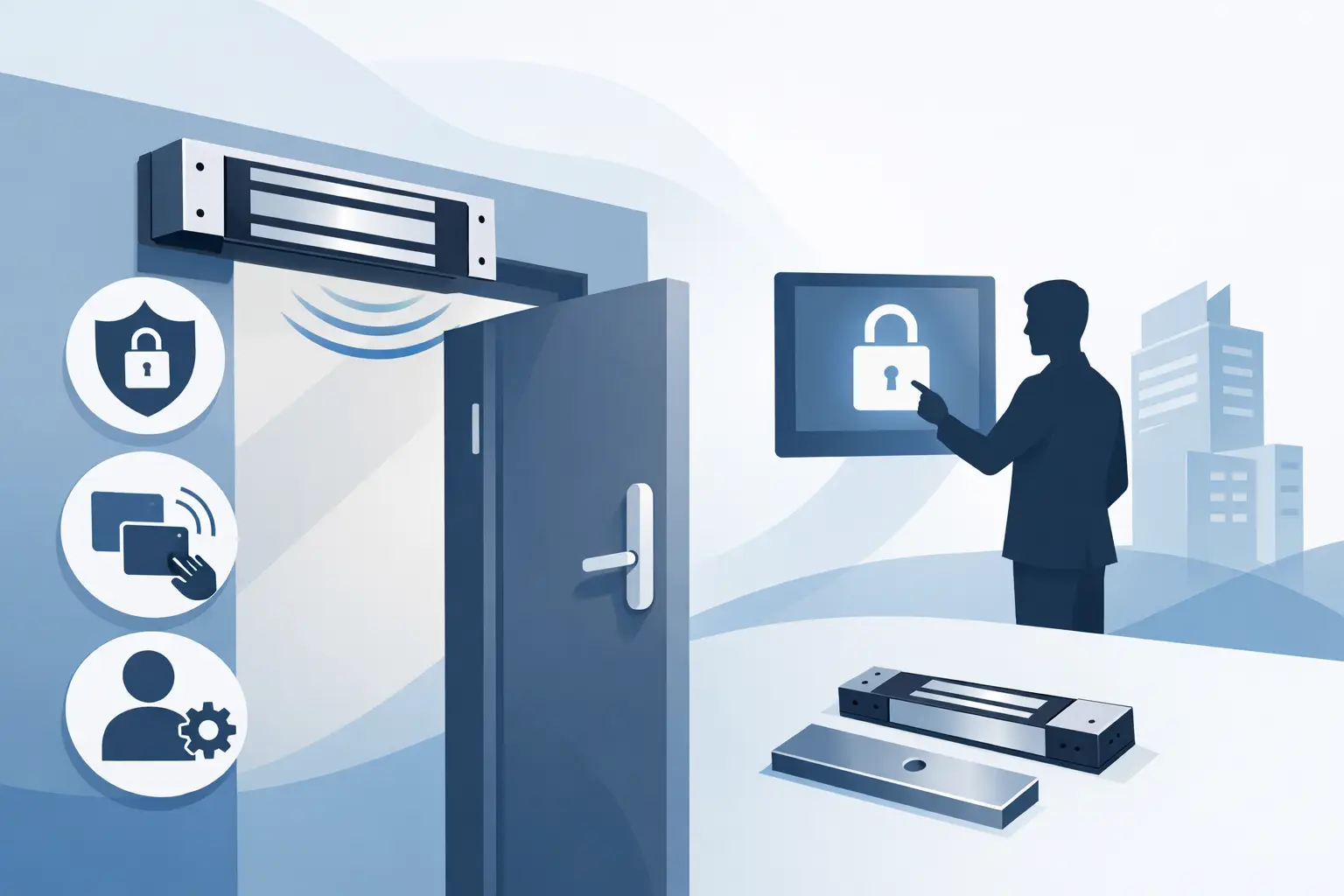
A door that looks simple on the plans can become the hardest opening in the building once access control is added. Out-swing doors, glass storefront entries, vestibules, stairwell doors, and perimeter gates all bring different constraints. A magnetic door lock system is often the right answer when you need strong holding force, clean integration with credentials, and reliable operation across high-traffic openings.
That does not mean every opening should get a maglock. The right choice depends on code requirements, door construction, traffic patterns, egress expectations, and how the rest of the access-control system is designed. For installers, facility teams, and property managers, the best results come from treating the lock as one part of a complete opening, not a standalone device.
What a magnetic door lock system actually does
A magnetic door lock system uses an electromagnet mounted on the frame and an armature plate mounted on the door. When power is applied, the magnet bonds to the plate and secures the opening. When power is removed, the door releases.
This basic operating method matters because maglocks are fail safe by design. If power drops, the door unlocks. In some applications that is exactly what you want, especially where life safety and free egress are central requirements. In other cases, such as certain perimeter or storage openings, a fail secure hardware strategy may be more appropriate, which points buyers toward electric strikes or electrified locksets instead.
Maglocks are usually specified by holding force, commonly 600 lb or 1200 lb models for doors, with higher-capacity options for larger or more demanding openings. The number alone should not drive the selection. Door size, wind load exposure, mounting condition, and traffic abuse all affect what performs well in the field.
Where magnetic door locks make the most sense
A magnetic door lock system is commonly used on commercial glass aluminum storefront doors, office entries, apartment common doors, schools, healthcare facilities, and certain gate or industrial access points. They are especially useful when there is no practical way to modify the door edge for a strike or lock body, or when the opening calls for surface-mounted hardware.
On retrofit jobs, that surface-mount advantage can save time and reduce disruption. You are not cutting into a narrow aluminum stile or trying to match older mechanical prep. For integrators working on existing buildings, that can make the difference between a clean upgrade and a costly workaround.
High-traffic openings also favor maglocks in many cases. There are fewer moving mechanical parts at the locking point, which can be an advantage in buildings where doors cycle constantly throughout the day. That said, heavy traffic also increases the importance of proper door alignment, quality closing hardware, and correct armature installation. A maglock cannot compensate for a sagging door or a failing closer.
The real selection criteria
Buyers often start with holding force, but the more useful starting point is the opening itself. A hollow metal out-swing door in a commercial corridor is one thing. A frameless glass door with top rail, a pair of lobby doors, or a gate exposed to weather is another.
Mounting configuration is usually the first technical filter. Some openings accept a standard surface-mounted maglock with a straightforward bracket. Others need L brackets, Z brackets, header extensions, filler plates, or glass-door mounting solutions. On double doors, you may be looking at dual maglocks or a coordinated setup that accounts for the inactive leaf and egress hardware.
Power requirements come next. Most magnetic locks are field-selectable for 12VDC or 24VDC, but the full system design still matters. You need enough current capacity for the lock, reader, request-to-exit device, motion sensor, door position switch, controller, and any delayed egress or emergency release components. Undersized power supplies create intermittent problems that look like hardware failure but are really system design issues.
Monitoring is another point that separates a basic opening from a managed one. Many commercial buyers want bond status monitoring, door status, and remote release visibility at the panel. A lock with integrated status outputs can simplify troubleshooting and improve event reporting, especially in larger systems.
Code, egress, and life safety are not side notes
This is where many magnetic lock decisions are won or lost. A maglock may be easy to mount, but it still has to comply with the applicable building, fire, and life safety requirements for that opening. The release method has to be correct for the occupancy and the authority having jurisdiction.
In practice, that may include a request-to-exit motion sensor, push-to-exit button, fire alarm interface, and immediate release on alarm condition. Some openings require hardware that releases upon loss of power and also upon activation of listed releasing devices. Others may require specific signage, timed release behavior, or closer coordination with the fire and access-control plans.
For schools, multifamily properties, and commercial buildings with public-facing entries, these details are not optional. They shape the entire opening design. If there is any uncertainty, lock selection should happen alongside code review, not after material is ordered.
Installation details that affect performance
A magnetic door lock system is only as good as the door and frame condition behind it. A misaligned frame, a loose closer arm, or a warped door can reduce holding reliability and create nuisance callbacks.
The armature must be mounted so it can pivot slightly and meet the magnet face squarely. Installers sometimes overtighten the armature hardware, which prevents proper contact. That small mistake can turn a 1200 lb lock into a weak, inconsistent opening.
Surface preparation also matters. Magnet faces should remain clean and flush. Wiring should be protected and routed properly through the frame or raceway. On aluminum storefronts and glass entries, bracket stability is critical because flex at the header can affect bond performance over time.
For exterior openings and gates, environment becomes a bigger factor. Weather-rated hardware, corrosion resistance, and protected power distribution should be considered early. A lock that performs well inside a climate-controlled vestibule may not be the right match for a perimeter gate exposed to rain, dust, and temperature swings.
Integration with the rest of the access system
Maglocks are rarely installed alone. They are typically part of a broader system that may include card readers, keypads, intercoms, telephone entry, video verification, credential management, and remote release.
That integration is one of their biggest strengths. A magnetic door lock system can pair well with managed access control in apartment buildings, commercial offices, schools, and industrial sites where operators want centralized control over multiple openings. Remote release from a front desk, directory-based visitor access, scheduled unlock periods, and event tracking all fit naturally into that setup.
Still, there are trade-offs. Because maglocks are fail safe, backup power planning becomes more important. If the site expects doors to remain secured during short outages, battery backup and power supervision need to be specified correctly. If the site cannot accept unlocked status during a prolonged power event, another locking strategy may be a better fit for that opening.
When a maglock is not the best answer
There are cases where buyers should pause before choosing a magnetic lock. If the door is an inswing opening with suitable prep for an electric strike, a strike may offer a cleaner egress path and different security behavior. If the opening must remain locked during power loss, fail secure hardware may be more appropriate. If the code path for maglock release becomes overly complicated, an electrified panic device or electrified mortise solution may make more sense.
This is why experienced distributors and installers ask about the whole opening, not just the lock. The right hardware choice depends on traffic, code, frame type, power, credentialing method, and who is using the door every day.
Buying with fewer surprises
For serious buyers, the safest approach is to define the opening before selecting the part number. Door material, handing, swing, header depth, frame condition, power availability, indoor or outdoor exposure, fire alarm interface, and release method should all be clear before ordering.
It also helps to think beyond the lock body. Brackets, monitored outputs, power supplies, request-to-exit devices, push buttons, signage, emergency release hardware, and replacement armatures are often part of the same job. Sourcing those components from a supplier that understands complete access-control openings can prevent mismatched parts and field delays. That is one reason professional buyers work with specialized distributors such as UnikCCTV when the project calls for more than a generic catalog match.
A magnetic door lock system can be a strong, practical solution when it is selected for the right opening and installed as part of a complete, code-aware access design. The best results come from asking a simple question early: what does this door need to do every day, under normal use and under emergency conditions? The answer usually points to the right hardware much faster than the spec sheet alone.



 No products in the cart.