
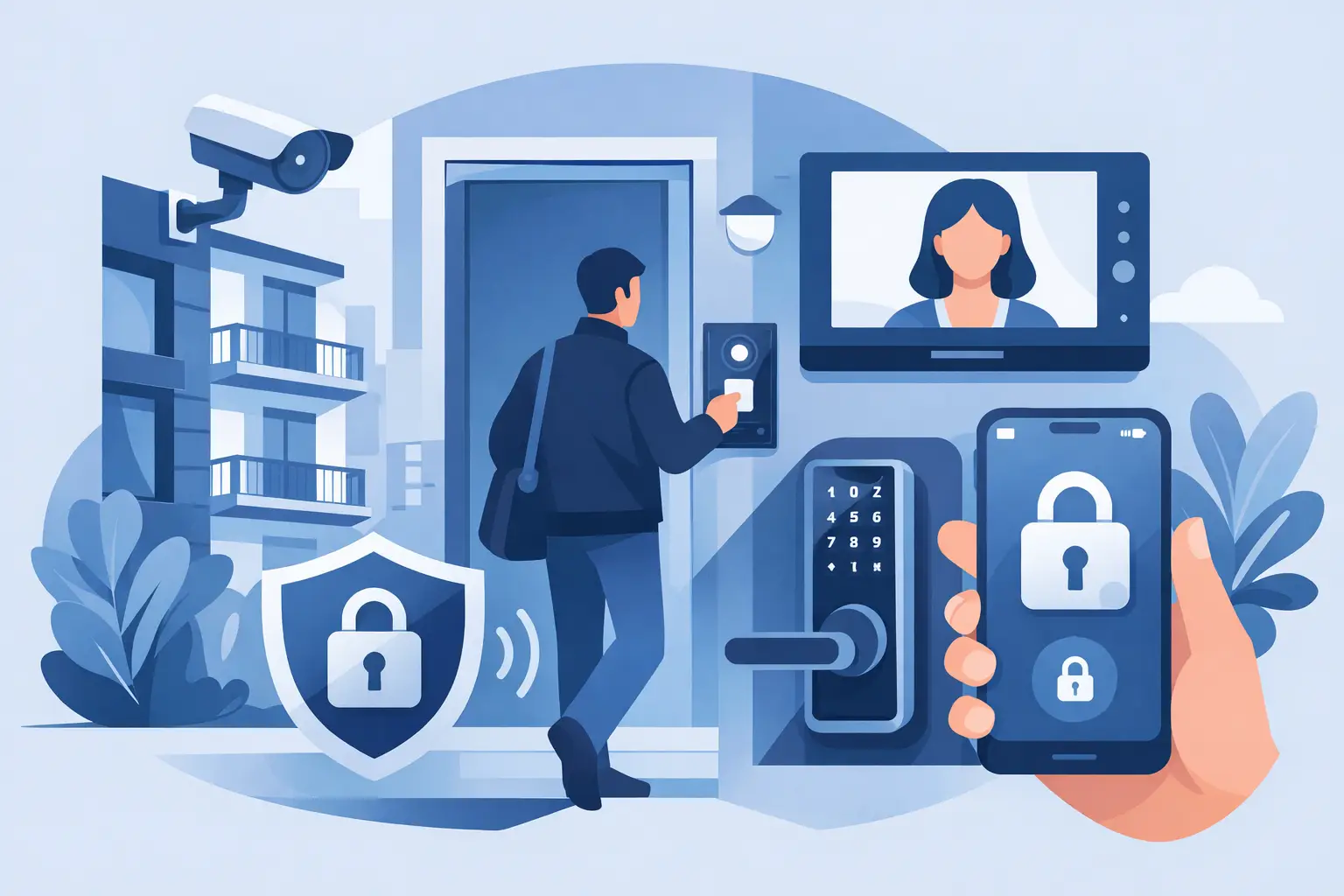
A front door that stays unlocked after a delivery, an intercom that cannot reach the right resident, or a camera pointed at the wrong angle can create daily problems for a multifamily property. This apartment entry security guide is built for property managers, building owners, installers, and facilities teams who need entry systems that work reliably under real operating conditions.
The right design is not simply a matter of adding an electronic lock to the lobby door. Apartment entry security depends on how visitors are identified, how residents grant access, how doors are monitored, and how the system behaves during power loss, fire alarm events, tenant turnover, and routine service calls. Start with the building’s actual traffic pattern, then specify equipment that fits the door, wiring, management process, and budget.
Start With the Entry Points That Matter
For most apartment buildings, the main entrance deserves the highest level of control and monitoring. It is where residents, guests, delivery drivers, contractors, and prospective tenants all converge. However, a good system review also includes side doors, rear entrances, garage entries, basement doors, package rooms, laundry rooms, roof access, and connecting corridors.
Walk the property at the times it is busiest and least staffed. A rear door may appear low-risk during a daytime inspection but become the preferred entry point after dark. A package room may need a separate credential policy because delivery traffic is frequent but should not provide access to residential floors. The objective is to assign each opening a level of control that matches its use.
Document the door condition before selecting hardware. Note the frame material, door material, swing direction, existing closer, panic hardware, weather exposure, glass sidelites, and available power path. An access-control plan can fail quickly when an electric strike is selected for a damaged frame, or when a maglock is proposed for a door that cannot meet required egress and life-safety conditions.
Choose the Right Visitor Communication Method
Intercoms are the working center of many apartment entry systems. The proper choice depends largely on the number of units, the building’s wiring condition, and what residents expect from visitor access.
A traditional audio intercom can be a practical fit for smaller buildings where residents only need to speak with visitors and release the entrance remotely. It is familiar, cost-conscious, and often easier to service when existing low-voltage wiring is available. Video intercoms add visual verification, which is particularly useful at buildings with frequent package deliveries, controlled lobbies, or higher visitor volume.
For larger or recently renovated properties, IP-based intercoms can support directory management, call routing, mobile credentials, and centralized administration. These systems offer useful operating flexibility, but they also require dependable network planning. Confirm switch capacity, cable paths, power backup, cybersecurity responsibilities, and whether the management team has someone who can maintain user records.
Do not select an intercom based only on its display or app features. Confirm how it calls residents, whether it supports the required number of apartments, how directory changes are made, and how the door release integrates with the locking hardware. A system that looks modern but creates extra work for every move-in and move-out is not a good operational fit.
Select Locks Based on Door Use and Life Safety
The locking device must match the opening. Electric strikes, electromagnetic locks, electrified panic hardware, and electrified mortise or cylindrical locks all serve different applications.
An electric strike is often a practical option for a standard framed entry door with mechanical latching hardware. It can allow controlled release without requiring the lock body to be replaced, provided the strike is compatible with the latch, frame preparation, and door alignment. The door must latch consistently for the system to secure properly.
Magnetic locks are common on aluminum storefront-style entrances and other doors where an electric strike is not practical. They require careful planning for code-compliant egress, emergency release, fire alarm interface where required, and door monitoring. A maglock holding a door closed is only one part of the installation. The release path and safety devices are equally important.
Electrified panic hardware is often appropriate for common-area exit doors, garage connections, or openings with higher occupant load. It can preserve free egress while allowing access control from the secure side. For any controlled opening, verify local code requirements and consult the authority having jurisdiction when the application raises life-safety questions.
Door closers and alignment deserve attention. A high-quality lock cannot compensate for a sagging door, a weak closer, or a latch that misses the strike. Correcting mechanical door issues before the electronic installation reduces callbacks and helps preserve lock performance.
Build an Access-Control Plan Residents Can Use
Apartment access control should make authorized entry simple while limiting the circulation of lost keys, copied fobs, and outdated credentials. The best credential method depends on the property and its residents. Key fobs and cards remain dependable options for many managed buildings. Mobile credentials can reduce the need to issue physical items, but they require resident enrollment procedures and a plan for people who do not use smartphones.
At minimum, separate credentials by access level. Residents may need the main entry, their assigned floor, and amenities. Maintenance staff may need broader access during scheduled hours. Vendors should receive temporary or limited credentials rather than a permanent building-wide fob. Former residents and terminated vendors should be removed promptly.
A properly configured access-control system also creates useful records. Door events can help a manager investigate repeated forced-door alarms, confirm whether a credential was used, or identify doors that are being held open. These records are not a replacement for good management practices, but they provide information that mechanical keys cannot.
For properties with multiple buildings, use a system that can scale without forcing staff to manage separate databases for each entrance. A centralized platform can simplify credential enrollment, access schedules, and reporting. The trade-off is that the installation requires more planning around network infrastructure, controller locations, backup power, and future service access.
Use Cameras to Verify, Not Just Record
Cameras at apartment entrances should answer practical questions: Who approached the door? Did someone use a credential, follow another person inside, force the door, or leave it propped open? Placement and lighting matter more than simply increasing camera count.
Install a camera where it can capture faces at a usable angle before a visitor reaches the door. A second view can cover the approach, lobby, or door swing area. Avoid placing every camera high above the entrance, where it may record hats and tops of heads rather than usable identification. At night, test the image with exterior lighting, glass reflections, headlights, and the intercom’s illumination operating normally.
Camera systems should be coordinated with entry events. When possible, connect access-control events, door contacts, and video recording so a forced-open or held-open condition can be reviewed quickly. Storage time should reflect the property’s operating needs, incident patterns, camera count, resolution, and recording settings. A recorder sized for a few days of retention may be inadequate if management typically receives incident reports a week later.
Do Not Skip Door Monitoring and Power Backup
A controlled door should report whether it is actually closed and secured. A door position switch can identify a door that is held open or fails to close. A request-to-exit device provides a defined egress signal. Depending on the application, forced-door and held-open alerts can give staff an opportunity to respond before an unsecured entrance becomes a routine condition.
Power planning is equally important. Intercoms, access controllers, locks, network equipment, and cameras may require separate power supplies or backup arrangements. During a power outage, the desired behavior of the opening must be determined in advance and must comply with applicable code. Some applications require fail-safe operation, while others may use fail-secure hardware. That decision cannot be made solely on security preference.
A professional installation should provide labeled power supplies, protected wiring, accessible service locations, and documented connections. This matters months later when a technician needs to troubleshoot a single door without interrupting the entire building.
Plan for Daily Management Before Installation
The equipment is only as dependable as the process around it. Establish who adds and removes residents, who issues credentials, who changes intercom directory entries, and who can authorize vendor access. Keep a move-out checklist that includes credential deactivation, key return, mailbox changes, parking access, and removal from visitor-call directories.
Schedule periodic testing of each entrance. Check that the intercom calls the intended unit, the electric release operates, the door closes and latches, the camera view is usable, and the door monitor reports correctly. Seasonal changes can affect door alignment, exterior cabling, and weather-exposed hardware, so inspection should not be limited to installation day.
For larger projects or unusual openings, working with an experienced security equipment supplier such as UnikCCTV can help installers and managers match intercoms, locking hardware, access-control components, cameras, and supporting parts before the job reaches the field.
A well-planned apartment entrance does more than restrict access. It gives residents a predictable way to receive visitors, gives staff a manageable process for controlling credentials, and gives the property a clear path to investigate problems when they occur. Start with the door condition and daily workflow, then build the system around how the building actually operates.

 No products in the cart.