
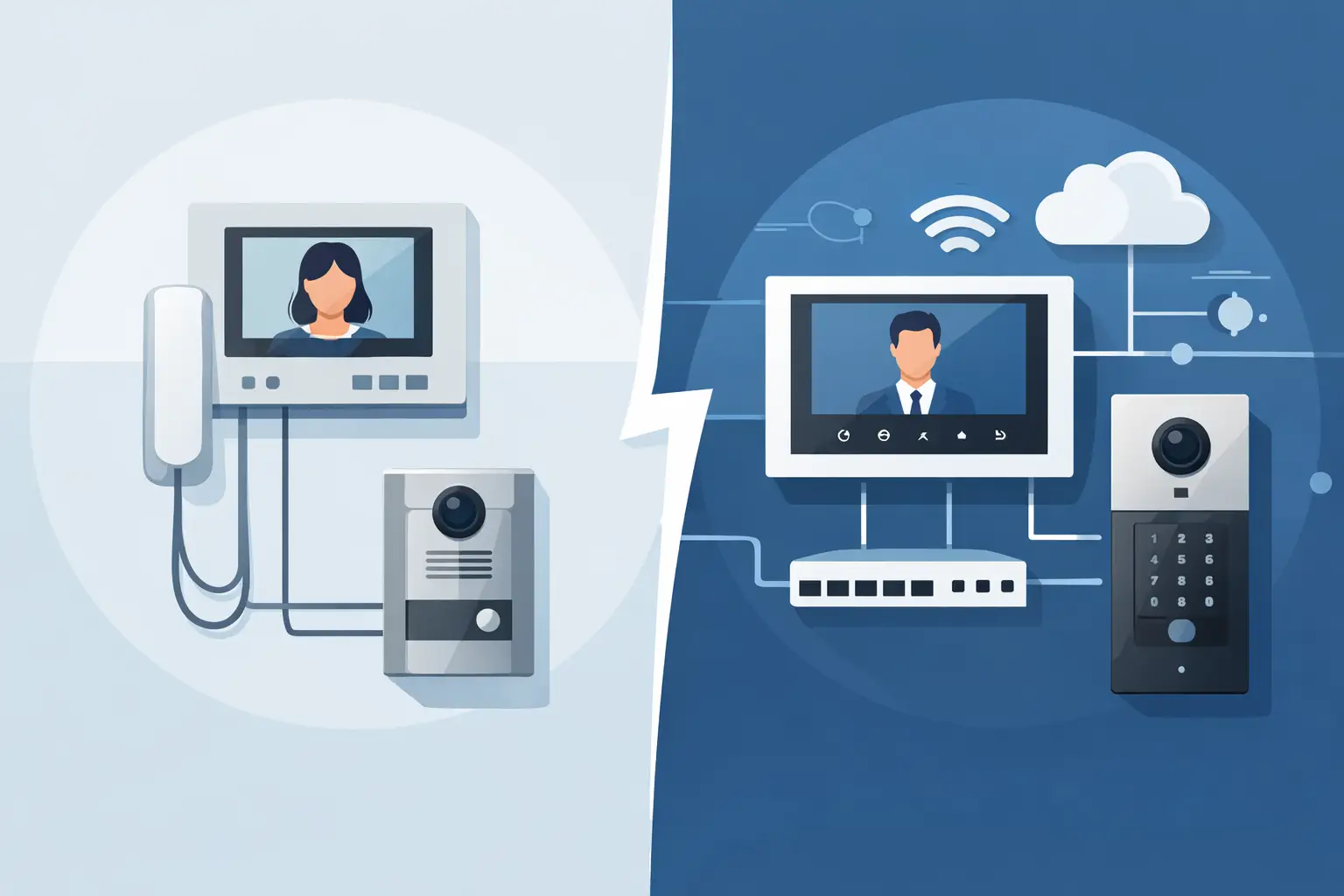
If you are weighing 2 wire versus IP intercom options, the real question is not which technology sounds newer. It is which one fits the building, the wiring path, the door hardware, and the long-term service plan. A system that looks efficient on paper can become expensive fast if it forces major cable replacement, network rework, or added labor at every opening.
For installers, property managers, and facility teams, this choice usually comes down to two very different deployment models. A 2-wire intercom is often selected because it can simplify retrofit work and reduce disruption in existing buildings. An IP intercom is typically chosen for flexibility, broader integration, and easier expansion across larger or more complex sites. Neither is automatically better. The right answer depends on the job.
Understanding 2 wire versus IP intercom systems
A 2-wire intercom uses a pair of conductors to carry power and communication between system devices. In many applications, that makes it attractive for upgrades in older apartment buildings, offices, and mixed-use properties where pulling new network cable would add time and cost. Depending on the platform, 2-wire systems may support audio-only or video intercom functions, indoor monitors, door release, and sometimes mobile forwarding through a system gateway.
An IP intercom runs over a network infrastructure, usually with Cat5e or Cat6 cable and standard switching hardware. It can support video, audio, remote management, integration with access control, and communication across multiple buildings or remote locations. In a modern commercial environment, an IP platform often gives more options for expansion and system administration, especially when the customer already has structured cabling in place.
The gap between the two is not just wiring type. It is the difference between a purpose-built intercom bus and a network-based communication platform.
Wiring and installation realities
When people compare 2 wire versus IP intercom systems, wiring is usually the first deciding factor because it directly affects labor.
In retrofit work, 2-wire has a clear advantage when usable existing cable is already in the walls. Garden apartments, older multi-tenant buildings, and small commercial properties often do not have structured network cabling to every tenant station or entry point. If the existing pathway can support the manufacturer’s 2-wire requirements, the installer may avoid opening walls, patching surfaces, or reworking conduit runs. That can keep projects moving and help maintain budget.
IP intercom installation is often cleaner in new construction or major renovation. If the project already includes network drops, switches, rack space, and power planning, IP can be straightforward. Power over Ethernet can reduce local power requirements for some devices, although not every door station or accessory will be powered the same way. The benefit is consistency. Cabling, switching, and device addressing fit into a familiar network framework.
That said, IP is not always simpler. A network-based intercom can introduce VLAN planning, bandwidth considerations, switch capacity questions, cybersecurity requirements, and coordination with the customer’s IT team. On some jobs, that is normal. On others, it slows the schedule.
Cost is not just equipment price
A lot of buyers try to settle this question by comparing device pricing, but equipment cost alone does not tell the full story.
A 2-wire system can be cost-effective in retrofit projects because the savings often come from labor and cable reuse rather than lower hardware pricing. If you can replace stations and door units without rebuilding infrastructure, total installed cost may come in lower even if the devices themselves are not dramatically cheaper.
IP intercom systems can make more financial sense when the site needs growth, centralized management, or integration with other systems. A school campus, warehouse complex, or multi-entrance commercial property may spend more up front on network-capable hardware, but save later through easier scaling and administration. If the customer expects to add doors, buildings, or remote answering stations, IP often has a stronger long-term case.
Service costs matter too. A simpler 2-wire system may be easier to troubleshoot in certain contained environments. An IP system may allow remote diagnostics and software-based management, but it can also require more network knowledge from the service team.
Scalability and system growth
This is where IP usually starts to separate itself.
If the site is a single entry, a small office, or a modest apartment retrofit, a 2-wire intercom may cover the requirement without adding unnecessary complexity. It handles visitor communication, tenant or occupant response, and door release in a focused way. For many properties, that is enough.
But if the project may expand into multiple entrances, multiple buildings, guard stations, concierge desks, mobile app answering, directory management, or integration with a broader access-control platform, IP is often the better foundation. It is built for distributed architecture. Devices can be managed across a network rather than being tied only to a dedicated intercom bus.
This matters for commercial and institutional customers because requirements tend to grow. A front entry intercom today can become part of a larger managed entry system next year.
Integration with locks, access control, and video
Intercoms do not operate in isolation. They sit at the door, which means they usually need to work with electric strikes, magnetic locks, request-to-exit devices, credentials, cameras, and sometimes elevator or gate control.
A 2-wire system can absolutely support door release and basic entry functions, and many platforms provide practical solutions for apartments and small commercial sites. The limitation is usually not whether it can open a door. The question is how far it can go beyond that.
IP intercom systems tend to offer broader integration options. They may tie into SIP-based communications, directory services, VMS platforms, network video, card access systems, and remote management tools. For a site that wants one credential database, event logging, or central monitoring, that flexibility matters.
Still, more integration is not always better. If the customer only needs reliable visitor communication and controlled entry at one or two doors, an advanced IP feature set may not deliver real value.
Reliability and maintenance in the field
Reliability is not just about hardware quality. It is also about how many points of failure a system introduces.
A well-selected 2-wire intercom can be dependable because the architecture is relatively contained. There are fewer network dependencies, fewer switch issues, and less interaction with outside IT policies. In properties where the owner wants a straightforward door communication system that staff can understand easily, this has value.
An IP intercom can also be highly reliable, especially in professionally managed network environments. It benefits from standard infrastructure, centralized monitoring, and easier device management in larger deployments. But if the network is unstable, poorly segmented, or shared with too many competing priorities, the intercom can inherit those problems.
For that reason, the best system is often the one that matches the customer’s actual support capacity. A property with no in-house IT support may do better with a focused intercom platform. A commercial campus with dedicated network administration may benefit from IP.
When 2 wire versus IP intercom becomes a building-by-building decision
Older apartment buildings are one of the strongest cases for 2-wire. Existing pathways are limited, tenants are already in place, and minimizing disruption matters. If the requirement is to modernize entry communication without tearing open the building, 2-wire can be the practical move.
New multifamily projects often lean toward IP, especially when developers want app-based answering, concierge support, package room integration, and future service expansion. The same is true for schools, offices, and industrial properties where multiple entrances and central oversight are part of daily operations.
Small businesses fall in the middle. A single-tenant office with one front door may be better served by a simple 2-wire or compact intercom solution. A business park with several suites, gates, and shared access control may be better off with IP from the start.
Which one should you choose?
Choose 2-wire when the site is a retrofit, the existing cabling path is a major concern, the system scope is relatively contained, and the customer wants dependable intercom function without turning the project into a network buildout.
Choose IP when the property needs broader integration, centralized management, easier expansion, or multi-site communication. It also makes sense when the job already includes structured cabling and the customer is prepared to support a networked platform.
The best buying decision usually comes from walking the site first, not comparing spec sheets in isolation. Cable condition, device count, door hardware, network readiness, and expected growth will tell you more than any brochure. For professional buyers, that is where the difference between a workable system and the right system becomes clear.
If the project has enough moving parts that the answer is not obvious, that is usually a sign to slow down and match the intercom type to the full entry workflow, not just the front panel at the door.


 No products in the cart.