
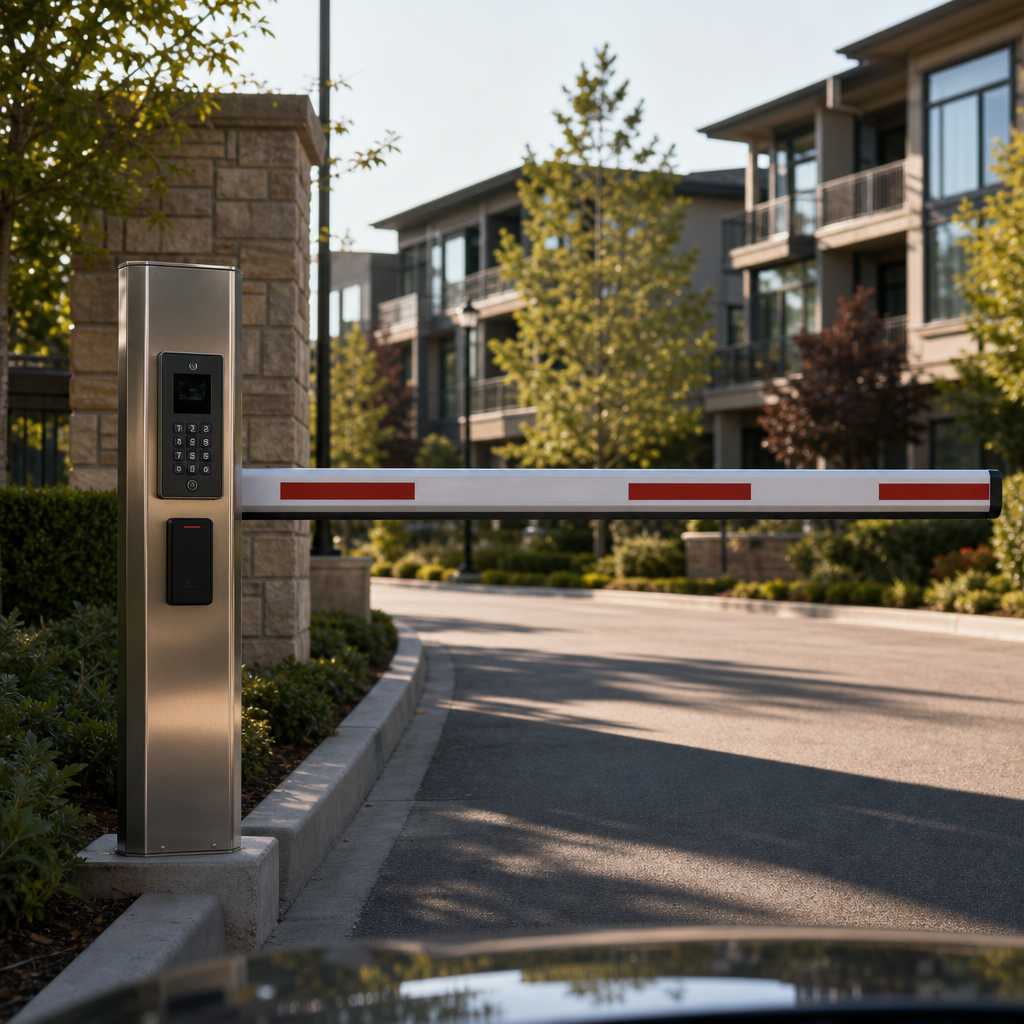
Unauthorized vehicle entry costs commercial property owners thousands of dollars annually in liability claims, vandalism, and theft. For residential communities, a single gap in perimeter access is enough to compromise the safety of hundreds of residents. Gate access control is no longer a luxury feature reserved for high-end gated estates. It is a baseline security requirement for apartment complexes, HOA communities, commercial parking lots, and industrial facilities. This guide breaks down exactly how to choose, configure, and maintain a gate access system that actually works, whether you are managing a single-entry residential gate or a multi-lane commercial lot.
Table of Contents
- Quick Takeaways
- Why Gate Access Control Matters More Than Most Property Managers Realize
- Types of Gate Access Control Systems
- Vehicle Access Control for Commercial Lots
- Community Gate System Design for Residential Properties
- Comparison of Gate Access Technologies
- Integration with Intercoms and CCTV Surveillance
- Common Mistakes in Gate Access Installation
- Frequently Asked Questions
- References
Quick Takeaways
| Key Insight | Explanation |
|---|---|
| Credential type determines security tier | PIN-only entry is the weakest option. Biometric or card-plus-PIN two-factor authentication is the minimum recommended for commercial lots and gated communities with 50+ units. |
| Vehicle access control requires loop detectors or LPR | Pedestrian access systems do not scale to vehicle traffic. License plate recognition (LPR) or inground loop detectors are necessary for reliable vehicle throughput. |
| Remote management is not optional for large properties | Properties with multiple entry points need cloud-based or networked access management so credentials can be revoked instantly across all gates. |
| Power backup is a non-negotiable requirement | A gate that fails open during a power outage eliminates all security. Every system must include battery backup or a fail-secure mechanism. |
| Intercom integration reduces tailgating incidents | Gates paired with video intercoms allow operators to visually verify visitors before granting access, cutting tailgating by a significant margin. |
| Wireless systems lower installation cost on existing properties | Retrofitting wired systems into older buildings is expensive and disruptive. Wireless gate access transmitters cut installation time and cost substantially. |
| Audit logs are a legal asset | Access event logs showing who entered and when can protect property owners in liability disputes and insurance claims. |
Why Gate Access Control Matters More Than Most Property Managers Realize
The real risk is not a dramatic forced-entry breach. It is the slow accumulation of unauthorized access events that erode security over time. A contractor who was terminated six months ago still has a working gate code. A resident who moved out left their clicker with a subletter. A delivery driver propped the gate open for 20 minutes. These are the actual failure modes that property managers deal with, and none of them are solved by a physical gate alone.
Gate access control solves the credential management problem by giving administrators a way to issue, track, and revoke access in real time. According to data from Statista, the global access control market was valued at over $9 billion in 2022 and is projected to grow steadily through 2030, driven largely by demand in commercial and multi-family residential sectors. That growth reflects a real shift in how property operators think about perimeter security.
In practice, a properly configured gate system does three things simultaneously: it keeps unauthorized vehicles and people out, it creates an auditable record of every entry event, and it makes legitimate access frictionless for residents, employees, and approved visitors. When one of those three functions fails, the entire system loses its value.


Types of Gate Access Control Systems
Not every property needs the same solution. The gate technology you choose should match the traffic volume, security tier, and physical layout of your site. Choosing a system that is either underpowered or overly complex for your context creates operational problems that offset any security benefit.
Keypad and PIN Entry Systems
PIN-based entry is the most common starting point for residential communities because it is affordable and easy to use. The critical weakness is that PINs get shared. Once a code is distributed to 200 residents, it is effectively public. PIN systems work best as a secondary factor, not as a standalone credential.
RFID and Proximity Card Systems
RFID cards and fobs offer a significant improvement over PINs because each credential is unique and tied to a specific individual. When a resident moves out, the facility manager deactivates that single card without changing anything for the remaining residents. For multi-tenant residential buildings and mid-size commercial properties, RFID remains one of the most practical and cost-effective credential formats available.
Biometric Gate Access
Fingerprint readers and facial recognition systems eliminate the credential-sharing problem entirely because the credential is the person. UnikCCTV’s lineup includes facial recognition locks and biometric access systems specifically designed for high-security entry points. The tradeoff is higher hardware cost and a need for proper enrollment workflows. For facilities where workforce accountability matters, biometric gate access is worth the investment.
Mobile and Bluetooth Access
Smartphone-based credentials are increasingly popular in newer developments because residents already carry their phones. Mobile access systems can be managed remotely via an app and updated instantly. The dependency on battery life and network connectivity is a real operational consideration that should factor into your backup plan.
Pro tip: For any residential community with more than 100 units, deploy at least two credential formats at the main gate. A mobile credential paired with a keypad backup ensures residents are never locked out due to a single point of failure.
Vehicle Access Control for Commercial Lots
Commercial parking lots and industrial facilities have access control demands that residential systems simply are not designed to handle. The volume of vehicles, the mix of authorized employees and visitors, and the need for throughput speed all require dedicated vehicle access control infrastructure.
License Plate Recognition Systems
LPR cameras read vehicle license plates and compare them against an authorized database, triggering gate opening automatically for approved vehicles. The technology has matured significantly and now operates accurately in low-light and high-speed scenarios. LPR is the preferred solution for large commercial lots where issuing physical credentials to every driver is impractical.
Inground Loop Detectors
Loop detectors are embedded in the pavement and detect the electromagnetic signature of a vehicle above them. They are typically used in combination with a credential reader to confirm both the presence of a vehicle and a valid access credential. Loop detectors also prevent gate arms from closing on a vehicle that is still in the gate opening, which is a critical safety and liability concern.
Barrier Gates vs. Swing and Slide Gates
Barrier arms are the standard for high-volume commercial lots because they cycle quickly and are lower cost to replace if struck by a vehicle. Swing and slide gates provide stronger physical deterrence and are better suited to perimeter security where unauthorized vehicle ramming is a realistic concern, such as utility facilities or restricted government-adjacent sites.
In practice, the biggest commercial lot failures come from undersizing the gate controller for the expected transaction volume. A controller rated for 50 daily cycles will degrade quickly in a 300-cycle-per-day environment. Always specify hardware based on peak-hour volume, not average daily volume.

Community Gate System Design for Residential Properties
A community gate system for a residential property has to serve two distinct groups with different needs: the residents who want fast, frictionless access and the property manager who needs auditability and control. Getting both right requires deliberate design, not just hardware selection.
Single Entry vs. Multi-Entry Layouts
Properties with a single controlled entry point are significantly easier to manage and audit. Multi-entry layouts introduce complexity: credentials must be synchronized across all gates, and each additional entry point is another potential failure point. If your property has secondary service or delivery gates, consider whether those gates need full access control or can be managed with a simpler intercom-to-release system.
Visitor Management at the Gate
Resident access is only half the problem. Managing visitor access without creating a bottleneck at the gate requires a clear protocol. Options include telephone entry systems that allow residents to buzz in guests remotely, QR code passes issued via app for expected visitors, and video intercom systems where a staffed or remote operator verifies and grants entry.
UnikCCTV offers wireless intercom systems that integrate directly with gate controllers, giving residents the ability to see and speak with visitors before granting access, without requiring a physical guard station. This is particularly effective for gated HOA communities where staffing a gatehouse is not economically viable.
Resident Onboarding and Credential Management
The most well-designed gate system fails when credential management is handled informally. Property managers should enforce a documented onboarding process: residents receive credentials upon move-in and credentials are immediately deactivated upon move-out. Annual audits of active credentials catch orphaned access entries that accumulate over time.
Pro tip: Set all resident credentials with an automatic expiration date tied to their lease term. This forces a credential renewal check at lease renewal and eliminates the risk of former tenants retaining active gate access.
Comparison of Gate Access Technologies
The table below compares three primary gate access approaches commonly deployed in residential communities and commercial properties. Each has distinct strengths depending on property size, budget, and security requirements.
| Technology | Best Use Case | Key Limitation |
|---|---|---|
| RFID Card / Fob System | Multi-tenant residential buildings and mid-size commercial properties where individual credential tracking is required | Physical cards can be lost, stolen, or cloned; requires card management infrastructure |
| License Plate Recognition (LPR) | High-volume commercial parking lots and industrial facilities where issuing individual credentials is impractical | Higher upfront cost; requires clean camera sightlines and regular database maintenance |
| Biometric Access (Fingerprint / Facial Recognition) | High-security entry points where accountability is critical, such as server rooms, restricted commercial zones, or executive residential buildings | Higher hardware cost; requires enrollment process; may raise privacy concerns in some jurisdictions |
Integration with Intercoms and CCTV Surveillance
A gate that opens and closes without any visual record is a gap in your security posture. The gate access control system and your surveillance infrastructure need to work together, not operate as separate silos. In practice, the best-performing systems treat the gate as an event trigger that activates camera recording and logs a timestamped entry simultaneously.
“Physical security is only as strong as its weakest integration point. A gate without a camera is just a speed bump.” – Security industry practitioner perspective cited in physical security design literature.
CCTV cameras positioned at gate entry and exit points serve three functions: they deter unauthorized attempts, they capture footage of every vehicle and individual passing through, and they provide post-incident evidence for disputes or liability claims. UnikCCTV’s CCTV surveillance equipment is designed to work alongside gate and intercom hardware, enabling property managers to pull entry footage by timestamp directly from the access log.
Wireless intercom systems are especially valuable at gates because they eliminate the cable run between the gate panel and the building entrance, which is a common cost barrier on retrofit projects. Residents or operators can receive gate call notifications on a connected panel or smartphone, see the visitor, and release the gate remotely. This workflow is faster, more reliable, and more secure than any key-sharing or code-sharing alternative.
Common Mistakes in Gate Access Installation
A common mistake is selecting a gate system based on upfront hardware cost rather than total cost of ownership. A cheaper controller that requires proprietary service contracts or lacks remote management capability will cost more over three years than a higher-quality networked system installed correctly from the start.
Ignoring Fail-Safe vs. Fail-Secure Configuration
Every gate system must be configured for what happens when power is lost. Fail-open systems unlock automatically during a power failure, which is required at emergency egress points but is a security disaster at a perimeter entry. Fail-secure systems remain locked during power failure, which protects the perimeter but must be paired with a battery backup or manual override for safety compliance. Most properties need a combination of both, depending on the gate location and applicable fire codes.
Underestimating Cable and Infrastructure Requirements
Property managers frequently underestimate the infrastructure required to connect gate hardware to the access control panel, particularly on older properties. Running conduit and low-voltage cable across a parking lot or under a driveway is expensive and disruptive. Wireless gate access transmitters from UnikCCTV’s product line address this directly, enabling controller-to-gate communication without trenching, which reduces installation cost and project timeline significantly.
Failing to Plan for Visitor and Emergency Vehicle Access
Emergency vehicle access at gated communities is a code requirement in most jurisdictions. The standard solution is a Knox Box or emergency access keyswitch that firefighters and paramedics can use to open the gate without waiting for authorization. Failing to include this in the system design can result in code violations and delayed emergency response, both of which represent serious liability exposure.
Visitor access planning is equally important and equally neglected. If residents cannot easily admit guests, they will find workarounds, such as propping the gate open or sharing their credentials, that undermine the entire system. Design visitor access workflows before installation, not after.
Frequently Asked Questions
What is the difference between a gate access control system and a door access control system?
Gate access control systems are designed for vehicular and high-traffic pedestrian entry points at the perimeter of a property, such as parking lot entrances, community gates, and facility entrances. Door access control systems manage entry into individual interior spaces. Gate systems typically require heavier-duty hardware, weather resistance, and vehicle detection capability that standard door access hardware does not provide.
How much does a gate access control system cost to install?
A basic RFID-based gate access system for a single-entry residential community typically starts around $2,000 to $5,000 including hardware and installation. LPR-based commercial systems with barrier gates and camera integration can range from $8,000 to $25,000 or more depending on lane count and software requirements. Wireless systems reduce installation labor cost on retrofit projects significantly compared to wired alternatives.
Can existing gate hardware be upgraded to a smart access control system?
In most cases, yes. Existing swing and slide gates can be retrofitted with new access control boards, RFID readers, or intercom systems without replacing the gate mechanism itself. The key requirement is that the gate operator must have a compatible dry contact input for the access controller to trigger. A professional assessment of your existing gate operator model will confirm compatibility before any purchase.
What credentials work best for a large residential community with frequent resident turnover?
RFID fobs or cards are the most practical credential format for high-turnover residential properties because individual credentials can be deactivated instantly without affecting other residents. Mobile credentials are an increasingly viable alternative for communities where residents can be expected to use a smartphone app reliably. Avoid shared PIN codes as the primary credential in any community with more than 20 units.
How do vehicle access control systems handle visitor and delivery vehicles?
Most vehicle access control platforms support temporary or one-time credentials that can be issued to visitors in advance. For delivery vehicles, options include a dedicated intercom or callbox at the gate connected to a property management console, QR code passes sent via text or email, or an LPR whitelist that includes frequently visiting delivery fleet plates. For high-security properties, all non-credentialed vehicles should be held at the gate until manually released by an operator or resident.
Is a wireless gate access system as reliable as a wired system?
Modern wireless gate access systems using encrypted frequency-hopping radio communication are highly reliable for standard residential and commercial applications. The practical advantage is that they eliminate the conduit and cable infrastructure that drives up installation cost and complexity on existing properties. For high-security or mission-critical applications, wired systems remain the preferred choice because they are not subject to radio frequency interference or range limitations.
Have you recently upgraded a gate access system on your property, or are you currently evaluating options? Share what factors mattered most in your decision.
References
- Statista: Access control market size data and global security industry statistics
- Forbes: Commercial real estate security trends and property technology investment analysis
- NIST: Federal guidelines on physical access control systems and credential standards
- DHS: Perimeter security and vehicle access control best practices for facilities
- IHS Markit via McKinsey: Physical security technology adoption in commercial and residential sectors

 No products in the cart.