
If you are pricing a surveillance system for a small office, a multi-unit property, or a larger commercial site, the dvr vs nvr recorder question affects more than storage. It changes your camera choices, cabling plan, installation labor, network requirements, and how easily the system can grow later.
For professional buyers, that matters. The recorder is not just a box that saves video. It is part of the system architecture, and the right choice depends on the building, the number of cameras, the existing wire in place, and the level of image detail the customer expects.
DVR vs NVR Recorder: The Core Difference
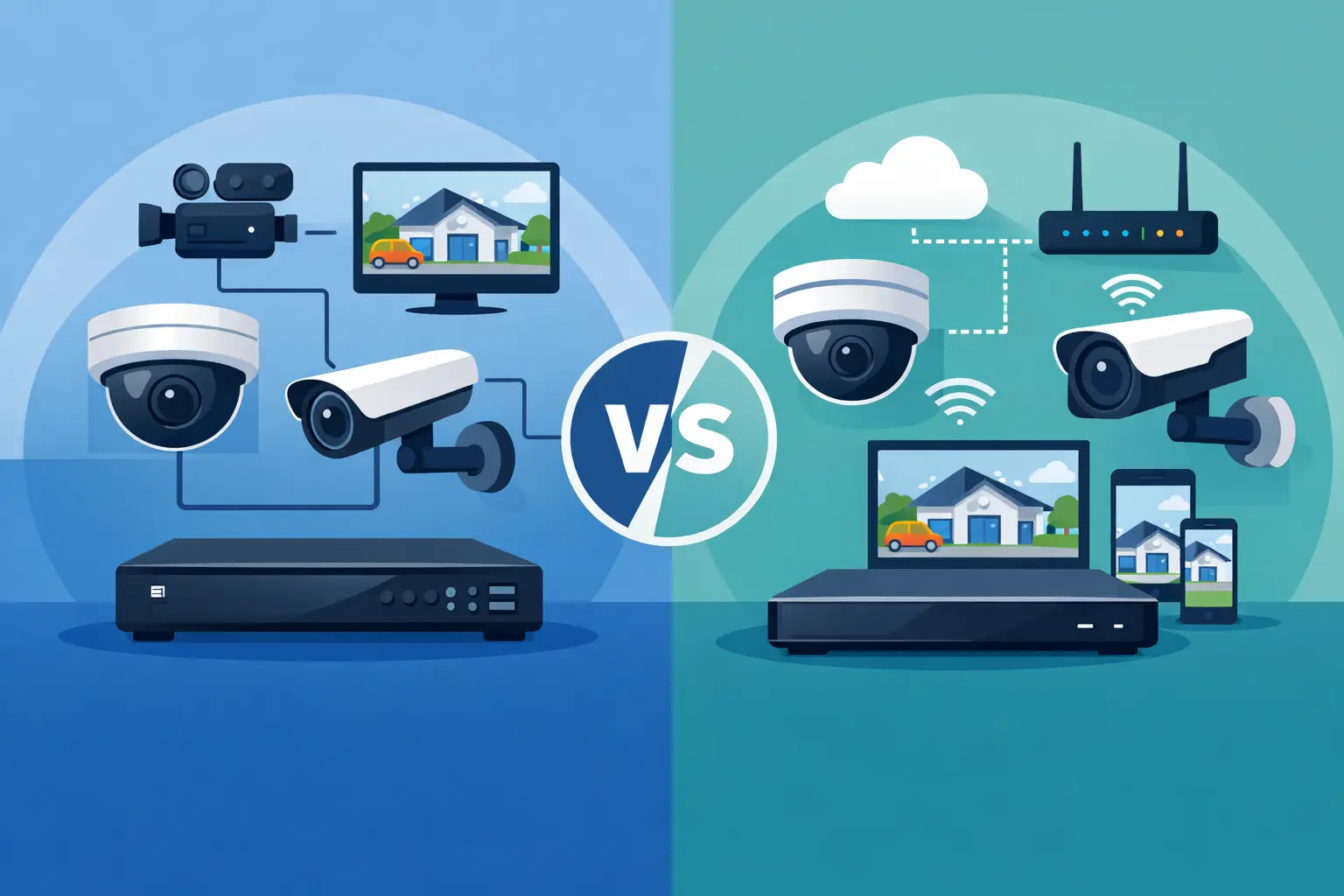
A DVR, or digital video recorder, is typically used with analog cameras, including formats such as HD over coax. The video signal comes from the camera to the recorder over coaxial cable, and the recorder processes and stores the footage.
An NVR, or network video recorder, is built for IP cameras. In this setup, the camera itself handles much of the image processing, then sends digital video over a network to the recorder. Most NVR systems use Ethernet cabling, and many are paired with PoE switches or built-in PoE ports to carry both power and data on one cable.
That distinction sounds simple, but it drives nearly every practical difference in the field. DVR systems are often a strong fit when a site already has usable coax in place. NVR systems usually make more sense when the goal is higher resolution, cleaner scalability, and broader network-based features.
When a DVR Recorder Makes More Sense
A DVR recorder is still a practical choice in many installations, especially where budget control and existing infrastructure are priorities. If a property already has coax runs from an older analog system, reusing that wire can save substantial labor. For retrofit work in retail spaces, apartment buildings, warehouses, or schools, that can be the deciding factor.
Modern HD-over-coax systems are also better than many buyers expect. They can deliver solid image quality for general surveillance, entrances, parking lots, hallways, and perimeter coverage without the cost of a full IP migration. For many properties, that level of performance is enough.
DVR systems can also be simpler for certain straightforward jobs. If the requirement is a fixed set of cameras, local recording, and dependable monitoring without heavy network integration, DVR remains a valid commercial option.
The trade-off is flexibility. Analog systems generally offer fewer advanced analytics, less convenient expansion, and more dependence on home-run cabling back to the recorder. When the site grows, the wiring plan can become a limitation.
Best-fit DVR applications
DVR is often the better fit for analog upgrades, budget-sensitive jobs, and locations where coax is already installed and still in good condition. It works well for convenience stores, smaller offices, detached buildings, and residential or light commercial properties that need reliable recording without major network design.
When an NVR Recorder Is the Better Investment
An NVR recorder is usually the stronger long-term option for new installations and larger systems. IP cameras support higher resolutions more easily, and they tend to offer a broader range of features such as intelligent detection, line crossing alerts, facial capture support on certain models, audio, remote configuration, and better integration with network-based infrastructure.
Cabling is often more efficient too. With Ethernet and PoE, one cable can handle both power and communication. That can reduce installation complexity, especially in offices, schools, mixed-use buildings, and properties where camera locations are spread out across multiple zones.
NVR systems also scale more naturally. Adding cameras to an IP environment is typically easier than expanding an analog layout, provided the network is designed correctly. For a growing business, a multi-building site, or a property manager who expects future changes, that flexibility has real value.
The trade-off is that NVR systems put more weight on network planning. Switch capacity, bandwidth, power budgets, and IP addressing all need to be considered. If those details are ignored, even good hardware can perform poorly.
Best-fit NVR applications
NVR is usually the right call for new construction, commercial upgrades, larger camera counts, and sites where image detail and future expansion matter. It is especially well suited for schools, industrial facilities, office campuses, apartment complexes, and access-controlled properties where surveillance may need to work alongside intercoms, door stations, or centralized management.
Image Quality, Bandwidth, and Storage
One of the biggest reasons buyers lean toward NVR systems is image quality. IP cameras commonly offer higher megapixel options, which helps when you need facial detail at entry points, license plate coverage in controlled lanes, or wide-area views where digital zoom may be needed later.
That said, better image quality increases storage demands. A 4MP or 8MP camera running around the clock will consume more space than a lower-resolution analog stream, especially if frame rates are high and motion recording is not optimized. NVR systems give you more room to pursue detail, but they also require better storage planning.
DVR systems can be more economical on storage, depending on the camera format and recording settings. For general-purpose monitoring where evidentiary detail is not needed at every camera, that can be enough. The right answer depends on what the footage must actually accomplish. Watching activity is not the same as identifying a face or reading a plate.
Installation and Cabling Considerations
In a dvr vs nvr recorder comparison, installation labor is often where the budget shifts.
With DVR, each camera usually home-runs back to the recorder over coax, with separate power unless a specific setup combines it. That can be straightforward in smaller jobs, but it becomes more labor-intensive as buildings get larger or more segmented.
With NVR, cameras connect through the network. Depending on the design, you may run cables to PoE switches closer to the camera zones rather than pulling every line back to one central point. That can simplify some layouts and improve expansion options later.
But IP systems are not automatically easier. In older buildings, network pathways may be limited, switch locations may require enclosure planning, and proper segmentation may be needed if the surveillance system shares infrastructure with other services. Installers know that the cleanest camera spec sheet does not solve a poor network design.
Cost: Upfront vs Long-Term
DVR usually wins on initial cost in many standard applications. Analog cameras and compatible recorders can offer a lower entry point, and wire reuse can reduce labor even more. For a fixed-scope project, that can make good business sense.
NVR often carries a higher upfront cost, especially when higher-resolution cameras, PoE switching, and better storage arrays are included. But the long-term value can be stronger if the customer expects system growth, wants smarter features, or needs better image quality to support investigations and liability protection.
This is why the cheapest system on paper is not always the lowest-cost system over time. If a customer installs DVR today and replaces it two years later because the site expanded or the footage detail is not good enough, the original savings can disappear quickly.
Integration With Broader Security Systems
For many professional buyers, surveillance does not stand alone. It needs to work alongside intercoms, gate entry, electronic locks, and access control.
NVR-based IP systems generally offer more integration flexibility, especially in environments where devices are already network-connected. That can matter in apartment buildings, schools, commercial offices, and managed sites where event-based recording or shared monitoring workflows are useful.
DVR systems can still be effective in standalone surveillance roles, but they are usually less adaptable when the project expands into broader security infrastructure. If the customer is building a more connected environment, NVR often aligns better with that direction.
Which One Should You Choose?
If the site has existing coax, a defined camera count, and a need for dependable video without major network complexity, DVR may be the right fit. It is practical, cost-conscious, and still viable for many professional installations.
If the project is new, growing, or expected to deliver higher image detail and better integration options, NVR is usually the stronger platform. It gives you more room to scale and more access to advanced camera features, but it also requires more careful planning.
For many buyers, the real answer is not which technology is newer. It is which recorder type matches the property, the wiring, the operational goals, and the expected life of the system. That is where experienced product guidance matters, especially when the recorder is only one piece of a larger security deployment.
A good surveillance system starts with the right architecture, not just the right price tag. If you choose with the building and the use case in mind, the recorder will support the job instead of limiting it later.


 No products in the cart.