
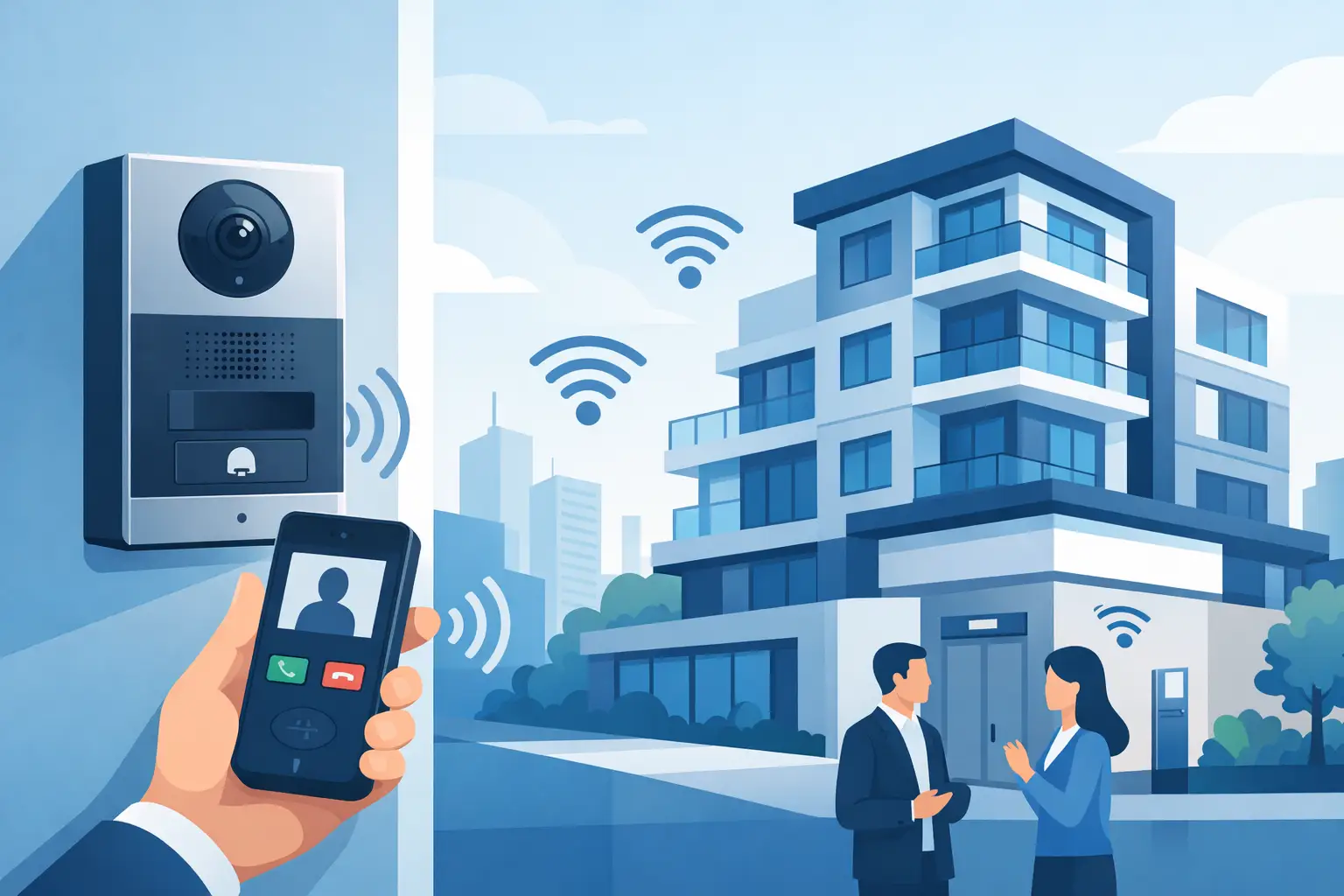
If you are looking at the zdl-7500 wireless building intercom system, you are probably not shopping for a novelty device. You are trying to solve a real communication or entry-control problem – often in a building where running new wire is expensive, disruptive, or simply not practical. That changes how this product should be evaluated. The right question is not whether wireless sounds convenient. The right question is whether the system fits the building, the traffic pattern, and the level of control you actually need.
Where the zdl-7500 wireless building intercom system makes sense
A wireless building intercom can be a good fit when the site has limited pathways for cabling, finished walls that should not be opened, detached structures, or a need for faster deployment. In those cases, the zdl-7500 wireless building intercom system may appeal to property managers, office administrators, school facilities staff, and owners who need voice communication without a full wiring project.
That said, wireless is not automatically the better choice. In a new construction project or a major renovation, hardwired intercom equipment may still be the stronger long-term option because it reduces dependence on signal conditions and local interference. Wireless saves labor in many retrofits, but labor savings can be offset if the site has signal obstacles, poor mounting locations, or a need for integration that the platform does not fully support.
For many buyers, the main advantage is speed. A system like this may be considered when a front entry, interior office, gatehouse, warehouse door, or secondary building needs communication quickly and the project cannot wait on conduit work. That is especially relevant in occupied buildings where downtime and wall repair create extra cost.
What to verify before you buy
Before choosing any wireless intercom, start with the layout. The distance between call station and receiving unit matters, but so does what sits between them. Concrete block, brick, elevator shafts, metal doors, structural steel, and mechanical rooms can all affect performance. A quoted wireless range on paper does not tell the whole story.
Power is the next checkpoint. Some systems rely on plug-in power supplies, some use batteries in part of the setup, and others may support a mixed approach. That affects maintenance planning. A battery-powered station may be useful in locations where power is difficult to reach, but it also introduces service intervals and the risk of inconsistent operation if maintenance slips.
Then there is the question many buyers ask too late – does the intercom only talk, or does it also support door release? In building applications, communication alone may not be enough. If staff can speak to a visitor but still have to walk to the door, the system may solve only half the problem. If entry control is part of the requirement, make sure the unit can work with electric strikes, magnetic locks, gate operators, or access-control relays where needed.
Audio quality should also be treated as a functional requirement, not a convenience feature. In a noisy office, a multi-tenant entry, a receiving dock, or a school vestibule, weak audio can turn into repeated calls, delayed entry, and frustrated occupants. Speaker volume, microphone sensitivity, and noise handling matter more than feature lists.
zdl-7500 wireless building intercom system in real property use
The most common use case is controlled visitor communication at an entry that does not justify a full-scale integrated access platform. A smaller office, mixed-use property, detached building, internal service entrance, or secondary resident access point may benefit from a simpler wireless intercom approach. In these settings, installation practicality often carries more weight than enterprise-level features.
Another use case is temporary or transitional deployment. If a building is being reconfigured, an expansion is underway, or a security desk has been moved, a wireless intercom can fill an operational gap without forcing a permanent wiring decision too early. That can be useful for facilities managers trying to maintain communication while a larger infrastructure plan is still in development.
There is also a niche but real need in properties with awkward cable routes. Historic buildings, converted industrial spaces, and occupied multi-use properties often present installation constraints that make wireless more than a convenience. In those cases, the value is not just faster setup. It is the ability to place communication points where the building would otherwise make that difficult.
Integration questions that matter
For professional buyers, a building intercom should not be evaluated in isolation. It may need to work alongside door hardware, credentials, cameras, recording equipment, or an existing access-control setup. That is where many low-end wireless products fall short.
If the zdl-7500 wireless building intercom system is being considered for a commercial or managed property, ask whether it can trigger a lock release reliably, whether relay timing can be adjusted, and whether the receiving end can be placed where staff actually work. A technically acceptable intercom still becomes a poor fit if it forces awkward operations at the desk or front office.
It also helps to clarify whether the system is intended for one entrance or multiple locations. Some buyers assume a wireless intercom can be expanded easily across a property, only to find that the platform is better suited for point-to-point communication than multi-entry management. If the site may grow, expansion path matters from the start.
Video is another dividing line. Some properties only need voice and release, especially at interior doors or lower-risk entries. Others need visual verification for liability, package handling, after-hours control, or school visitor management. If video is part of the requirement, a voice-only wireless system may be too limited even if the initial price looks attractive.
Installation realities installers and managers should consider
Wireless products are often marketed as simple to install, but field conditions still decide the result. Mounting height, weather exposure, line obstructions, interior interference sources, and power routing all affect reliability. On paper, the job may look easy. On site, a poor mounting location can create audio dropouts or inconsistent call delivery.
Exterior placement deserves extra scrutiny. If the entrance station is exposed to rain, direct sun, dust, or seasonal temperature swings, the enclosure rating and material quality become important. An intercom at a sheltered office vestibule faces different conditions than one mounted at a perimeter gate or warehouse entry.
Installers should also think about serviceability. If batteries, programming controls, or pairing functions are difficult to access, future maintenance becomes slower and more costly. That matters in managed properties where maintenance staff, not the original installer, may be the people called when a station stops responding.
Trade-offs compared with hardwired systems
The strongest argument for wireless is reduced installation disruption. Less cable, less wall work, and faster deployment can make the zdl-7500 wireless building intercom system appealing in retrofit environments. For the right site, that benefit is real.
The trade-off is that wireless systems are more dependent on the radio environment and placement discipline. Hardwired intercoms typically offer more predictable performance across difficult construction types, and they may be better suited for larger, more permanent deployments. If the building has heavy masonry, multiple floors of reinforced structure, or critical life-safety-adjacent communication needs, wireless should be evaluated carefully rather than assumed to be sufficient.
Cost also deserves a more honest look. Wireless can reduce labor, but if extra repeaters, power accommodations, repositioning, or troubleshooting are required, the installed cost can move closer to a wired alternative. Buyers comparing systems should think beyond unit price and include site conditions, service expectations, and the cost of future adjustments.
Who should consider it, and who should not
A wireless building intercom is often a strong candidate for smaller commercial properties, internal office communication points, detached structures, temporary entry control needs, and retrofit jobs where cable paths are a problem. It can also fit residential buildings or mixed-use sites where basic voice communication and practical installation matter more than advanced software control.
It may be a weaker fit for large campuses, high-security facilities, heavily shielded structures, or properties that require centralized management across multiple doors with credentialed access, video verification, and event logging. In those environments, the intercom is part of a broader security system, and standalone wireless equipment may not offer enough control or reporting.
For buyers who want help matching the equipment to the building, this is where an experienced distributor matters. A product spec can tell you what a unit is supposed to do. It cannot tell you whether it suits a concrete school vestibule, a multi-tenant office entry, or a metal-sided industrial structure without someone asking the right questions.
The best way to evaluate the zdl-7500 wireless building intercom system is to treat it like infrastructure, not electronics. Look at the building, the entry workflow, the lock hardware, the noise level, and the path for future growth. If those pieces line up, wireless can be a practical answer. If they do not, identifying the mismatch early will save far more than the initial purchase price.


 No products in the cart.