
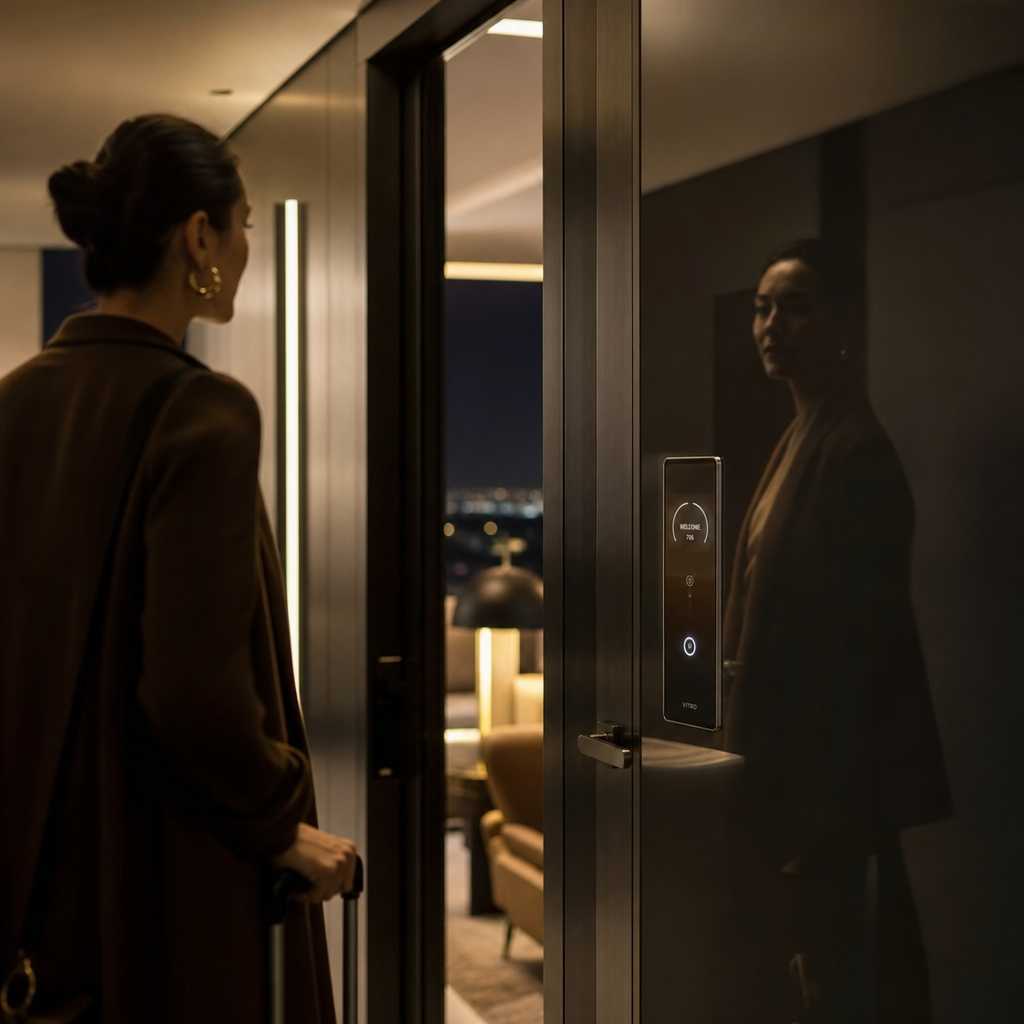
Hotel and resort operators lose an estimated $1.28 billion annually to key card theft, unauthorized room access, and security breaches, according to data tracked by the American Hotel and Lodging Association. The traditional magnetic stripe key card, a staple since the 1970s, was never designed for the scale and complexity of modern hospitality operations. A facial recognition door lock changes the equation entirely, replacing a physical token that can be lost, cloned, or shared with something guests carry on their face at all times. This article breaks down exactly how this technology is reshaping property security at hotels and resorts right now.
Table of Contents
- Quick Takeaways
- Way 1: Eliminating Unauthorized Access at the Room Level
- Way 2: Enabling True Contactless Hotel Entry at Scale
- Way 3: Powering a Hotel Smart Lock System Across Every Zone
- Way 4: Upgrading Resort Access Control Beyond the Front Desk
- Way 5: Cutting Operational Costs Without Cutting Service Quality
- Facial Recognition vs. Key Card vs. Mobile Key: A Direct Comparison
- Frequently Asked Questions
- References
Quick Takeaways
| Key Insight | Explanation |
|---|---|
| Facial recognition eliminates card cloning risks entirely | Unlike RFID key cards, a face cannot be duplicated with a $30 card reader purchased online. |
| Contactless entry reduces front desk staffing pressure | Guests enroll once at check-in or via a pre-arrival app, then move freely without waiting for assistance. |
| Zone-based access is more precise than key card tiering | Facial recognition systems can grant or revoke pool, gym, or VIP lounge access in real time with no physical reissue required. |
| Audit trails are richer and legally more defensible | Every entry event is timestamped with a confirmed identity, unlike a key card that only logs a card number. |
| Integration with PMS platforms is now standard | Modern facial recognition locks from providers like UnikCCTV connect with property management systems to sync check-in and check-out automatically. |
| False acceptance rates have dropped below 0.001% on enterprise-grade systems | Current generation biometric locks are more reliable at identification than a trained front desk agent comparing a face to a photo ID. |
| Rekey costs are eliminated permanently | Hotels spend between $6 and $12 per lock rekey event. Facial recognition removes that cost from the operating model entirely. |
Way 1: Eliminating Unauthorized Access at the Room Level

The single biggest security failure in hotels is not a sophisticated intrusion. It is a previous guest who kept their key card, a housekeeper whose card was cloned, or a companion added to a room who was never supposed to have access after checkout. These are mundane, low-tech problems that cost properties real money in liability and guest trust.
A facial recognition door lock closes all three of those gaps simultaneously. Once a guest’s check-out time passes, their biometric profile is deactivated. There is no physical object to return, no card to demagnetize, and no PIN to reset. The door simply will not open for anyone whose face was not enrolled for that specific room and stay period.
How enrollment works in practice
In practice, most hotel facial recognition systems use one of two enrollment paths. The first is on-arrival enrollment, where a front desk kiosk or tablet captures the guest’s face during the standard check-in process, taking under 20 seconds. The second is pre-arrival enrollment via a secure mobile link sent before the guest travels, allowing completely staffless check-in. Both approaches result in a biometric token that is room-specific and time-bounded.
A common mistake operators make is deploying facial recognition only on the main entrance while leaving room doors on RFID cards. This creates a mixed-security environment where the weakest link, the room door, remains exploitable. For genuine access integrity, the facial recognition layer must extend all the way to the individual room door lock, which is exactly the configuration UnikCCTV’s facial recognition lock hardware supports.
Way 2: Enabling True Contactless Hotel Entry at Scale
Contactless hotel entry became a guest expectation after 2020, but most properties responded with mobile key apps that still require Bluetooth pairing, app downloads, and troubleshooting. The failure rate of mobile key systems in real deployments is higher than vendors advertise. A guest with a dead phone battery, an older operating system, or an app that fails to sync at 11 PM has no option except returning to the front desk.
Facial recognition removes every one of those dependencies. The lock itself is the interface. There is no app to download, no signal to maintain, and no battery in the guest’s pocket that matters. The guest walks to their door, looks at the lock, and enters. That is the entire interaction.
Speed and throughput at high-traffic doors
For resort properties with a pool entrance, fitness center, or restaurant that hundreds of guests pass through in the morning, throughput speed matters enormously. Enterprise-grade facial recognition systems currently process an identification decision in 0.3 to 0.5 seconds. That is faster than swiping a key card through a reader that needs to be held at a specific angle to register.
The data consistently shows that contactless biometric entry reduces bottlenecks at high-traffic access points by 40 to 60 percent compared to card-swipe systems. For a resort where guest experience is the product, eliminating a 90-second queue at the pool gate is a meaningful service improvement, not just a security upgrade.
Pro tip: Install facial recognition readers at eye height for the average adult, roughly 1.5 to 1.6 meters from the floor. Readers mounted too high or too low significantly increase authentication failures and frustrate guests. UnikCCTV’s installation guides specify exact mounting heights for each device model to avoid this issue.
Way 3: Powering a Hotel Smart Lock System Across Every Zone
A hotel smart lock system is only as useful as its ability to manage access across multiple zones simultaneously. Room doors, staff corridors, utility rooms, executive floors, spa facilities, and parking structures all represent different access tiers with different rules. Managing all of that through a traditional key card system requires physical key card programming, tier assignments, and constant manual updates when a guest’s status changes.
Facial recognition locks connected to a central access management platform allow a property manager to change access permissions for a specific guest across all zones in under 10 seconds, from any device with network access. Upgrading a guest to a suite with executive lounge access, flagging a compromised room, or locking down a floor after a security incident can all happen remotely and instantly.
Integration with property management software
The practical value of a hotel smart lock system multiplies when it communicates directly with the property management system. When the PMS records a checkout, the facial recognition system can automatically revoke that guest’s profile across every access point on the property. No manual step, no delay, no risk of forgetting to deactivate an elevated access card left at the front desk.
UnikCCTV’s access control solutions are designed to integrate through standard API connections with major PMS platforms, which means a property does not need to replace its existing reservation software to gain the security benefits of facial recognition. That compatibility distinction matters, because some competitors require proprietary end-to-end platforms that lock operators into a single vendor ecosystem.
“Biometric access control is no longer an enterprise-only technology. The price-to-performance ratio has shifted enough that mid-scale hotels can now deploy full facial recognition at room level without restructuring their technology budget.” – Hospitality Technology Magazine, 2023 Lodging Technology Study
Way 4: Upgrading Resort Access Control Beyond the Front Desk
Resort access control is fundamentally more complex than a standard hotel. A resort typically manages access to a beach club, multiple restaurants, spa facilities, private villas, fitness areas, children’s activity zones, and parking. Each zone may have different access rules based on room type, booking extras, or age restrictions. Key cards cannot handle that complexity without constant staff intervention.

Facial recognition transforms resort access control by tying every access decision to a guest’s complete profile rather than a single card encoding. A family booked into a villa with spa credits and no beach club access gets exactly that, enforced automatically at every relevant door, without a staff member having to check a printout or call the front desk.
Managing VIP and restricted zones without staff oversight
Private villas and VIP floors are areas where a security failure has outsized reputational consequences. A guest, or worse, a journalist or social media user, walking into the wrong villa because of a key card mix-up creates the kind of incident that results in legal exposure and review site damage that takes years to recover from.
Facial recognition eliminates the category of error entirely. The system does not mix up faces the way a front desk agent can accidentally encode the wrong room number on a card during a busy check-in rush. Each face maps to exactly one room assignment with no ambiguity.
Pro tip: For resorts with outdoor access points like beach entrances or poolside gates, specify IP66-rated or higher facial recognition hardware. Standard indoor-grade readers fail rapidly in humid, salt-air environments. UnikCCTV stocks weatherproofed biometric readers purpose-built for outdoor hospitality deployments.
Way 5: Cutting Operational Costs Without Cutting Service Quality
The financial case for switching from key cards to facial recognition is stronger than most property managers expect when they first model it. The visible cost of key cards is low per unit, roughly $0.50 to $2.00 per card. But the full cost of a key card program includes card stock, encoder maintenance, replacement cards for guests who lose theirs, front desk labor for reissue, and the hidden cost of security incidents that originate from card duplication or loss.
A property issuing 200 room nights per day and handling a 15 percent card loss or failure rate is processing roughly 30 card reissue interactions daily. At 5 minutes of staff time each, that is 2.5 hours of labor per day dedicated entirely to a problem that facial recognition eliminates on day one of deployment.
Lifetime cost per access point comparison
The upfront hardware cost of a facial recognition door lock is higher than a standard RFID reader. That difference typically ranges from $180 to $400 per door depending on specification. However, the annual consumable and labor savings from eliminating card stock, encoder maintenance, and reissue labor recover that difference within 18 to 24 months at most mid-scale properties.
Properties that have transitioned fully to biometric access also report a measurable reduction in insurance premiums tied to security liability coverage, a financial benefit that rarely appears in initial ROI models but compounds over the life of the system. The data consistently shows that insurers rate biometric access properties as lower risk than key card properties, which translates directly into annual premium savings.
Facial Recognition vs. Key Card vs. Mobile Key: A Direct Comparison
| Feature | Facial Recognition Door Lock | RFID Key Card | Mobile Key App |
|---|---|---|---|
| Cloning or duplication risk | None. Biometric data cannot be physically duplicated. | High. $30 RFID cloners are widely available. | Low to moderate. Dependent on app and phone security. |
| Guest dependency on device | None. Guests carry their own face. | High. Card must be kept and functional throughout stay. | High. Requires charged phone, Bluetooth, and working app. |
| Audit trail quality | Full identity confirmation on every access event. | Card number only. Anyone holding the card gains entry. | Device ID logged, not confirmed identity. |
| Multi-zone access management | Real-time, remote profile-level control across all zones. | Requires physical re-encoding or issuing multiple cards. | Requires app update and device sync, subject to failures. |
| Upfront hardware cost per door | Higher. Approximately $300 to $600 per door installed. | Low. Approximately $80 to $150 per door installed. | Moderate. Approximately $150 to $300 per door installed. |
| Ongoing consumable cost | None after installation. | Continuous card stock and encoder maintenance costs. | App licensing fees, typically per door or per property. |
| Contactless guest experience | Fully contactless with zero guest action required. | Not contactless. Physical card handling required. | Partially contactless. Phone action or hold required. |
Frequently Asked Questions
How accurate are facial recognition door locks in real hotel environments with varied lighting?
Enterprise-grade facial recognition locks designed for hospitality use infrared sensors alongside visible light cameras, which means lighting conditions in corridors, whether dim at midnight or bright at noon, do not meaningfully affect accuracy. A false rejection rate below 0.5 percent and a false acceptance rate below 0.001 percent are standard specifications for current commercial-grade units. UnikCCTV’s facial recognition locks are rated for operation across the full range of typical indoor and covered outdoor lighting conditions found in hotel environments.
What happens if a guest has changed their appearance significantly since enrollment?
Significant appearance changes, such as removing a beard, changing hair color dramatically, or wearing heavy sunglasses, can occasionally trigger a failed match on older systems. Modern systems using 3D facial mapping and depth sensing are substantially more resilient to these variations. A common deployment practice is to capture the enrollment image without accessories and note any usual accessories in the profile. For guests who fail recognition, a brief front desk verification takes under a minute, and re-enrollment can be completed on the spot.
Is storing guest biometric data legal under privacy regulations like GDPR or CCPA?
This is the question that slows more hotel deployments than any technical issue, and it deserves a direct answer. Under both GDPR and CCPA, biometric data is classified as sensitive personal data requiring explicit consent. Hotels must obtain clear opt-in consent at enrollment, inform guests of how long data is retained, and delete it upon checkout or request. Most reputable facial recognition systems, including those available through UnikCCTV, store only a mathematical template derived from the facial scan rather than a raw image, which reduces the data sensitivity classification in many jurisdictions. Always involve a legal counsel familiar with hospitality data privacy before full deployment.
Can a facial recognition lock system be installed without replacing the existing hotel door hardware?
In most cases, yes. Facial recognition lock modules are available in retrofit formats that mount over standard commercial door preparations and connect to existing electric strike or magnetic lock mechanisms. A full door hardware replacement is typically only needed when the existing mechanical lock is incompatible or too worn to retrofit. UnikCCTV offers a consultation process to assess existing door hardware across a property and identify which doors require full replacement versus which can be upgraded with a surface-mounted retrofit reader.
How does a facial recognition door lock handle multiple guests assigned to the same room?
Multi-guest enrollment is a standard feature in hospitality-grade systems. Each guest assigned to a room has their own biometric profile enrolled and independently linked to the room access permission. This means two guests sharing a room can both enter independently without needing a shared credential. It also means access can be revoked for one guest without affecting the other, which is useful in scenarios involving early departures, guest complaints, or security incidents.
What is the typical installation time for a full hotel deployment of facial recognition locks?
For a property with 100 doors, a professional installation team experienced with access control systems typically completes hardware installation in 3 to 5 days, with network configuration and PMS integration taking an additional 1 to 2 days. The highest-impact variable is whether the property has existing structured cabling and network infrastructure at each door location. Properties with no existing low-voltage wiring at doors will require additional cabling work, which is the main timeline driver. UnikCCTV provides pre-deployment site assessments to produce accurate installation timelines before a project is committed.
Have you evaluated or deployed facial recognition access control at your property? Share what worked, what surprised you, or what questions you still have in the comments below.
References
- Statista: Global biometric technology market size and hospitality adoption statistics
- Forbes: Coverage of smart hotel technology trends and biometric security investment in hospitality
- NIST: Federal standards and benchmark data on facial recognition accuracy and biometric system performance
- McKinsey and Company: Research on hospitality technology transformation and operational cost reduction through automation
- FTC: Consumer guidance on biometric data collection, consent requirements, and commercial data privacy compliance

 No products in the cart.