
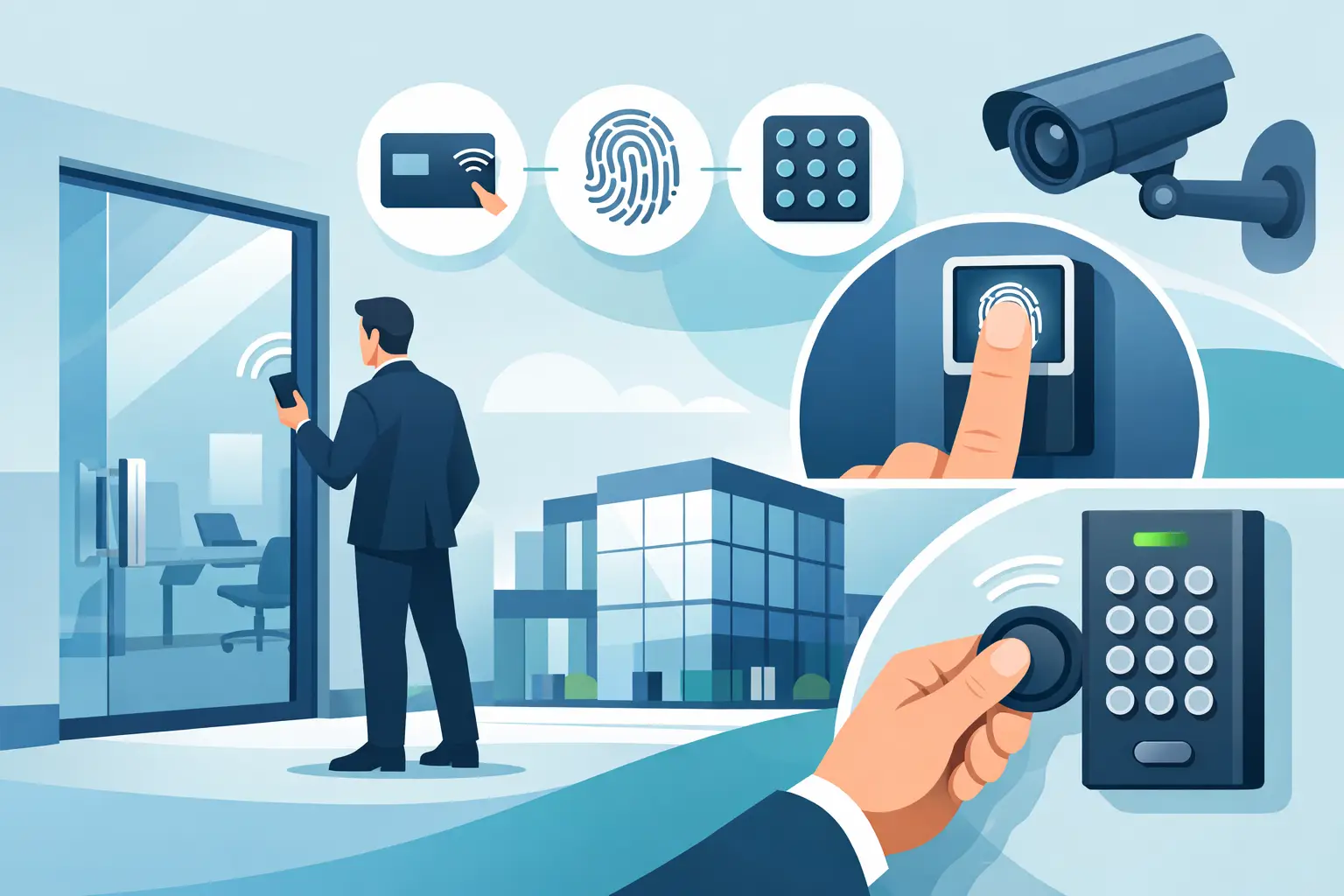
A front door that stays locked is not the same thing as a controlled entry point. In commercial properties, the real question is who gets in, when they get in, how that decision is recorded, and what happens when the system needs to scale. A commercial door access system is not a single product. It is a working combination of credentials, readers, locks, power, exit hardware, and management rules that has to match the building and the way people actually move through it.
That is where many projects go off track. Buyers compare readers or software features, but the weak point is often the door itself, the lock type, or the wiring path. A system can look right on paper and still create daily problems if it does not fit the opening, traffic level, fire code requirements, or the staff using it.
What a commercial door access system really includes
At the door level, most systems start with a credential reader, an electric locking device, a power source, and a way to request exit from the secured side. Add a controller or access panel, and now the opening can make decisions based on programmed permissions. Add software or cloud management, and administrators can assign users, create schedules, review events, and respond to changes without rekeying the building.
That sounds straightforward, but every opening has its own constraints. A glass storefront door may need a different lock strategy than a metal hollow door in a school corridor. A gate entrance has different environmental demands than an interior office suite. A warehouse man door with heavy traffic may need hardware chosen more for cycle durability than appearance.
The practical point is this: access control starts with the opening. If the door, frame, and hardware are not evaluated first, the electronics will not solve the problem.
Start with the opening, not the software
A reliable commercial door access system begins with a site-specific review of each controlled door. Installers and property managers usually get better results when they ask simple operational questions before looking at product features.
Is the door wood, aluminum, steel, or glass? Is it a narrow stile storefront door or a full-frame commercial opening? Is there a panic bar already installed? Does the door need to stay positively latched for life safety or code reasons? Is this a fail safe or fail secure application? Is there enough room for an electric strike, or is a maglock being considered because the existing frame limits other options?
Those questions matter because the lock choice drives much of the rest of the system. Electric strikes work well in many commercial openings where the mechanical lockset remains in place and controlled release is needed. Magnetic locks can be effective in some applications, especially where frame conditions support them, but they come with code, egress, and fire alarm integration considerations that have to be handled correctly. Electrified lever locks, crash bars, and gate locks each bring different wiring and installation demands.
A good system design is less about picking a popular device and more about matching hardware to the opening and the use case.
Credentials and readers: convenience versus control
Most buyers are familiar with cards and fobs, but credentials now include PIN codes, mobile credentials, and biometrics. Each option has a place, and each comes with trade-offs.
Cards and fobs are still common because they are easy to issue, easy to replace, and familiar to staff. For many offices, apartment common areas, and light commercial sites, they remain a practical standard. PIN-based entry can reduce the need to carry credentials, but codes are often shared unless management is disciplined. Mobile credentials can simplify administration and reduce physical card handling, but not every user base wants to rely on smartphones, and some sites prefer a simpler hardware-only approach.
Biometric readers may fit higher-security areas, yet they are not automatically the best choice for every building. They can add cost, raise user acceptance concerns, and require more careful planning around enrollment and throughput.
Reader format matters too. A buyer who only looks at price can end up with readers that do not align with the intended credential type or future expansion plans. In multi-door facilities, standardizing credential technology early saves frustration later.
Where commercial door access system projects usually need more planning
Single-door jobs are often treated as simple, but they still need attention to power, door status, and exit devices. Multi-door systems multiply those details. The difference between a clean installation and a service-heavy one is often found in planning, not hardware quality alone.
Power and backup
Locks, controllers, and readers need stable power. Backup power is not optional if controlled entry has to continue through an outage or if doors must fail to the correct state for safety. The power supply also has to match the locking hardware and current draw. Undersized power causes nuisance failures that look like lock problems but start at the supply.
Door position and request-to-exit
A controlled opening should do more than grant access. Door position switches help verify whether a door is actually closed or being held open. Request-to-exit devices matter for safe, code-compliant egress and for cleaner event reporting. Leaving those components out may lower the initial price, but it usually reduces visibility and control.
Network and management method
Some customers want browser-based or cloud-managed control. Others prefer an on-premise system with local administration. Neither approach is universally better. Cloud management can simplify remote oversight for distributed properties, while local systems may better suit sites with strict IT policies or limited outside connectivity. The right choice depends on who will manage the system and how often credentials and schedules change.
Matching the system to the property type
A commercial office usually needs scheduled access by employee group, visitor handling at selected doors, and audit trails for sensitive areas like server rooms or inventory spaces. In that setting, convenience and speed matter because entry points can see repeated daily use.
Schools and educational facilities tend to prioritize perimeter control, lockdown capability, and consistent hardware across multiple doors. These sites also need careful attention to life safety, code compliance, and staff training. A strong feature set means little if the staff cannot use it confidently during a real event.
Apartment and mixed-use buildings often blend resident access, visitor entry, and service access into one system. Common entries, gates, vestibules, and interior amenity spaces may all need different permission rules. The challenge is not just controlling the front door. It is organizing multiple user groups without making the property difficult to manage.
Industrial and warehouse sites usually have a different priority set. They may need durable hardware for dusty or high-traffic conditions, access segmentation between office and production areas, and integration with gates, delivery points, or time-based access rules for vendors.
Integration matters, but only when it serves the site
Many buyers ask whether a commercial door access system should integrate with intercoms, video surveillance, alarms, or gate operators. Often the answer is yes, but only if the integration solves an operational problem.
Video verification at a main entry can help staff confirm visitor identity before releasing a door. Intercom integration makes sense where there is regular guest or delivery traffic. Alarm inputs can add value when a forced door or held-open condition needs immediate attention. Gate and pedestrian entry coordination can simplify management at larger properties.
The mistake is adding integration because it sounds advanced. Every added subsystem increases coordination, programming, and support needs. The best installations are not the ones with the longest feature list. They are the ones where each component has a clear purpose.
What to ask before buying
The strongest buying decisions usually come from a short list of practical questions. How many doors need control now, and how many later? Who will manage users and credentials? What hardware is already on the openings, and can any of it stay in place? Does the site require audit history, schedules, remote unlock, or integration with video or intercoms? What happens during a power loss, network outage, or fire alarm event?
It also helps to ask who will support the system after installation. Commercial access control is not a one-time purchase in the way a standalone lock is. Users change, doors get abused, credentials are lost, and facilities expand. Long-term serviceability matters just as much as initial function.
This is where working with a specialized distributor can save time. Companies such as UnikCCTV work with installers, resellers, facility teams, and property managers who need application-specific hardware, not guesswork. When the door type, lock method, and credential plan are aligned from the start, the system is easier to install, easier to maintain, and far more dependable in daily use.
A commercial door access system should make the property easier to run, not harder to troubleshoot. If the hardware fits the opening, the credentials fit the users, and the management approach fits the organization, the result is not just tighter security. It is a building that functions the way it should every day.

 No products in the cart.