
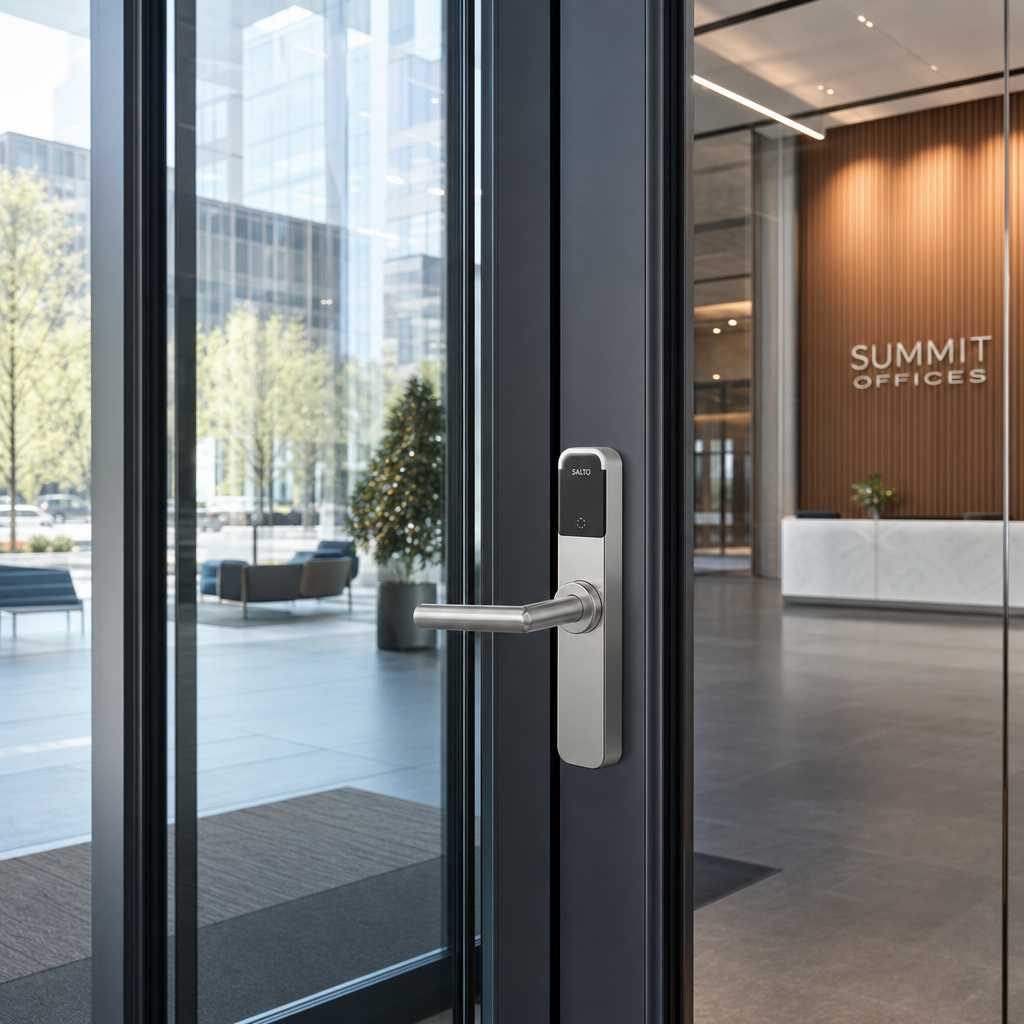
Physical keys are a liability. They get copied, lost, and handed off without accountability. Yet most commercial buildings still depend on them. A commercial latch lock Bluetooth system changes that equation entirely, giving property managers real-time access control, detailed audit logs, and the ability to revoke credentials remotely. According to Statista, the global smart lock market is projected to exceed $6 billion by 2027, and commercial applications are the fastest-growing segment. If you manage a business, an apartment complex, or a multi-tenant facility, the shift to Bluetooth-enabled keyless entry is not a trend. It is the operational standard your competitors are already adopting.
Table of Contents
- Quick Takeaways
- What Is a Commercial Latch Lock Bluetooth System?
- How Bluetooth Latch Locks Work in Commercial Settings
- PIN Code Commercial Lock vs. Bluetooth: Which Wins?
- Keyless Entry Business Benefits That Actually Move the Needle
- Choosing the Right Bluetooth Latch Lock for Your Property
- Installation and Integration with Existing Access Systems
- Common Mistakes to Avoid When Deploying Bluetooth Locks
- Frequently Asked Questions
- References
Quick Takeaways
| Key Insight | Explanation |
|---|---|
| Bluetooth range is 30 to 100 feet | Most commercial Bluetooth locks authenticate within 30 feet, which is ideal for door entry without requiring the user to physically touch a keypad. |
| Audit logs are the real ROI | Every Bluetooth access event is timestamped and tied to a specific credential, giving facility managers full accountability without manual logbooks. |
| PIN code commercial locks serve as reliable backups | Facilities should never rely on Bluetooth alone. A PIN code commercial lock fallback ensures access during app failures or dead phone batteries. |
| Credential revocation is instant | When an employee leaves, a Bluetooth credential can be deleted immediately from the management portal, unlike physical keys which require lock changes. |
| Multi-credential support is non-negotiable | The best commercial latch locks accept Bluetooth, PIN, RFID card, and biometric inputs to serve diverse user groups across a single property. |
| Battery life matters more than you think | Commercial Bluetooth locks should offer at least 12 months of battery life under normal usage. Lower-end units fail within 6 months and create emergency lockout situations. |
| Weather and duty cycle ratings are mandatory specs | For exterior commercial doors, look for IP65 or higher ingress protection and a duty cycle rated for at least 100,000 lock and unlock operations. |
What Is a Commercial Latch Lock Bluetooth System?
A commercial latch lock Bluetooth system is an electromechanical door lock designed for high-traffic business environments that uses Bluetooth Low Energy (BLE) to communicate with authorized smartphones or dedicated fobs. Unlike consumer-grade smart locks, commercial versions are built to withstand constant use, extreme temperatures, and the physical stress of a busy entry point.
The latch mechanism itself works identically to a traditional spring latch or deadbolt, but the unlocking signal comes from a verified Bluetooth credential rather than a metal key. The lock communicates with a management app or cloud platform, and every access event is logged automatically.
In practice, property managers at multi-unit buildings or office complexes use these systems to issue digital keys to tenants, staff, and vendors without ever meeting them in person. That remote credentialing capability alone eliminates hours of administrative work per month across larger facilities.


How Bluetooth Latch Locks Work in Commercial Settings
Bluetooth latch locks use BLE protocol to create a short-range encrypted handshake between the lock hardware and an authorized device. When a credentialed user walks within proximity, the app on their smartphone sends an encrypted token to the lock. If the token matches the stored credentials, the latch retracts and the door opens. The entire process takes under a second.
Proximity Authentication vs. Tap-to-Unlock
Some commercial Bluetooth locks use proximity authentication, meaning the door unlocks automatically when the credentialed phone gets within a defined range. Others require the user to tap a button in the app or wave their phone near the reader. For high-security areas like server rooms or cash storage, tap-to-unlock is the smarter choice because it prevents accidental unlocks when someone walks past the door.
For lobby doors and common areas in apartment buildings or coworking spaces, proximity authentication reduces friction significantly and improves the user experience, especially for deliveries and staff carrying equipment.
Cloud-Connected vs. Standalone Bluetooth Locks
Cloud-connected locks sync access events and credential changes through a Wi-Fi or LTE gateway, enabling real-time management from any location. Standalone Bluetooth locks store credentials locally and sync only when the admin app is in range. For a property manager overseeing multiple buildings, cloud-connected systems are the only practical option. Standalone systems work for single-location small businesses where the owner is on-site daily.
Pro tip: Always verify whether a commercial Bluetooth lock uses AES-128 or AES-256 encryption for its BLE communication. Lower-security protocols can be vulnerable to replay attacks, which is an unacceptable risk for any commercial property.
PIN Code Commercial Lock vs. Bluetooth: Which Wins?
This is one of the most common decisions facility operators face when upgrading their access control, and the answer is not one or the other. The most effective commercial latch locks combine both methods.
| Feature | Bluetooth-Only Lock | PIN Code Commercial Lock | Hybrid Bluetooth + PIN Lock |
|---|---|---|---|
| Access without a smartphone | Not possible | Yes, always available | Yes, PIN fallback available |
| Audit trail per user | Full credential-level logging | Limited (shared PIN = no individual tracking) | Full logging for Bluetooth; limited for shared PIN |
| Credential revocation speed | Instant via app | Requires PIN change for all users | Instant for Bluetooth; PIN reset needed for shared codes |
| Vulnerability to shoulder surfing | None | High if PIN is observed | Low (Bluetooth primary; PIN as backup) |
| Best use case | Tech-forward offices with young staff | Service entrances, delivery bays | Main entrances, apartment lobbies, multi-tenant offices |
A common mistake is deploying a PIN code commercial lock with a single shared code for an entire team. When an employee leaves, you either absorb the security risk of leaving the old code active or force every remaining employee to memorize a new one. Individual PIN codes per user, combined with Bluetooth credentials, solve this entirely.
“Access control is only as strong as your ability to revoke it. A lock that takes 48 hours to effectively lock out a terminated employee is not a security system. It is a waiting room for incidents.” – Security Industry Association, Physical Security Best Practices Report
Keyless Entry Business Benefits That Actually Move the Needle
Keyless entry business upgrades are often sold on convenience, but the measurable operational benefits go much deeper than not carrying a key.
Eliminating Key Management Costs
The average commercial property spends between $200 and $800 per rekeying event when keys are lost or an employee departs. For a business with 20 staff members and normal turnover, that cost compounds quickly. A commercial latch lock Bluetooth system reduces this to zero. Credentials are issued and revoked digitally at no marginal cost per event.
Time and Attendance Integration
Commercial Bluetooth locks can integrate directly with time and attendance systems, using the door access event as a clock-in record. UnikCCTV offers time attendance clocks that can be paired with access control infrastructure to create a unified entry and workforce management system without running separate software platforms.
Remote Access for Property Managers
A property manager overseeing multiple apartment buildings does not have time to be physically present for every contractor visit, move-in, or maintenance call. With a cloud-connected commercial latch lock Bluetooth system, they can issue a time-limited digital key to a plumber for a Tuesday morning window, then have that credential automatically expire at noon. No coordination, no physical key handoff, no chasing keys back afterward.
Pro tip: When evaluating keyless entry business systems, look for platforms that offer scheduled credential expiry rather than just manual revocation. Timed credentials are especially valuable for short-term contractors, cleaning crews, and tenant guests.

Choosing the Right Bluetooth Latch Lock for Your Property
Not every commercial Bluetooth lock is built for the same environment, and choosing the wrong one creates operational problems within months of installation.
Door Thickness and Backset Compatibility
Commercial doors are typically thicker than residential doors, often ranging from 1.75 to 2.25 inches. The lock’s backset, which is the distance from the door edge to the center of the keyhole, must match the existing door prep. The two standard backsets are 2.375 inches and 2.75 inches. Always confirm these measurements before ordering, or you will be paying for a second installation visit.
ANSI/BHMA Grade Ratings for Commercial Use
ANSI/BHMA Grade 1 is the only acceptable rating for commercial latch locks on primary entry doors. Grade 2 is a residential standard. Grade 1 locks are tested for 250,000 operational cycles, which matters enormously for a business door that opens dozens of times per day.
Multi-Credential Capability
The strongest commercial deployments use locks that accept Bluetooth, RFID/proximity cards, biometric fingerprint, and PIN code inputs from the same unit. UnikCCTV’s range of access control products includes biometric access systems and facial recognition locks that can be integrated alongside Bluetooth latch locks to create layered access control for high-security areas within the same facility.
A common mistake is specifying a lock based on Bluetooth capability alone and then discovering that older employees or visitors without smartphones cannot access the building independently. Multi-credential locks eliminate this problem at the hardware selection stage.
Installation and Integration with Existing Access Systems
One of the most overlooked aspects of deploying a commercial latch lock Bluetooth system is integration with existing infrastructure. Most commercial properties already have some combination of intercom systems, CCTV surveillance, and door entry hardware. Adding Bluetooth locks should extend this ecosystem, not fragment it.
Wired vs. Wireless Installation
Battery-powered Bluetooth locks are the fastest to install because they require no wiring runs. However, for high-traffic commercial doors, a wired power connection is preferred because it eliminates battery management as an operational concern. In practice, facilities with more than 50 daily door access events should lean toward wired installations for their primary entry points and reserve battery-powered Bluetooth locks for interior office doors or storage areas.
Intercom and Gate Access Integration
For apartment buildings and gated commercial properties, the Bluetooth latch lock at the main door should work in coordination with the intercom system. UnikCCTV specializes in exactly this type of integrated setup, offering wireless intercom systems and gate access controls that can share a unified credential management platform with Bluetooth door locks. This means a tenant’s smartphone credential works at the gate, the building entrance, and their specific unit door without managing three separate apps.
The data consistently shows that access control systems with unified credential management have significantly lower administrative burden than fragmented multi-vendor setups. When a tenant moves out, a single deactivation in the management portal removes access across all points simultaneously.
Common Mistakes to Avoid When Deploying Bluetooth Locks
After working through commercial installations across residential buildings, office parks, and retail facilities, the same errors appear repeatedly. Knowing them upfront saves significant cost and frustration.
The first mistake is skipping a site survey. Bluetooth signals can be attenuated by thick steel doors, certain glass types, and reinforced concrete frames. A short site survey identifies these interference points before hardware is ordered, not after.
The second mistake is relying on a single credential method. As discussed, a Bluetooth-only lock creates a lockout risk when a user’s phone battery dies or their app crashes. Hybrid locks with PIN code commercial lock fallback capability prevent these situations from becoming facility emergencies.
The third mistake is underestimating user training. Staff and tenants who do not understand how to use a Bluetooth lock will default to propping doors open, which eliminates every security benefit the system was installed to provide. A brief onboarding session, supported by written instructions, is not optional. It is part of the deployment.
The fourth mistake is ignoring firmware update capability. Commercial Bluetooth lock vulnerabilities are discovered and patched regularly. Locks that cannot receive over-the-air firmware updates become security liabilities within two years of installation. Always confirm OTA update support before purchasing.
Frequently Asked Questions
Can a commercial Bluetooth latch lock work without a smartphone?
Yes, if the lock supports multiple credential types. The best commercial Bluetooth latch locks also accept PIN codes, RFID cards, or biometric inputs, so users without a compatible smartphone can still gain access. This is essential for facilities with diverse user populations including older tenants, delivery personnel, and maintenance staff.
How far does Bluetooth reach on a commercial door lock?
Bluetooth Low Energy, which is the standard protocol used in commercial latch locks, operates effectively between 30 and 100 feet in open air. In a building environment with walls and steel door frames, expect reliable communication within 15 to 30 feet. Some locks allow you to configure the proximity threshold so the door only responds when the user is within 10 feet, reducing accidental unlocks.
What happens when the Bluetooth lock battery dies?
Most commercial Bluetooth latch locks include a low-battery alert that notifies the admin via the management app when power drops below 20 percent. Quality units also include an emergency power terminal, often a 9-volt contact point on the exterior, that allows a temporary external battery to power the lock long enough to enter a PIN code or trigger the mechanical key override. Never deploy a commercial lock without confirming these emergency access options exist.
Is a PIN code commercial lock more secure than a Bluetooth lock?
Neither is inherently more secure. A Bluetooth lock with weak encryption is less secure than a well-managed PIN code system. A PIN code lock with a single shared code among many users is far less secure than a Bluetooth lock with individual credentials and full audit logging. Security comes from the implementation, not the technology type alone. The most secure commercial deployments use Bluetooth as the primary method with individual PIN codes as a fallback, and regular audit log reviews to catch anomalies.
Can I integrate a Bluetooth latch lock with my existing CCTV system?
Yes, and this integration is one of the most valuable configurations for commercial properties. When a Bluetooth lock logs an access event, that timestamp can trigger the CCTV system to flag the corresponding camera footage for that door, making it easy to review exactly who entered and when. UnikCCTV’s product lineup includes both CCTV surveillance equipment and access control hardware specifically designed for this type of unified security architecture.
How many users can a commercial Bluetooth lock support?
Entry-level commercial Bluetooth locks typically support 50 to 100 user credentials stored locally. Cloud-connected enterprise locks can support thousands of users across multiple doors and locations, with no practical upper limit beyond the capacity of the management platform. For multi-tenant residential buildings or large office campuses, cloud-connected systems with unlimited user support are the only viable option.
Do commercial Bluetooth locks work with Apple Wallet or Google Wallet digital keys?
Some commercial Bluetooth locks are beginning to support NFC-based digital keys through Apple Wallet and Google Wallet, but this capability is not yet universal. Most commercial-grade systems use their own proprietary app or a platform-specific credential format. Confirm digital wallet compatibility before purchasing if this feature is important to your tenant or employee experience, as retrofitting is not always possible.
If you have deployed a commercial Bluetooth latch lock in your facility, we want to hear what worked, what did not, and what you wish you had known before installation. Share your experience in the comments.
References
- Statista: Smart lock and access control market size projections and commercial segment growth data
- Forbes: Business security technology trends and the shift from physical keys to digital credential management
- NIST: Federal guidelines on encryption standards and Bluetooth Low Energy security protocols for commercial access systems
- U.S. Small Business Administration: Physical security recommendations and access control best practices for commercial properties
- McKinsey and Company: Facility management technology adoption rates and operational cost reduction through smart building infrastructure

 No products in the cart.